

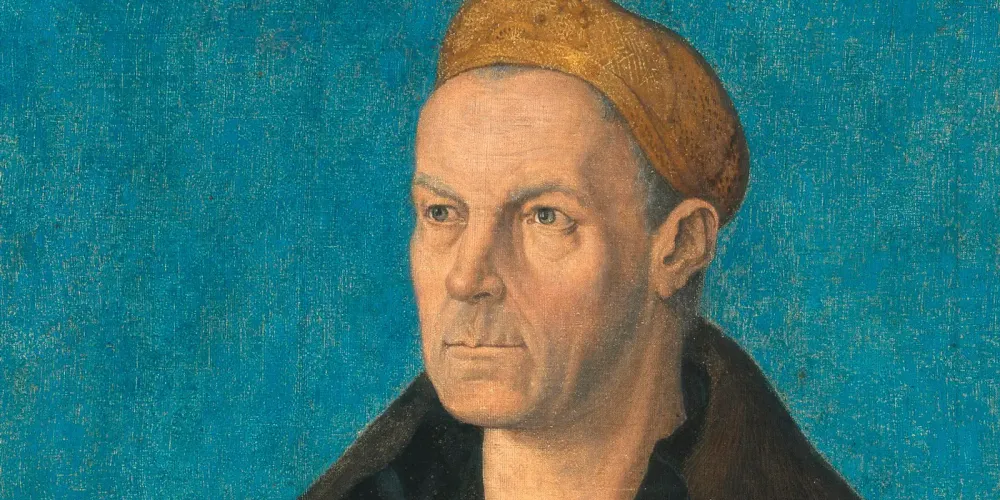


At the end of the ninth century, the belief spread across Europe that society consisted of three orders: the oratores, the bellatores, and the laboratores, or clergy, warriors, and workers; alternatively, the clergy, the nobility, and the third estate. In the way this model was developed throughout the Middle Ages, the king did not belong to any of these orders.
It must therefore have been astonishing for Charles V, King of Spain and elected Holy Roman Emperor, to receive a letter from what was, after all, an ordinary laborator, politely but unequivocally urging him to settle his debts. The story is told at the beginning of Bankers of God and Emperor by Peter Anthonissen, recently published and offering a detailed account of the rise and fall of the Fugger dynasty.
“Jakob Fugger often made me think of a sixteenth-century Elon Musk, though cool-headed and deadly serious.”
Within just a few generations, the Fuggers rose from poor serf farmers who supplemented their income as weavers during the winter to become probably Europe’s first billionaires. Jakob Fugger often reminded me of a sixteenth-century Elon Musk, though cool-headed and deadly serious.
The story of the Fuggers can be read from different perspectives and with different interests. What struck me was the extent to which emperors, popes, princes and all manner of rulers depended on financiers. It reveals just how powerful money was in the fifteenth and sixteenth centuries, on the eve of modernity.
There was spiritual power and military power. There were kings, a pope and an emperor. Yet who occupied those positions and who could wage war was largely determined by people with vast wealth and a willingness to take calculated risks.
In return for their loans, they sought opportunities guaranteed by both secular and ecclesiastical authorities to make even more money. To become pope, cardinals had to be bribed. To become emperor, the prince-electors had to be paid. People like the Fuggers provided the necessary funds in exchange for lucrative favours in return. That level of wealth coexisted with widespread poverty.
Laboratores
It offers a different perspective on the period that followed: the modern age. In the light of the Fuggers, modernity appears not as an era in which the orders were abolished, but as one in which efforts were made to ensure that each order carried out its own role without determining what the others should do. The laboratores concerned themselves with the economy. Judges administered justice but did not make laws. Parliament made laws, but not in a way that allowed parliamentarians to turn legislation into a profitable economic activity.
In short, we tried to separate powers and orders. Until recently, that worked reasonably well, and Bankers of God and Emperor would simply have been a history book. Today, it is an uncomfortable mirror reflecting our own times.
“Democracy is only possible if political power cannot be bought with money.”
To separate money from political power, and to avoid the sort of bargaining seen between Emperor and Fugger, systems of party financing were developed. Democracy is only possible if political power cannot be bought with money. That is why most European countries have strict rules in this area.
In Belgium, political parties receive direct public funding in proportion to their electoral success. That funding is accompanied by restrictions on how the money may be spent. Legal entities and unincorporated associations are prohibited from supporting political parties. Private individuals, you and I, may donate no more than €2,000 per year, not the millions that could be used to buy political influence.
In the United States, these rules have always been less stringent, but still not lenient enough for greedy billionaires. They want more political power so they can become even richer. Congress would not have granted them that opportunity, so the task was accomplished by the Supreme Court. In 1976, it ruled that financial support from organisations and individuals to political parties and candidates constituted a form of free speech. Money was thereby equated with a vote.
In 2010, the Supreme Court made it even easier for billionaires to exert political influence. In the most recent presidential election, we saw Elon Musk make extensive use of that possibility.
Crypto Market
Fifteenth-century Europe produced figures who sought imaginative ways of combining different forms of power. Maximilian I of Austria dreamed of becoming pope and then crowning himself emperor in Rome.
Twenty-first-century America has Trump: a president who regulates the cryptocurrency market while personally earning billions from it; who literally sells access to himself; who strikes property deals; who pardons federal crimes in exchange for financial support; who passes on stock-market information a little earlier to those willing to pay 60,000 to 100,000 dollars per month; who personally receives a Boeing 747 as a gift from a foreign power; and whose family accumulates billions at remarkable speed during his presidency.
People often say that America is sliding towards fascism. It seems more like the dawning of a new Middle Ages, in which the emperor openly and shamelessly demonstrates how easily political power can be converted into money, and money into political power.
Bio
Mark Elchardus is Emeritus Professor of Sociology at the VUB and the author of Reset, Freedom/Security and Beyond Borders. His column appears fortnightly. In the United States, political power is increasingly being transformed into money, and vice versa, he writes.