

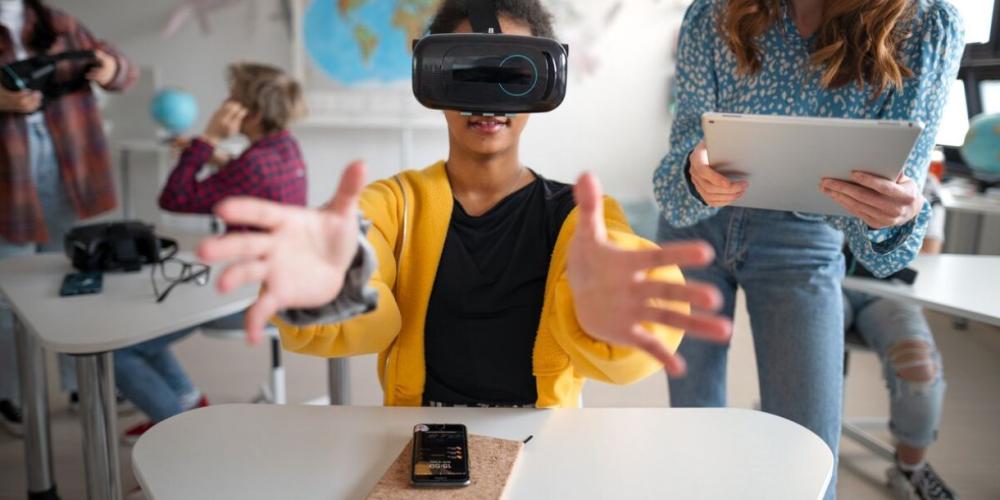


The metaverse is often associated with virtual games, but according to Professor Kateryna Osadcha, the technology could also bring about radical change in higher education. As a postdoctoral researcher at the VUB and a researcher at the Institute for Digitalisation of Education in Ukraine, she is investigating how virtual environments, AI and traditional teaching methods can come together to form a new educational model.
The metaverse in higher education: what does this actually look like in practice?
Kateryna Osadcha: “The advent of immersive technologies makes it possible to create interactive, virtual learning environments in which students can experiment with situations that are more difficult, more expensive or riskier in the real world. Think of medical students practising surgical procedures on virtual bodies first, or engineering students learning to operate complex machines virtually. The metaverse also offers opportunities in language teaching. You can simulate social and cultural situations in which students practise conversations. In the humanities, you can reconstruct historical events, making abstract themes much more tangible. I see enormous opportunities, although implementing these will, of course, require time and resources.”
What does a virtual learning environment like this look like?
“Unlike a traditional online learning platform, a digital campus offers not only courses but also virtual laboratories, classrooms, meeting places and support services. It is a single, integrated educational space where learning, research and interaction come together. Students and lecturers navigate it via their digital twins: a digital alter ego that represents them. They can collaborate as if they were physically present. Teaching methods can take various forms, ranging from a real lecturer teaching via video and an avatar teaching in a virtual environment, to even a fully digital lecturer who looks and behaves like a human. Thanks to AI, such systems can deliver course content, provide feedback and personalise tasks. AI tutors that help students practise conversations and correct them immediately have been around for some time.”
“Even students who are physically unable to come to campus – due to distance, illness or war – get access to a rich learning environment”
What are the benefits of such a virtual campus?
“In the physical world, it is difficult to provide personalised education to every student. There are simply not enough lecturers and resources for that. A virtual learning environment offers much greater flexibility. Well-designed learning scenarios put the student at the centre. Virtual simulations help students to better understand complex concepts. Students can collaborate with virtual fellow students and share knowledge. All these factors can only enhance the learning experience. But the greatest advantage is accessibility. A virtual campus is open 24/7. Even students who are physically unable to attend the campus – due to distance, illness or war, for example – can participate in a rich learning environment.”
Yet there are also concerns about the dangers of technology. How do you view this?
“I don’t like to talk about ‘the dangers of technology’. Technology in itself isn’t dangerous. It all depends on how people use it. I compare it to the street. There are risks there too – traffic, crime… And yet we still go out. It’s the same with technology. I am, however, concerned about young people’s dependence on technology. They need to experience the real world. Too much screen time is harmful to their physical and mental health. Then there’s the dependence on major technology platforms. If a platform like Google were to suddenly disappear, it would have enormous consequences. And digital inequality also remains a challenge. Universities need to develop a well-thought-out policy to narrow that gap.”
How did you become interested in digital learning technologies?
“My entire career has centred on the question of how digital technologies can enhance higher education. Initially, it was all about the internet, distance learning and e-learning. Later, augmented and virtual reality were added to the mix. For more than 20 years, I worked at the Bogdan Khmelnitsky Melitopol State Pedagogical University in Ukraine. There, we had a STEAM lab with VR headsets and other technologies. When Russia invaded Ukraine, several universities were occupied or destroyed. That happened at my university too. Many academics and students were forced to flee. For over seven months, I was unable to write a single academic paper, but through the international Scholars at Risk programme, I was able to resume my research – first in Germany, and later in Norway. Today, I am a postdoctoral researcher at the VUB and I also work as a lead researcher at the Institute for Digitalisation of Education at the National Academy of Educational Sciences of Ukraine. My most recent publication is about the emergence of a new post-hybrid learning model: tribrid learning. At the moment, I am focusing primarily on how AI can be used in education and science.”
What exactly does ‘tribrid learning’ entail?
“The hybrid learning model combines online and face-to-face teaching. Tribrid learning adds a third component to this: the immersive virtual environment. Depending on the teaching objective, students and lecturers move between these three environments. For example, lectures and seminars take place on campus. The online learning platform is used for assignments and self-study, so that students can work at their own pace. The virtual environment is used for activities that are difficult to organise in the real world. Tribrid learning might look like this: today, students attend a lecture on campus; tomorrow, they complete an assignment in an online learning environment such as Moodle; and the day after tomorrow, they collaborate in a virtual laboratory in the metaverse.”
“The war in Ukraine highlights the
importance of digital solutions when
physical infrastructure fails”
Can you share any initial research data with us yet?
“It’s still too early to draw any conclusions. Many applications are still at a theoretical stage. The next step is to secure funding and set up practical experiments. Universities need to develop infrastructure, train lecturers and devise teaching models. So we’re still only at the very beginning. But interest is growing rapidly.”
Has the war changed your view of digital education?
“Many universities in Ukraine no longer have a safe campus. Students sometimes don’t dare to go to campus. The war has made it clear how important digital solutions can be when the physical infrastructure breaks down. Physical campuses will always remain important. When you look someone in the eye during a conversation, an energy is created that is difficult to capture digitally. Digital campuses are therefore not a replacement, but a valuable addition. They also offer an easy way to study abroad without having to travel.”
“Through my research, I hope to make
teachers’ work easier”
What is your personal mission as a researcher?
“I am a staunch idealist and humanist. My ambition is not personal success, but to carry out research that improves or simplifies people’s lives. Teachers are under considerable strain these days. Technology can support them and reduce their workload. If, for example, AI can take over routine tasks, then they will have more time for mentoring and interacting with students.”
Will technology ever make humans redundant?
“Throughout history, people have always feared new technology: books, machines, the internet and now AI. I don’t believe that AI will replace teachers. Teachers are professionals with practical experience and human insight that technology cannot replicate. I see AI more as an assistant that supports teachers and helps students learn. And to be honest: so far, humans have been quite ‘good’ at causing problems themselves. If technology can help us tackle major challenges such as war, hunger or inequality, that would be real progress.”
Bio
Kateryna Osadcha is a professor at the Bogdan Khmelnitsky State Pedagogical University in Melitopol, where she also served as director of the Distance Learning Centre (2012–2015), senior lecturer (2011–2021) and, subsequently, professor of Computer Science and Cybernetics (2021–2025). Between 2023 and 2025, she worked as a researcher at the Norwegian University of Science and Technology. Since 2025, she has been affiliated with the Institute for Digitalisation of Education at the National Academy of Educational Sciences of Ukraine. She is currently a postdoctoral fellow at the Vrije Universiteit Brussel as part of an international mobility programme and is conducting research into digital technologies in education.