

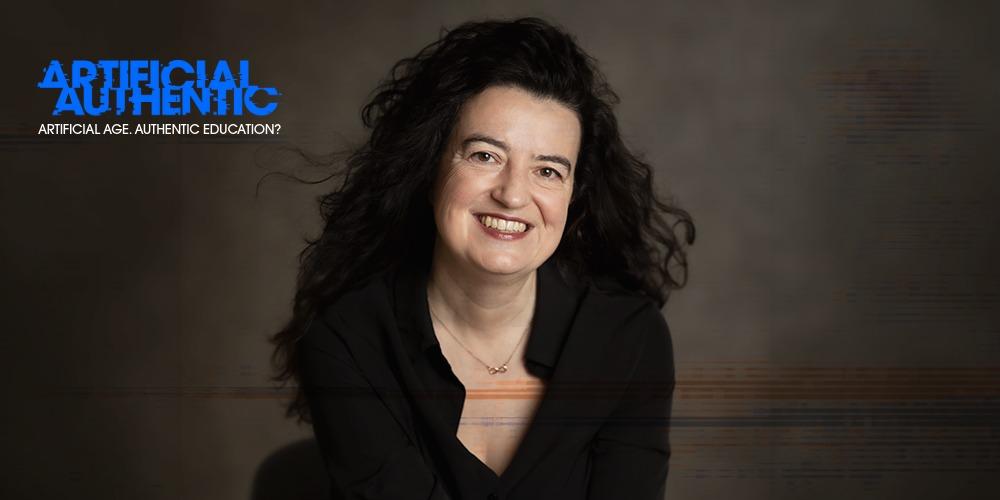


AI models are solving increasingly complex mathematical problems. Do we still need mathematicians? Absolutely, says Prof. Dr Ann Dooms, Professor of Mathematics at the VUB. According to her, mathematics is not at the end of its story, but at the beginning of a new revolution. “AI can combine existing knowledge and generate proofs at remarkable speed, but it is people who ask new questions, develop new mathematical structures and understand why a proof works.”
Article series
AI is changing work. How is it changing education?
Artificial intelligence will fundamentally change the way we work. But what does that mean for students who are building their careers today? In this series, VUB professors explain how AI is affecting their field, which competencies will become important in the future, and how degree programmes are adapting to a labour market in full transition.
Today, AI models are solving increasingly complex mathematical problems at high speed. Did you expect AI to come this far so quickly?
Ann Dooms: “Not at this speed. But the fact that it is happening actually fits into a much longer evolution. Mathematics is one of the oldest intellectual activities of humankind, and throughout history we have always looked for ways to support our mathematical work. From mechanical calculators to the computer, machines have repeatedly taken over part of the computational work, allowing mathematicians to focus on the thinking. AI is doing something similar today, but it goes beyond the level of calculation. Patterns are now being found in mathematical knowledge, allowing AI to construct proofs as well.”
What does a person actually learn by studying mathematics?
“Learning mathematics is much more than finding the correct answer as quickly as possible. You learn to tackle problems, abstract, recognise patterns, reason, and above all persevere when something does not work immediately. That ‘productive struggle’ is very important. If you try to solve a problem yourself and make mistakes, you develop insight and perseverance. If you immediately ask AI for the answer, you remove that learning process.”
“AI can establish connections within existing mathematics much faster”
How important do humans remain in mathematics? What can a mathematician do that AI cannot currently do?
“AI is very good at combining what already exists. It can see connections between enormous amounts of mathematical knowledge that no human could possibly oversee all at once. As a result, it can, for example, arrive at a proof more quickly. But today AI largely remains within the structures on which it has been trained. A mathematician can say: this structure does not work for my problem, so what new structure do we need? That is a fundamentally different step. The mathematician asks the question behind the question. Why are we investigating this problem? Which concepts are still missing? That is precisely why human abstraction and creativity remain important.”
Does the labour market still need mathematicians? And are new needs emerging?
“More than ever. Not only to develop new AI systems, but also to understand them properly and use them responsibly. In a team working with AI, you need people who can assess what such a system is doing mathematically, what is possible and where the limits lie, but also where the dangers are. Mathematical expertise is also essential when selecting data for training an AI system: are the data suitable, are the identified patterns relevant, and can we trust the conclusions?
“Moreover, mathematics is a very sustainable way of thinking. Every computer, from classical to quantum, runs on mathematics, and if you understand the underlying structures, you can also understand the new technologies built on them, such as AI. Including those that do not yet exist today.”
What expertise from mathematics is needed to develop AI responsibly?
“A very important one. We must, for example, be able to teach systems to recognise when they do not know something or when they should not perform an action. Today AI often provides an answer, even when it is actually uncertain. Mathematicians can help determine the conditions and structures within which a system operates reliably. This also concerns AI security: how do we ensure that AI does not simply perform a calculation when the underlying assumptions are incorrect, or when the solution is undesirable or unethical? Just think of the recent Hugging Face incident. That is one of the interesting new roles for mathematicians: thinking about what a system can and cannot, or may and may not, do, and how we can teach those boundaries to a machine.”
Will AI give mathematicians more time for fundamental research?
“That is my conviction. If the computer not only helps us with complex calculations, but can also find properties and proofs more quickly, time is freed up to look at the bigger questions. That is comparable to what happened when human ‘computers’ disappeared. They no longer had to spend a year calculating sines and cosines to a certain level of precision, but could think about which calculations and algorithms were needed to solve problems.
“We will now be able to search more quickly for suitable concepts for a problem, from the abstract to the practical. In my research group Digital Mathematics, for example, we work together with the Royal Library of Belgium to extract reliable information from old manuscripts. Because digital scans differ greatly from documents created on a computer, existing information extraction techniques, including the best LLMs, fail. By introducing a new mathematical concept that imitates the way humans read, we developed award-winning software a few years ago that outperforms commercial packages. We will now probably be able to shape and test our conceptual ideas theoretically more quickly.”
“The power of current AI is ultimately based on the knowledge that generations of mathematicians have gradually built up”
But if AI itself can generate theorems and proofs, can we be sure that they are correct?
“That will become an important new task for mathematicians. First of all, we must be sure that the theorem found actually solves the problem that was posed. Verifying that translation is not always straightforward. In addition, a computer-generated proof may be logically correct, but that does not mean we understand why it works. Behind every mathematical proof there is a mental image, an intuition. A mathematician understands why that particular step is taken and what it means. AI can produce an enormous number of logical steps without explaining that intuition and may therefore take a very large detour. That is why mathematicians will be needed to interpret computer-generated proofs, simplify them and provide the correct explanation.”
Are such interpretations and explanations already needed today?
“Yes. We are seeing more and more results generated by AI. However, it is often unclear how they were produced: who formulated the prompts, what data were the systems trained on, and so on. Another important issue is attribution. The systems are trained on vast amounts of published knowledge, but cannot always indicate who developed which ideas. A particular step in a proof may have been taken because AI was able to draw an analogy through pattern recognition, but it is then no longer clear where the idea came from. That, too, requires our attention. The power of current AI is ultimately based on the knowledge that generations of mathematicians have gradually built up.”
Does this progress not create a risk of cognitive laziness and dependency among mathematicians and their students?
“Certainly. Terence Tao, a renowned Australian mathematician, advocates an ‘AI diet’. Just as we must remain physically active, we must also keep using our brains. If you constantly outsource difficult thinking to AI, you risk losing knowledge, skills and learning capacity. We must therefore consciously maintain the ‘productive struggle’ we discussed earlier.
“For students, it is therefore advisable always to attempt an exercise or proof themselves first and then use AI as a critical reviewer. You can have your solution checked or ask where an error might be. If you are truly stuck, you can ask how you might begin, but not immediately request the complete solution. Because AI systems are trained on vast amounts of academic material, they are quite reliable when checking routine exercises. In this way, AI becomes a tireless study companion rather than a machine that takes over the thinking. Having said that, they do occasionally fall for trick questions.”
“If you constantly outsource difficult thinking to AI, you risk losing knowledge, skills and learning capacity”
Should the degree programme be adapted to the arrival of AI and the changing labour market?
“Certainly, but not by abandoning the essence of mathematics. Within our programme, we interact with students during lectures, while working on bachelor’s and master’s dissertations, and of course during examinations, ensuring that they understand what they write and can construct their own reasoning. That does not mean we do not teach students how to use AI intelligently while studying. Moreover, our programme must continue to provide insight into the mathematics behind successful models and therefore also focus on the new roles mathematicians will have in this new era.”
How can the VUB further prepare itself for this development?
“On the one hand, we need access to the infrastructure and computing power required to keep up with this development. Mathematics used to be a relatively inexpensive science of pen, paper and coffee. That is changing. If we want to remain competitive, we also need resources for substantial computational infrastructure.
“But equally important is that we continue to invest in education and the human interaction that comes with it. We should not think: AI can provide that explanation too, even in a personalised way, so we need fewer lectures. Right now, we need to pay more attention to understanding, discussion, history and the reasons behind the technology. A fellow student sitting next to you who asks a question may also give you ideas that you would never have thought of yourself, or for which your LLM chatbot was never trained.” (laughs)
BIO
Prof. Dr Ann Dooms is Professor of Mathematics at the Vrije Universiteit Brussel (VUB), where she leads the Mathematics & Data Science research group. Her field of research is digital mathematics, with a strong focus on pattern recognition, data and artificial intelligence in particular. She works interdisciplinarily on applications of mathematics, including cultural heritage, medical imaging, security and other societal challenges. Dooms is Chair of the Education Committee of the European Mathematical Society and of the Scientific Council of Defence. She writes monthly columns for De Tijd and EOS Wetenschap.
In brief
- AI does not replace mathematicians, but changes their role: machines increasingly take over calculation and analysis, while people can focus on new questions and structures.
- Mathematical expertise is becoming more important for AI: mathematicians are needed to develop systems, understand their limits and safeguard reliability.
- Human understanding remains crucial: AI can generate a proof, but a mathematician must understand why it works and be able to explain it.
- AI requires a different way of learning: students must use AI critically and in moderation, while continuing to practise and solve problems themselves.
- The labour market needs more mathematicians: not only for research and education, but also for AI, data science, and the development and assessment of future technologies.
Academic Opening 2026-2027
How do we prepare young people for a world in which artificial intelligence and technological change are having an ever greater impact? That question lies at the heart of the VUB's Academic Opening on Tuesday 22 September in Aula Q on the Etterbeek campus. Under the theme Artificial Age. Authentic Education?, the university will bring together students, researchers, lecturers, policymakers and societal partners for a debate on the future of education, knowledge and society.
For more information and to register, visit: Academic Opening 2026.
Also on 22 September: VUB Kick-Off
This year, the Academic Opening Ceremony and the VUB Kick-Off will take place on the same day at the Etterbeek campus. The Kick-Off is the annual welcome event that marks the start of the new academic year for students. Throughout the day, the campus will come alive with information stands hosted by VUB services, student associations and organisations from across Brussels. Students will have the opportunity to explore the wide range of services and activities available on and around campus, meet fellow students and take part in a variety of activities.