

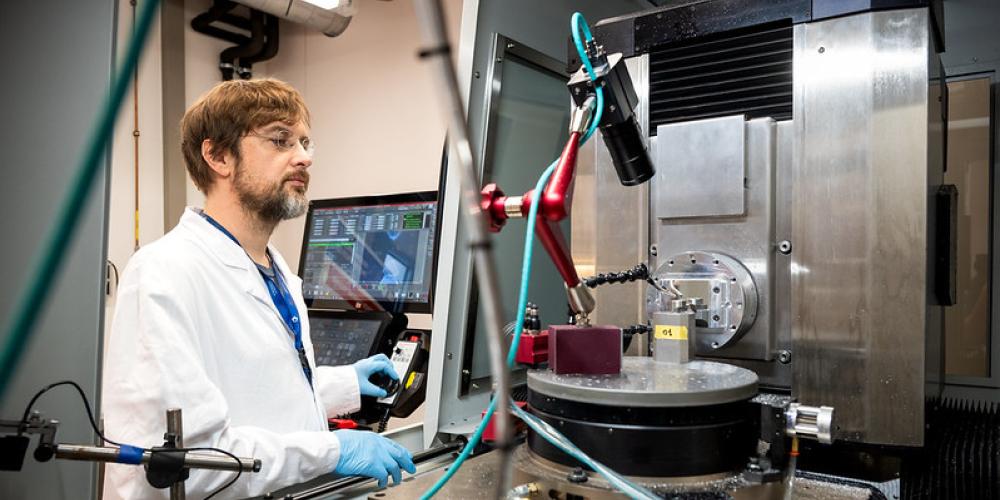


From ultra-fast internet and medical scanners to photonic chips and highly sensitive sensors, photonics is increasingly present in our daily lives. For twenty years, the Vrije Universiteit Brussel (VUB) and Ghent University (UGent) have been jointly educating engineers in this technology. On 19 and 20 October, both universities will celebrate this anniversary with an international symposium on, among other topics, photonic chips, quantum technology and new industrial applications. VUB, through its research group B-PHOT, has been a pioneer in photonics for more than thirty years.
"What is unique about photonics is that light can do much more than simply make something visible," says VUB professor Heidi Ottevaere. "We can use it to transmit information, measure extremely small changes, and develop new medical and industrial applications. Many people use photonics every day without knowing that it is photonics."
In 2006, VUB and UGent launched the joint Master's programme in Photonics Engineering. Twenty years later, more than 500 photonics experts have graduated from the programme, the majority of them international students. Many alumni now work at leading companies and renowned research institutions in Flanders and around the world.
The anniversary will be celebrated on 19 and 20 October with the symposium Advancing Excellence in Photonics for Flanders and the World. International scientists, industry representatives, alumni and students will come together to discuss recent developments and future challenges in photonics.
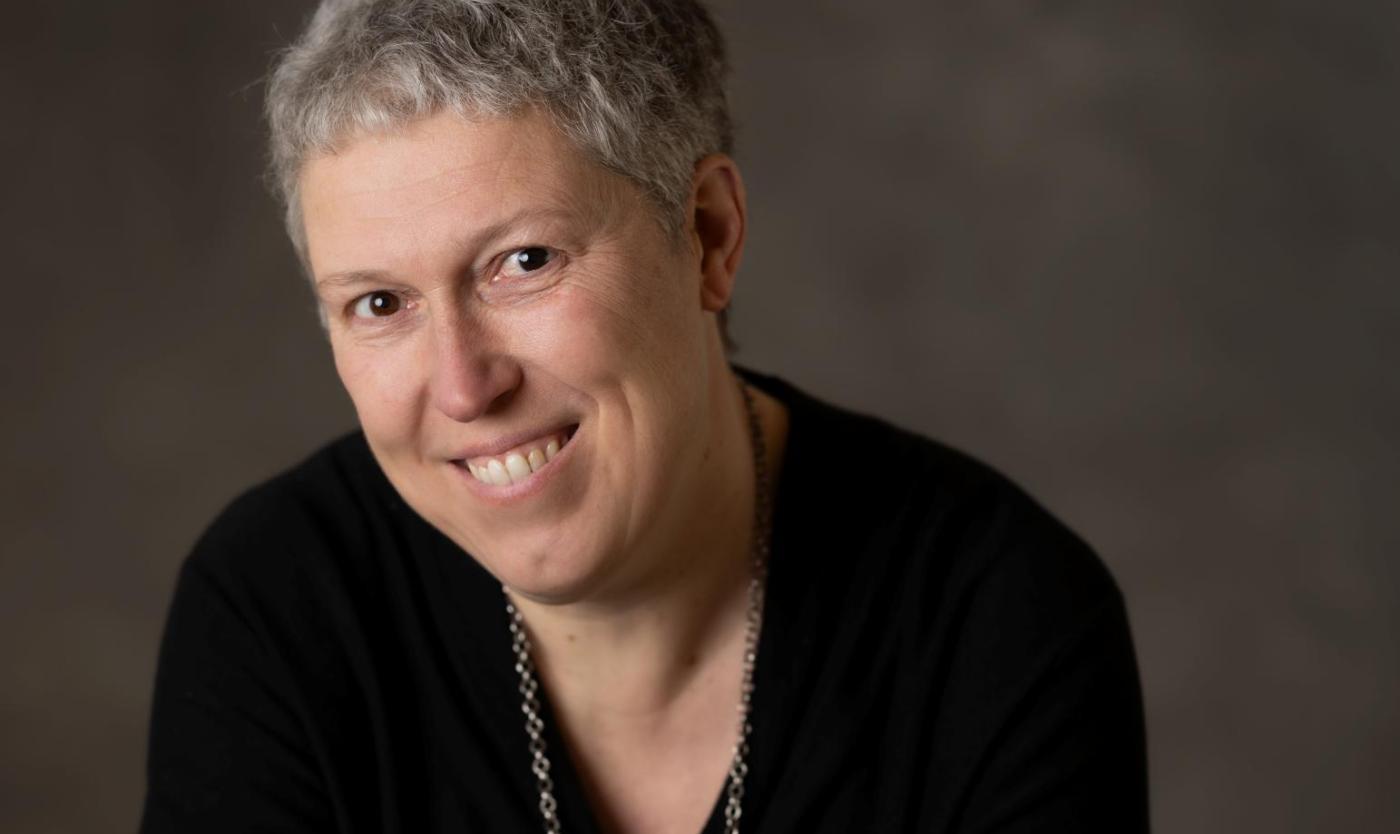
Heidi Ottevaere
Professor Heidi Ottevaere heads the Department of Applied Physics and Photonics at VUB and has been responsible for the Master's programme in Photonics for the past fifteen years. Within B-PHOT, she conducts research in biophotonics, where light-based technologies are used for medical applications and for monitoring pollution in water. At the symposium, she and emeritus UGent professor Roel Baets will look back on twenty years of joint photonics education.
Photonics is, simply put, the science and technology of light. Just as electronics uses electrons, photonics uses light to transmit information, create images, or measure extremely small changes. This may sound abstract, but the applications are highly tangible.
Photonics plays a role in areas including optical communication, imaging, laser technology, photonic chips, artificial intelligence, medical and industrial sensors, and sustainable energy. It can be used to transmit large amounts of information, identify substances, or perform highly precise measurements. In this context, light serves not only to make things visible, but also as a carrier of information and an exceptionally precise measurement tool.
“The International Network May Be One of the Finest Results of Twenty Years of Collaboration”
This broad range of applications is also reflected in the English-taught Master of Science in Photonics Engineering. Following this two-year programme, students receive a joint degree from VUB and UGent, combining photonics with subjects such as electronics, physics, materials science, information technology and life sciences.
During the symposium, several alumni will discuss where the programme has taken them. Peru Dharani is Senior Vice-President of Research at Barco. Pierre Wahl is co-founder and Head of Research at Luceda Photonics, a spin-off of UGent, imec and VUB that develops software for the design of photonic chips. Adetunmise Dada is an Associate Professor at the University of Glasgow and works on quantum technologies. Other alumni featured at the symposium include Joanne Oh, active in optical metrology at ASML, and Arno Bouwens, VP Engineering at the French biotech company Amatera.
"When this joint programme began twenty years ago, we could not possibly have predicted where our graduates would eventually end up," says Ottevaere. "Today, more than 500 former students are working in photonics, in companies and universities across the world. That international network may well be one of the finest results of twenty years of collaboration."
Master's students come into direct contact with research being conducted in Brussels and Ghent. "VUB and UGent each have their own areas of expertise," says Ottevaere. "That is precisely where the strength of the collaboration lies. Students not only study at two universities, but also engage with different research teams, technologies and approaches to applying photonics."
Brussels: a pioneer in Photonics
At VUB, photonics education began even before the joint Master's with UGent. More than thirty years ago, Professor Hugo Thienpont founded the research group B-PHOT Brussels Photonics. In 1993, together with Professor Irina Veretennicoff, he launched the first Master of Science in Engineering: Photonics on the European mainland.
Today, B-PHOT comprises around seventy researchers and technology experts. The group investigates, among other things, how light can be shaped with extreme precision, how optical fibres can function as sensors, and how substances can be identified using light. Photonic chips also form part of its research portfolio: miniature structures in which light is generated, guided or processed.
“Photonics is above all a field that looks to the future”
Another area is the combination of light technology with biology and medicine, one of Heidi Ottevaere’s research fields. She develops optical sensors and measurement systems for medical applications and environmental monitoring, for example to detect diseases at an early stage and non-invasively, or to measure pollutants in water.
How far precision light technology can go will also be demonstrated during the VUB programme on 20 October. Professor Michael Vervaeke of B-PHOT will explain the extremely precise optical technology required for the Einstein Telescope, the planned European observatory for gravitational waves. He will discuss how VUB research into ultra-precise optical mirrors and laser-light manipulation can contribute to the development of this new generation of detector.
Research in Ghent
At UGent, the Photonics Research Group, affiliated with imec and led by Professor Dries Van Thourhout, investigates how light-based technologies can be developed for new applications. The group works on photonic chips, faster communications, sensors, medical technology and new computing technologies. Lasers and biosensors are also among its research domains.
The future
Ottevaere knows VUB photonics education not only as a professor. She graduated from VUB in 1997 as an electrical engineer specialising in photonics and obtained her doctorate there in 2003. "Twenty years is a wonderful moment to look back, but photonics is above all a field that looks forward," says Ottevaere. "New ways of using light are constantly emerging. Our most important mission therefore remains the same: to educate young engineers who understand what is possible with light and who can then go on to devise new applications for it."
"AI offers new possibilities for photonics"
Rector Jan Danckaert joined the celebration of the photonics anniversary. In his speech, he looked back on his own memories and reflected on the future.
“For me, that history is also personal. I witnessed its early roots ‘from the first row’ as a young postdoc in what was then called the Department of Applied Physics (TONA @ VUB). Later on, I co-taught Optical Materials for many years with my Ghent University colleague Kristiaan Neyts.”
“Over these two decades, we have learnt a great deal about making a joint degree programme work. We had to balance student and staff mobility and develop a timetable across campuses in two different cities. It took sustained effort, but it gave our students access to the expertise of both universities. That was our shared ambition.”
“The AI revolution brings an urgent challenge: how to move and process more data without letting energy demand grow unchecked. Photonics has a central role to play here.”
“As AI is pushing up against physical limits and ever-increasing energy demands, photonics comes to the rescue with optical information processing. The relationship also works in the other direction, as AI opens new possibilities for designing and controlling photonic systems.”
“We must understand the assumptions of AI, question the results and be able to defend our design choices. That responsibility remains ours.”
“The pioneers we honour today created an opportunity for generations of students. To our students and alumni: you will decide what comes next.”