

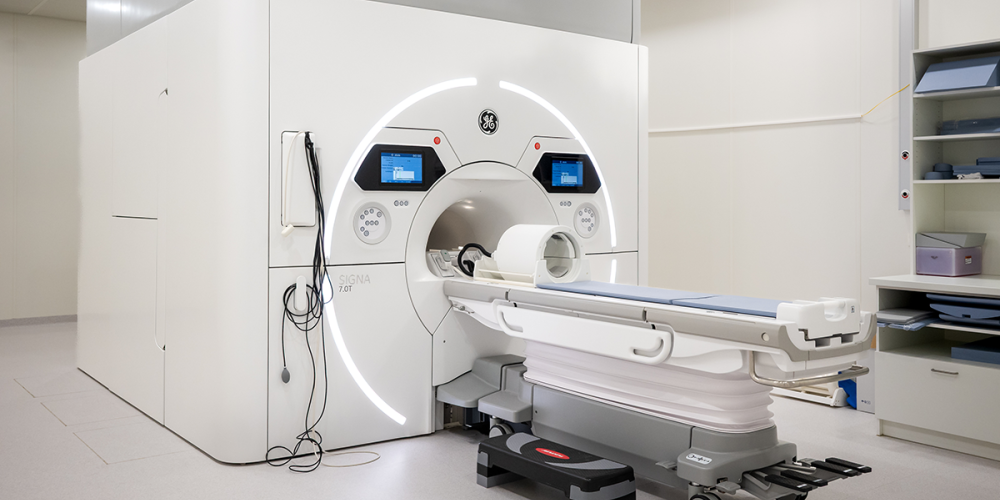


Detecting a tiny lesion that remains invisible on a conventional MRI scan can make all the difference to a patient. With Flanders' first 7 Tesla MRI scanner, researchers aim to gain deeper insights into diseases and accelerate the development of new imaging techniques for clinical use. The powerful scanner opens up new possibilities for studying conditions such as epilepsy, tumours, multiple sclerosis and cartilage disorders.
MRI scanners currently used in hospitals typically operate at magnetic field strengths of 1.5 to 3 tesla. The new scanner at the Research Park in Zellik operates at 7 tesla. This allows researchers to capture images in far greater detail, detect smaller lesions and measure certain substances and biological processes with greater precision.
The potential is particularly significant for epilepsy. When a conventional MRI scan fails to reveal the cause of epileptic seizures, the greater sensitivity of the 7 Tesla scanner may uncover a tiny lesion that would otherwise go undetected. If doctors can then treat that lesion, it could transform the patient's life.
The scanner will primarily be used for research. Scientists will investigate which anatomical details, substances and biological processes become visible at 7 tesla, and how this additional information could improve diagnosis and treatment. Their findings could also help improve medical imaging using the less powerful MRI scanners routinely used in hospitals.
To achieve this, Flanders 7T brings together five Flemish universities and four university hospitals. Researchers specialising in the brain, joints and various organs will share their expertise, technology and infrastructure. By combining their strengths, they aim to uncover missing pieces of the medical puzzle and ultimately translate advances in medical imaging into better patient care.
In the video, researchers explain how 7 Tesla MRI technology could transform medical imaging.