

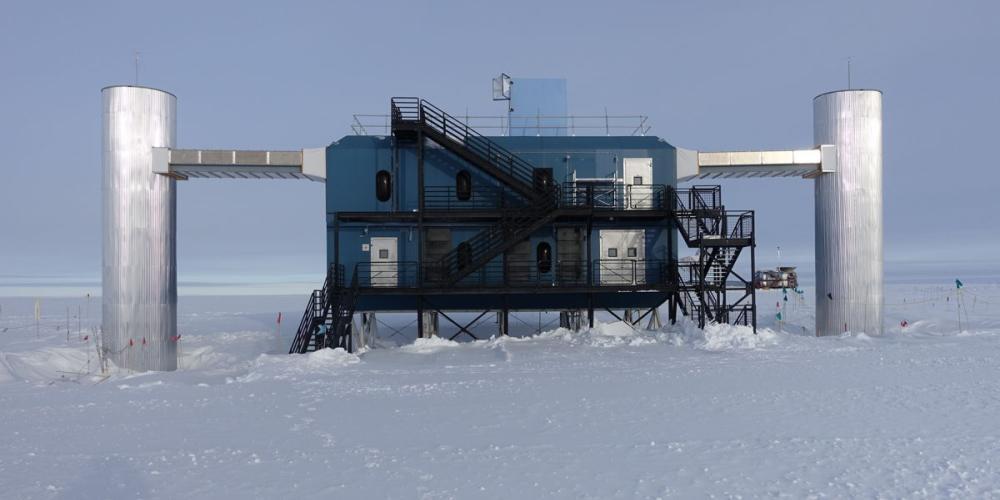


Belgian-American physicist Francis Halzen has been awarded the 2026 Nobel Prize in Physics for his decisive contribution to the IceCube Neutrino Observatory and the discovery of high-energy neutrinos from the cosmos. VUB physicists have also been involved in this vast scientific experiment at the South Pole for decades. Researchers in Brussels helped turn neutrino astronomy into a new way of observing the Universe and are already working on the next generation of detectors.
At first glance, it sounds like a mad idea: drill holes several kilometres deep into the Antarctic ice, lower thousands of light sensors into them, and use a cubic kilometre of ice as a telescope. In the late 1980s, Francis Halzen believed this would make it possible to detect neutrinos, almost elusive elementary particles capable of travelling through stars, planets and people from the furthest reaches of the Universe.
That insight earned him the Nobel Prize in Physics on 6 October. In 2013, IceCube succeeded for the first time in detecting high-energy neutrinos originating from beyond our Solar System. The achievement gave astronomy a fundamentally new way of studying the Universe.
“What powers cosmic radiation such as neutrinos?”
VUB physicists were there from the very beginning. VUB emeritus professor Catherine de Clercq initiated IceCube activities at VUB as early as 1999, together with colleagues from ULB, Ghent University and the University of Mons. VUB has therefore been an active participant in IceCube for more than 25 years, dating back to its earliest stages.
“I still remember the euphoria around the turn of the millennium when the first muon track was observed in AMANDA, IceCube’s predecessor,” VUB Professor Nick van Eijndhoven recalled during IceCube’s tenth anniversary. “But building IceCube, which was sixty times larger, was on an entirely different scale, and we genuinely wondered whether that enormous beast would actually work.”
A telescope spanning a cubic kilometre
Neutrinos are particularly interesting because they hardly interact with matter. While light can be absorbed during its journey and electrically charged cosmic particles are deflected by magnetic fields, neutrinos travel through the Universe almost unhindered and in a straight line. As a result, they can carry information from extreme cosmic environments that are difficult to study with conventional telescopes. Yet precisely because they interact so little with matter, they are extremely difficult to detect.
IceCube solves that problem through sheer scale. A total of 5,160 light sensors were installed in the Antarctic ice, distributed across 86 cables lowered into holes almost 2.5 kilometres deep. When a neutrino exceptionally does interact with matter, the sensors can detect the light produced by the resulting particles.
In 2013, the experiment delivered the first convincing evidence for a population of high-energy cosmic neutrinos. Five years later, another breakthrough followed. IceCube detected a neutrino that could be linked to the blazar TXS 0506+056, an active galaxy with a supermassive black hole at its centre. Observations from several other telescopes pointed to the same source. For the first time, this provided compelling evidence of where at least some high-energy cosmic neutrinos originate.
“With this discovery, we can solve centuries-old mysteries about the Universe,” Van Eijndhoven said at the time. “What powers cosmic radiation such as neutrinos?”
Brussels as a European IceCube hub
Belgium’s contribution is greater than many people realise. The Interuniversity Institute for High Energies (IIHE) of VUB and ULB has become one of Europe’s leading IceCube analysis centres. Researchers in Brussels are involved, among other things, in the search for high-energy neutrinos originating from gamma-ray bursts and active galaxies.
VUB is also involved in the current research programme studying the extreme Universe with IceCube.
That involvement continues today. Within VUB’s High Energy Physics Research Centre, Nick van Eijndhoven and Krijn de Vries lead astroparticle physics research related to IceCube and new detection techniques. VUB also participates in the current research programme investigating the extreme Universe using IceCube and expansions of the observatory.
Because the Nobel Prize does not mark the end of the story. IceCube has since been expanded through the IceCube Upgrade, while scientists are now working on IceCube-Gen2, a planned observatory with a much larger detection volume. Researchers are also exploring radio technology to detect neutrinos at even higher energies.
VUB is playing a role in that effort as well. Researchers such as Krijn de Vries and Simon De Kockere are developing techniques in which antennas capture radio waves produced when extremely energetic neutrinos interact with ice. Such detectors can cover much larger volumes than is feasible with optical sensors alone.
“Neutrinos offer us a unique view of the Universe that is not possible with traditional astronomy,” says De Kockere.
Halzen’s Nobel Prize therefore honours not only an idea that seemed remarkably bold almost forty years ago, but also an international scientific project to which generations of VUB researchers have contributed. What began as the question of whether a gigantic block of ice could serve as a telescope has evolved into an entirely new window on the Universe. And in Brussels, researchers are already helping to build its future.