

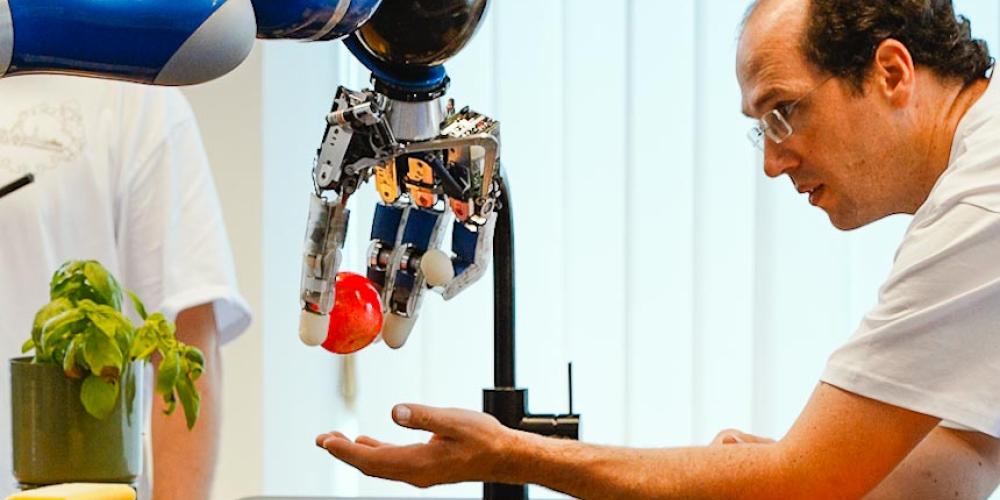


For ten days, robots took over VUB. At the invitation of imec-VUB, more than 80 European robotics researchers spent a week working together on a hackathon, public laboratory visits and workshops. The highlight of the event was a live robotics demonstration in the European Parliament on 2 September. With one burning ambition, according to organiser Prof. Dr Bram Vanderborght, head of Brubotics at imec-VUB: “We want to move robotics higher up the European political agenda.”
From 16 October 2026 | Meet VUB tech pioneers and robots at FTI Brussel
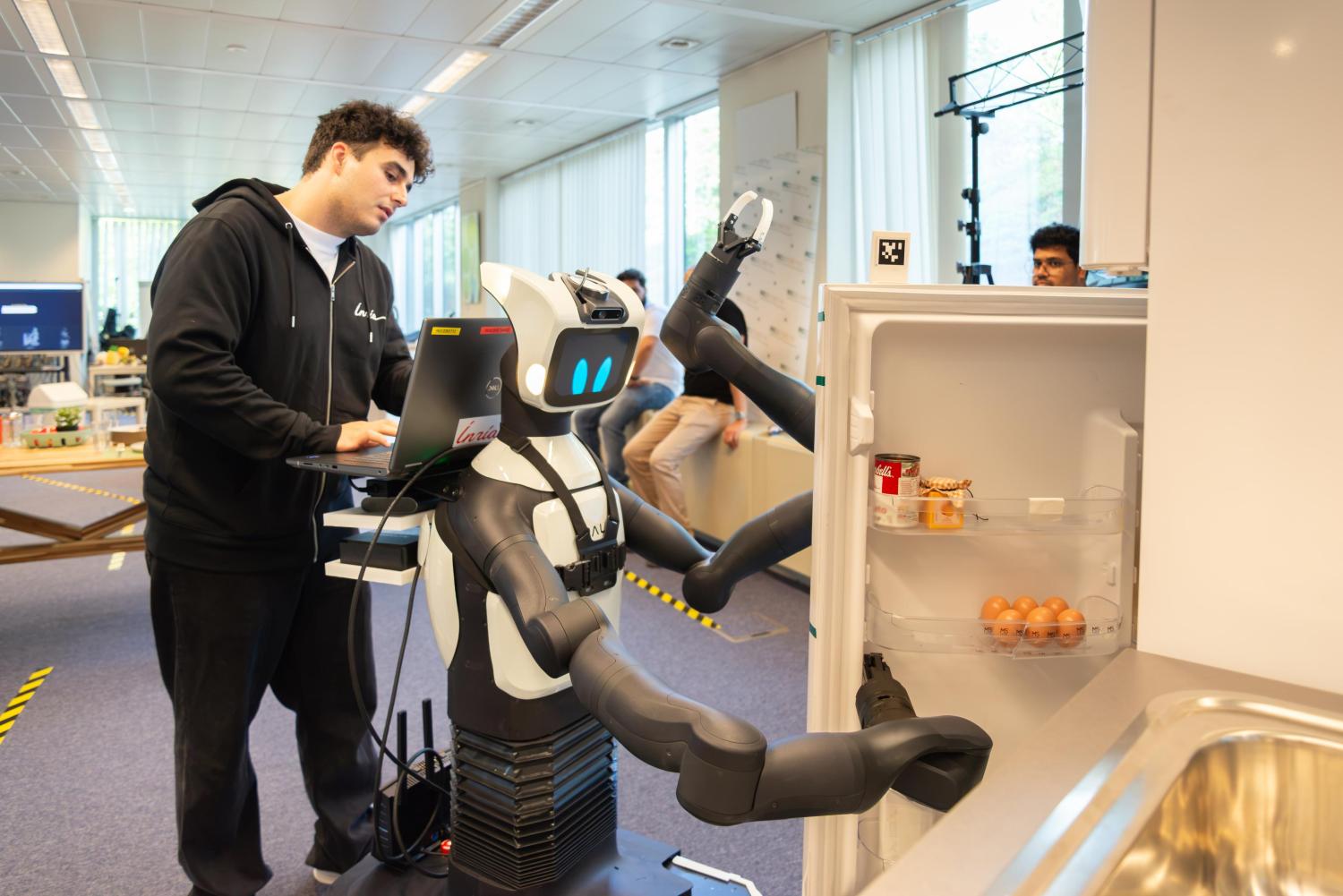
Clearing the table or putting away a bottle of water: you and I do it without a second thought. For robots, however, it is quite an achievement. In the laboratory of the AI Experience Centre (AIXC), four humanoids move autonomously between a table, a refrigerator and a sink. One removes plates from the table and carries them to the kitchen counter, while another opens the refrigerator door with one arm and places a carton of milk inside with the other. The accompanying scientists watch closely, ready to intervene and make adjustments. This is the moment to eliminate errors, ensuring that the showcase in the European Parliament runs smoothly.
“euROBIN provides a European ecosystem in which robots share data and knowledge”
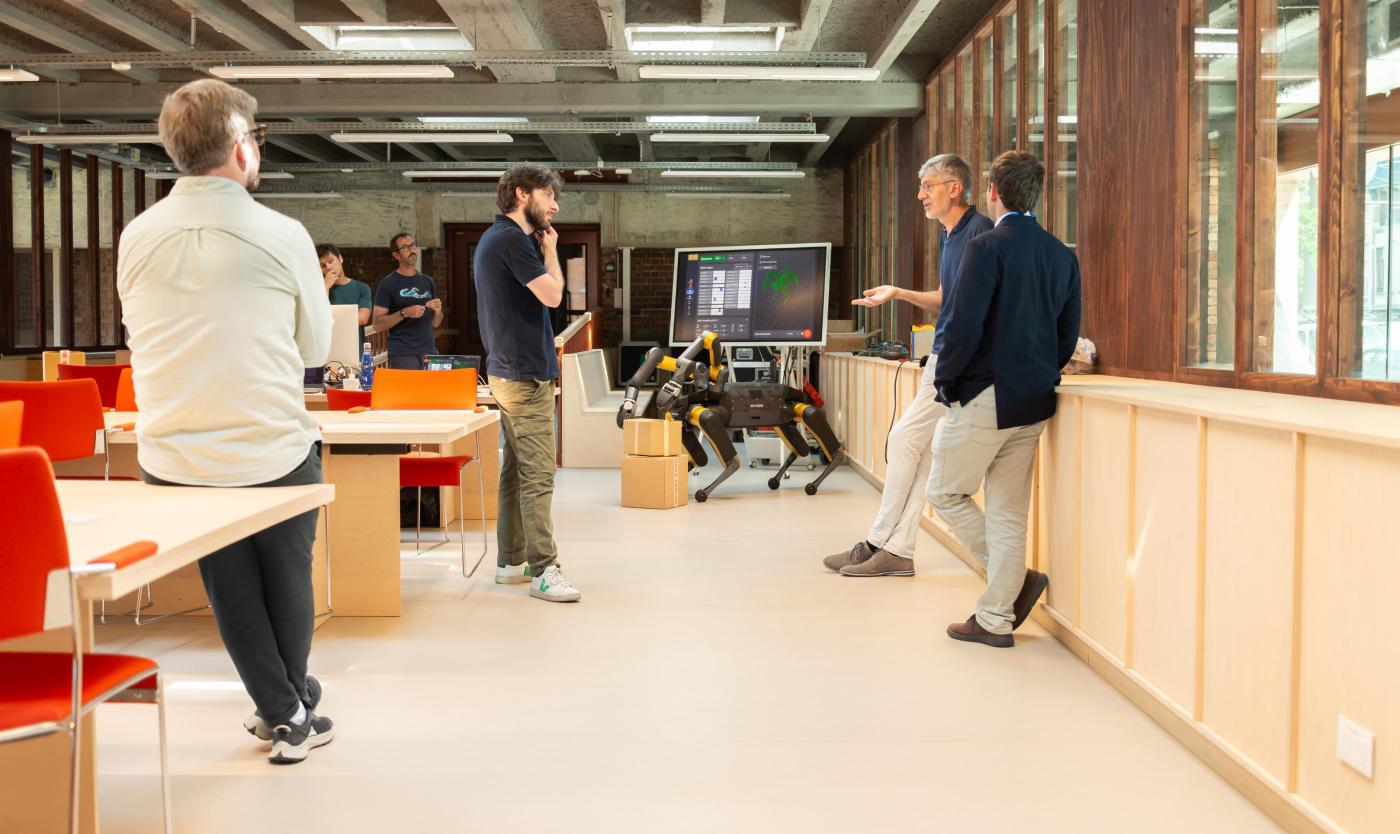
For days, humanoid robots, aerial robots, outdoor robots, consumer robots, manufacturing robots and industrial robots move around VUB’s four robotics locations (AIXC, the ETRO lab and USquare). Franglais, Spanglish and other varieties of Euro-English can be heard throughout the corridors. It is no surprise: researchers from all corners of Europe have gathered here. The occasion is the final week of euROBIN, a Horizon Europe-funded Network of Excellence Centres in Robotics that has run for four years. The network includes 24 academic partners, seven industrial partners and two associated partners from no fewer than 14 European countries.
Bram Vanderborght: “euROBIN was launched in June 2022. The ambition was to build a European ecosystem in which robots share data and knowledge and learn together to carry out tasks in human environments. Instead of working in isolation, the teams within the network share a common benchmarking and demonstration approach. This gives European researchers a shared platform to test their robots and present their results to industry, policymakers and the public. The public laboratory visits and the showcase in the European Parliament are good examples of this.”
“Europe must stand shoulder to shoulder with the US and China in robotics”
euROBIN organised its research around three concrete application areas: robotic manufacturing for the circular economy, personal assistant robots and outdoor robots for sustainability. The hope is that this will become the starting point for a European robotics industry capable of matching those of China and the United States. According to Prof. Dr Alin Albu-Schäffer of the German Aerospace Center (DLR), which coordinates euROBIN, that ambition is entirely realistic..
Alin Albu-Schäffer: “Within ten to fifteen years, Europe should have a robotics industry comparable in scale to today’s automotive industry, with five to ten major manufacturers. The market will be there. Over the next decade, 20 million people in Europe will retire. If robots replace even half of them, that already creates a market for 10 million robots. These will not only be humanoids helping in households and healthcare, but also quadruped robots and flying robots for logistics.”
China and the United States currently lead the field, Albu-Schäffer acknowledges. However, he believes Europe can close the gap. In his view, the expertise and research capacity are already in place. Europe has even pioneered technologies such as AI-based quadruped robots, human-robot interaction and flying robots.
Alin Albu-Schäffer: “From a geopolitical perspective, we really have no alternative. If robots become common in households, institutions and factories, we do not want them to be capable of spying for other countries, particularly where sensitive information is involved. Europe must stand shoulder to shoulder with China and the United States in robotics. That will not be easy, because those countries are advancing rapidly through national programmes and large amounts of venture capital. That is why we organised our showcase in the European Parliament and called on policymakers to invest in European research and commercialisation.”
“VUB is ready to help build a European robotics ecosystem”
Five days later, we spoke again with Bram Vanderborght. The showcase in the European Parliament had just concluded. How had it gone?
Bram Vanderborght: “Very well. Alex Foss, an influential figure in the European Parliament and host of the initiative, confirmed what Alin had already said earlier. What the automotive industry was to twentieth-century Europe, the robotics industry should become for this century: a cornerstone of society. The foundations are already there. We have excellent research, as well as the components and data needed to train robots using AI models. Because the European ecosystem operates differently from the American and Chinese systems, it takes longer for knowledge to be translated into start-ups and scale-ups. That is why, in an open letter, we asked Europe to address this challenge.”
At any rate, the issue is now on the agenda. It is partly a matter of geopolitical common sense: do we really want Chinese robots in our factories and institutions? It is also a question of safety: are these robots sufficiently safe to interact with people?
Bram Vanderborght: “Europe could require foreign-made robots to comply with European values and regulations on safety and privacy. That would give us the opportunity to develop our own ecosystem. The ambition is for one third of all robots to be European. Together with imec, VUB has considerable expertise in robotics and AI research. We already have several robotics spin-offs, with more in the pipeline. We can play an important role in building that European ecosystem.”