

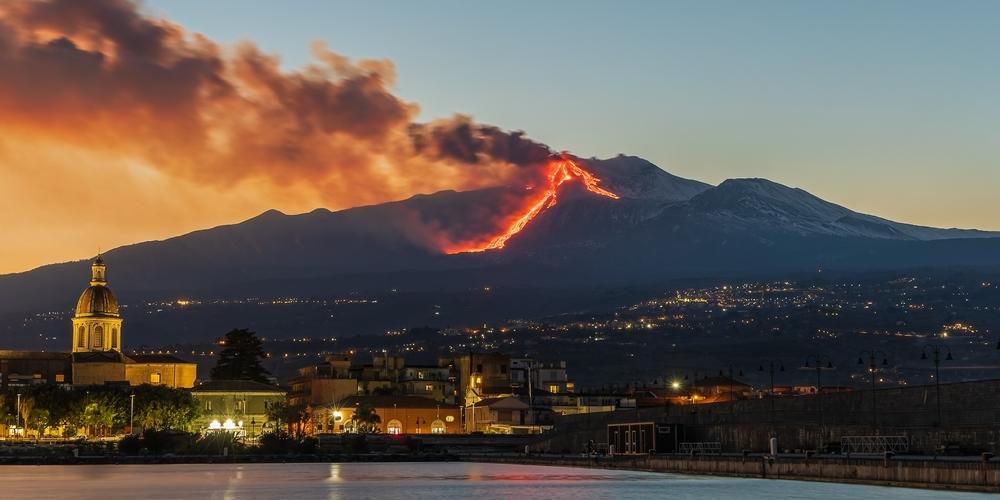


Volcanoes emit smoke. Beneath a volcano lies a huge chamber filled with liquid magma. A series of earthquakes means an eruption is imminent. And if a ‘supervolcano’ like Yellowstone were to awaken, a global catastrophe would be upon us. These are images and ideas that regularly crop up in news reports, documentaries and on social media. But scientifically speaking, the reality is often far more complex. An international research team, led by New Zealand volcanologist Janine Krippner and former VUB volcanologist Sam Poppe, is now setting the record straight on these persistent misconceptions about volcanoes: from the Ring of Fire and supervolcanoes to mega-tsunamis and the prediction of eruptions.
The volcanologists have therefore compiled eighteen of the most common misconceptions about volcanoes and volcanic eruptions in the *Journal of Applied Volcanology*. The authors address not only spectacular concepts such as ‘supervolcano’ and ‘mega-tsunami’, but also fundamental misunderstandings about earthquakes, climate, volcanic ash, magma systems and the possibility of predicting eruptions.
“Volcanoes provide spectacular imagery, which makes them a fertile ground for tall tales,” says Poppe. “But simplifications can easily take on a life of their own, with all the consequences that entails. Through our research, we aim to clarify what science can actually tell us, and where we need to exercise caution.”
A ‘smoking’ volcano?
A dark cloud above a volcano is often described as ‘smoke’. But what we see consists of various materials. During explosive eruptions, water vapour and other volcanic gases are blown into the air mixed with volcanic ash. This ash does not consist of the soft, charred material left behind after a wood fire, but of extremely small fragments of rock, minerals and volcanic glass. That distinction is important: volcanic ash can have consequences for aviation, infrastructure and health, and volcanic ash clouds can cause hot chunks of rock and cooling magma to rain down if you get too close. The words used to describe a volcanic plume are therefore more than just a detail.
Anyone who hears the word ‘magma chamber’ easily imagines an enormous underground cave completely filled with churning magma. Classic drawings of volcanoes also reinforce that image. The reality is more complex. The term ‘magma chamber’ is a simplification of a volcanic system that can extend deep into the Earth’s crust. That is why volcanologists are increasingly focusing on the entire magma system and the processes taking place within it. This is also important for understanding and predicting volcanic activity. Magma that moves or changes in composition does not automatically imply that a large underground reservoir is filling up until it eventually overflows.
Earthquakes are not infrequently recorded around active volcanoes. They can provide important information about what is happening underground, but an earthquake – or even a series of earthquakes – is not, in itself, a simple countdown to an eruption. Volcanologists therefore combine different types of observations. Among other things, they look at seismic activity and other changes in the volcanic system to try to understand what is happening. “A volcano is not a mechanism where a single parameter tells us when it will erupt,” says Poppe. “We have to bring together and interpret various signals. This allows us to assess scenarios and probabilities, but that is not the same as an exact prediction.”
Even a few alarming readings are not necessarily a harbinger of an eruption and do not indicate whether or when that inevitable eruption will follow. In reality, volcanic forecasting does not work like that. Even when volcanoes are monitored and researchers detect changes, this does not mean they can always predict exactly when an eruption will begin, how large it will be or when it will end. Volcanic systems are complex, and different volcanoes can behave very differently.
According to VUB volcanologist Matthieu Kervyn, communication about this uncertainty is particularly important. Kervyn did not contribute to the new study, but researches volcanic processes and risks at the VUB. “Uncertainty does not mean that scientists know nothing,” says Kervyn. “Monitoring can tell us a great deal about changes in a volcano. But we must communicate clearly about what we can establish, which scenarios are possible and where uncertainty remains.”
The ‘Pacific Ring of Fire’ is probably one of the best-known terms in volcanology. On world maps, a striking belt of active volcanoes and earthquakes does indeed form around the Pacific Ocean. The name may give the impression that all these volcanoes form part of a single system and that activity in one part of the Ring of Fire indicates what will happen thousands of kilometres away.
In reality, it is a vast zone in which various tectonic plates and plate boundaries interact. Volcanic activity must therefore be viewed within its local and regional geological context. The fact that two volcanoes around the same ocean are active at roughly the same time does not in itself prove a causal link.
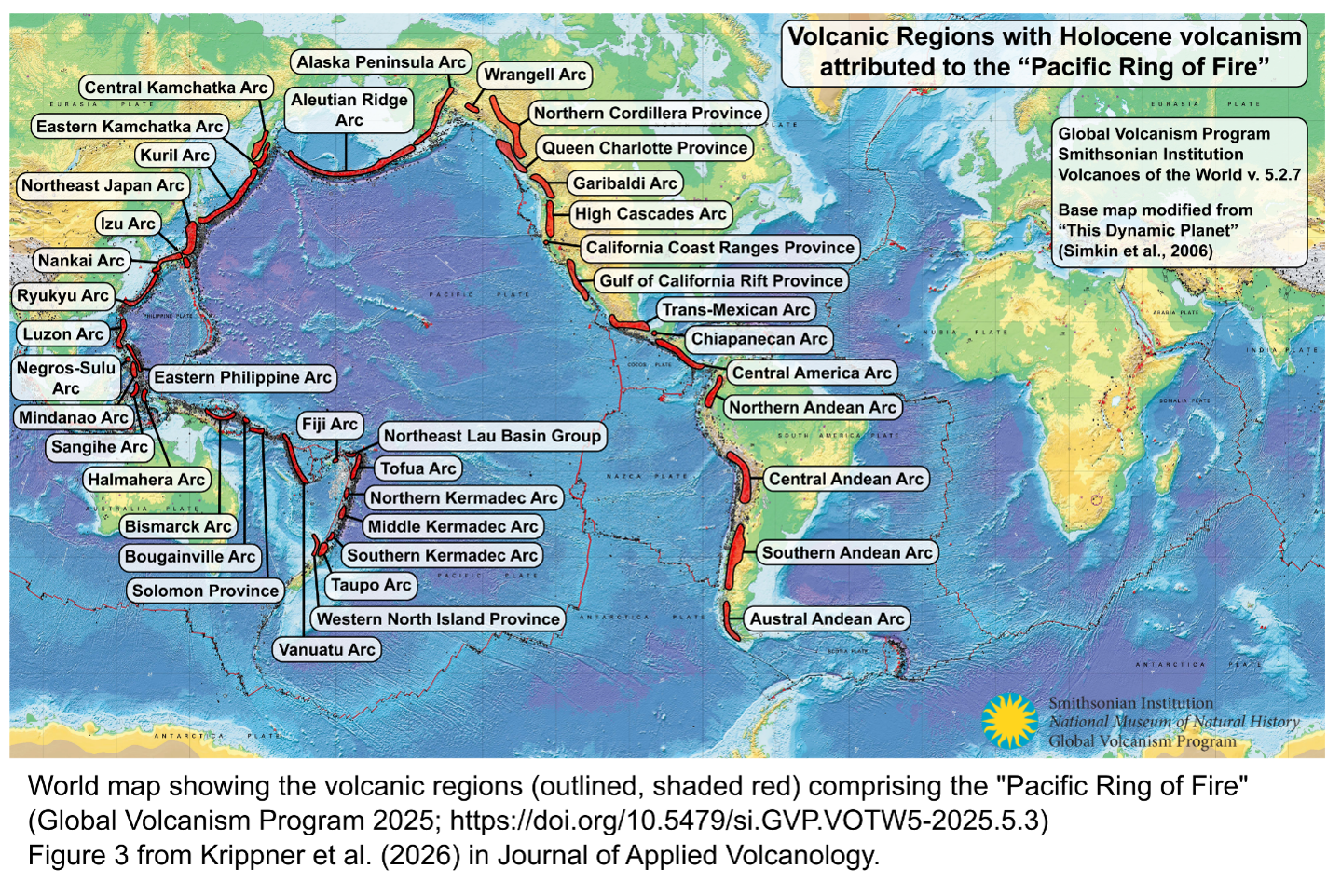
The new map of the area shown above, produced by the authors, illustrates this well. It is based on all the information from the ‘Volcanoes of the World’ database of the Global Volcanism Programme at the Smithsonian Institution in the US, the most comprehensive of its kind.
A term such as ‘supervolcano’ sounds like a scientifically defined type of volcano that conjures up the image of an exceptionally large mountain capable of a devastating eruption. The term is mainly associated with places such as Yellowstone in the United States.
“Such terms can create more confusion than clarity,” says Poppe. “The scale of the largest volcanic eruption in the past is not necessarily the most plausible scenario for a possible future eruption. It is more likely that such large volcanic systems will exhibit very different, much smaller forms of activity over a long period of time.”
‘Mega-tsunami’ is another term that quickly grabs attention. Volcanic processes can indeed cause tsunamis. Collapses, landslides and explosive processes can set large quantities of material or water in motion. It is a huge leap from the existence of such a mechanism to the prediction that a particular volcano will cause a catastrophic, ocean-wide tsunami. Scenarios must be assessed on the basis of the geology, the potential volume and mechanism of a collapse, the interaction with the water and the way in which waves subsequently propagate. According to the authors, it is particularly important in scenarios with potentially enormous consequences to distinguish between what is physically possible and what is considered likely on the basis of scientific research.
Another common misconception: major volcanic eruptions are responsible for global warming. However, the relationship between volcanoes and climate is complex. Between 2005 and 2015, volcanoes emitted the equivalent of less than 2 per cent of the carbon dioxide that humanity pumps into the atmosphere each year. Major explosive eruptions can propel material and gases high into the atmosphere, thereby causing a measurable cooling of the climate for a short period. Climate change, however, is a much broader phenomenon and is caused by a combination of factors, the main one being the burning of fossil fuels containing carbon.
One final issue is more relevant than ever: photographs and videos of volcanic eruptions are spreading at lightning speed. Spectacular images can be taken out of context, resurface during another eruption or be misinterpreted. A photograph shows what a camera captured at a single moment in time, but does not necessarily reveal which volcanic process we are seeing, how dangerous that process is, or what will happen next.
The speed at which images are shared globally today has a paradoxical effect. Scientific knowledge can be disseminated faster than ever, but rumours and misinterpretations travel at least as quickly.
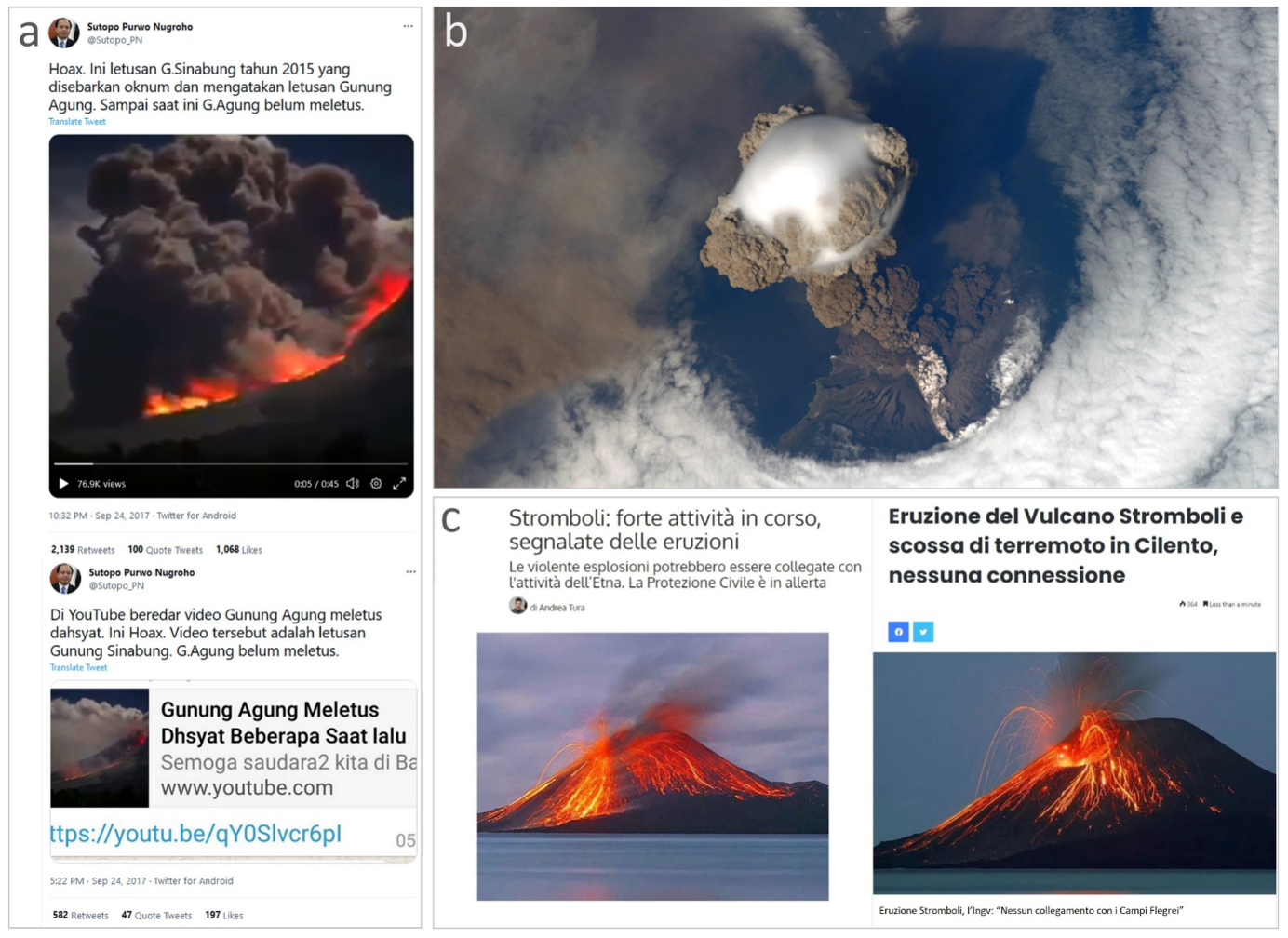
Examples of misleading photographs shared during recent volcanic activity: (A) Videos of pyroclastic flows from Mount Sinabung in Indonesia were circulating prior to the 2017 Mount Agung eruption. Local officials such as Sutopo Purwo Nugroho, spokesperson for Indonesia’s Badan Nasional Penanggulangan Bencana (BNPB), debunked these ‘hoaxes’ (tweets compiled on 18 February 2022). (B) This image of Sarychev Peak, taken on 12 June 2009 from the International Space Station, is part of a series of photographs that is often misused to describe eruptions around the world (image courtesy of NASA/JSC/Image Science and Analysis Laboratory). (C) Photographs of Anak Krakatau from 2007 with captions that incorrectly claim this is the Stromboli volcano in 2018; taken by Marco Fulle for the ‘Stromboli Online’ website. Figure 7 from Krippner et al., 2026.
The authors worked during and between volcanic crises in, amongst other places, Indonesia, the Philippines, New Zealand, Australia, Chile, the United States and Europe. In doing so, they witnessed at first hand how misinformation arises and how difficult it can sometimes be to correct it retrospectively.
In their article, they go on to examine seven specific cases: Mount Agung in Bali, Mount Etna in Sicily, Kīlauea in Hawaii, Tajogaite on La Palma, La Soufrière on Saint Vincent, the Taal Volcano in the Philippines and the Yellowstone Caldera in the United States; they also list eighteen misconceptions and assess them against the key scientific insights and recent research. The result is intended to serve as a practical resource for volcanologists, journalists and policymakers whenever a volcano once again dominates the news.
This is not only important to avoid undue panic. The opposite is at least as dangerous: that people underestimate a real risk because previous warnings were portrayed as exaggerated or incorrect.
“During a volcanic crisis, information must be available quickly, but above all it must be reliable,” says Poppe. “People need to be able to understand what is happening, what scientists base their assessments on, and what uncertainties remain. It is important to seek information from the correct and responsible authorities, wherever you are in the world as a tourist, or whatever news article you are writing.”
Kervyn agrees: “Volcanoes are spectacular enough in their own right. We don’t need to make them even more spectacular than they are. The better people understand how volcanoes really work, the better we can communicate the risks.”
Publication
Krippner et al. (2026), ‘Getting the story straight: Common misconceptions around volcanoes and eruptions with case studies of recent events’, Journal of Applied Volcanology.
Contact
Dr Sam Poppe was a former PhD researcher at the VUB (2014–2019) and is currently an Assistant Professor at the Space Research Centre of the Polish Academy of Sciences (Centrum Badań Kosmicznych PAN). Further information is available at sampoppe@cbk.waw.pl, sam35poppe@gmail.com and https://sampoppevolcano.wixsite.com/sampoppe
Prof. Dr Matthieu Kervyn is a professor at the VUB Department of Geography and was Sam Poppe’s former PhD supervisor.