

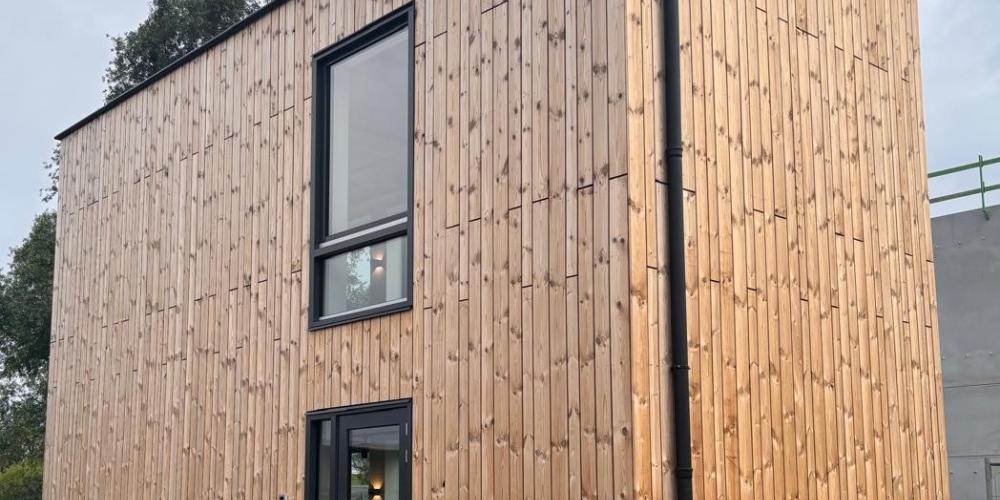


At the Green Energy Park test site, located within the Zellik research park, the European Horizon Europe project RECONSTRUCT is opening an innovative demonstration building that brings the future of circular construction to life. The Vrije Universiteit Brussel (VUB) is playing a key role in the project, which was realised using new circular building materials, digital innovations and research into reusable building systems. Over the coming years, the demonstration building will serve as a living laboratory where researchers, businesses and policymakers will work together to shape the construction sector of tomorrow.
The construction sector is responsible for a significant proportion of global CO₂ emissions and waste production. RECONSTRUCT aims to demonstrate that there is another way. The project is developing buildings that are no longer designed to be demolished, but whose components can be easily dismantled, reused or adapted after use.
The demonstration building in Brussels is one of two European pilot projects – alongside a second demonstration building in Barcelona – which prove that circular construction is already feasible today. “In Barcelona, we are demonstrating the recycling of building materials, whilst for the demonstration building in Zellik we are focusing on the reuse of building elements,” says Professor Hubert Rahier (Department of Sustainable Materials Engineering, SUME) Three VUB research groups are collaborating within RECONSTRUCT: Architectural Engineering (ARCH, Niels De Temmerman & Jeroen Poppe), Mechanics of Materials and Structures (MEMC, Tine Tysmans & Erich Meiners Muñoz) and Sustainable Materials Engineering (SUME, Hubert Rahier & Gulsen Nazerian). The project is coordinated by ITeC and brings together sixteen partners from across Europe.
VUB is developing materials and digital solutions
Among other things, the researchers have developed innovative alkali-activated cements incorporating blast furnace slag and plant-based waste streams. These materials produce up to five times fewer CO₂ emissions than traditional cement and are fully in line with the principles of circular construction. Combined with lightweight, modular building elements, this results in buildings that can be easily assembled, adapted and dismantled again.
To demonstrate this, a floor element (betweenthe first andsecond floors)will be removed from the building in a year’s time and replaced with an element made from cement developed at the VUB, in which the reinforcement will no longer consist of steel bars but of textile. “For the load-bearing floor system, we used fibre reinforcement instead of steel reinforcement,” says Prof. Tine Tysmans. “This avoids corrosion problems, enabling us to build structures that are not only thinner but also more sustainable. The concrete elements use less concrete, are lighter and last longer than traditional reinforced concrete. They are also designed to be easily dismantled and reused. This innovation therefore fits within the framework of circular construction at the building component level.”
The use of such technical textiles as reinforcement can reduce the amount of concrete in a structure by up to 80 per cent, which represents a significant economic as well as environmental benefit.
In addition, the VUB is also developing the digital building blocks of the circular economy. Thanks to material passports, BIM models and so-called digital twins, every building component remains traceable throughout its entire life cycle. A digital twin is a virtual copy of something that exists in the real world, such as a building, machine, factory or even a city. This digital copy continuously receives data from the real object, for example regarding temperature, energy consumption, wear and tear or movement. This enables researchers to monitor what is happening on a computer, predict problems and test changes without immediately having to make any adjustments in the real world. All of this simplifies future reuse and ensures more efficient management of raw materials.
The research findings are also shared with companies, designers and public authorities via the Brussels Circular Construction Hub, which is being developed as part of RECONSTRUCT.
Construction innovation in the test bed
The demonstration building was constructed in the test bed of Green Energy Park, the innovation organisation that develops and tests sustainable solutions in collaboration with the VUB and numerous partners. The test bed is located at the research park in Zellik, where research into energy, mobility, healthcare innovation and circular construction converges.
The building consists of a compact prefabricated structure of approximately 60 square metres and will be used in the coming years for measurements, demonstrations, training courses and workshops. It will thus serve as a practical environment in which new construction techniques can be tested and refined under realistic conditions.
Climate technology as a priority
RECONSTRUCT is one of the flagship projects of FACT (Flanders Alliance for Climate Technology). FACT brings together more than 350 VUB researchers who collaborate across faculties on the development and societal application of climate technologies. Through RECONSTRUCT, the VUB aims not only to contribute to more sustainable buildings, but also to support the European ambition to drastically reduce construction waste, maximise the reuse of materials and accelerate the transition to a circular economy.
Contact
More information on RECONSTRUCT: https://reconstruct-project.eu
Press contact Green Energy Park / Belgian Stakeholder Hub: ilse.vandenborre@greenenergypark.be
More information about FACT: https://fact-vub.be