

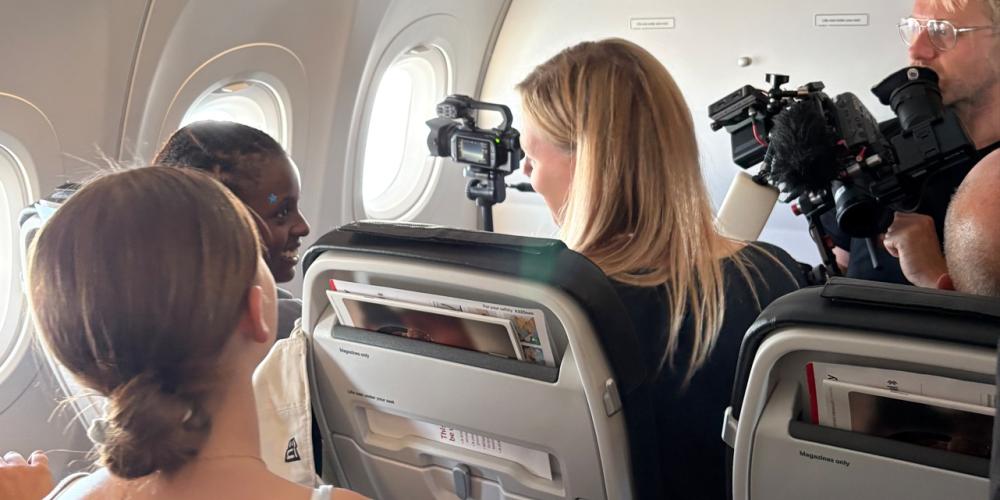


A team of VUB researchers took to the skies on the evening of 12 August to study the solar eclipse from a unique perspective. On board an Airbus A320, Professor in Lighting Valéry Ann Jacobs and astronomer Katrien Kolenberg, together with several researchers and students, carried out light and temperature measurements during the eclipse. For Valéry, the flight ultimately became more than a scientific experiment. "The brightest moment of this summer came, for me, precisely in the form of an eclipse."
"The most exciting moment of the eclipse flight took place before we had flown even a single metre." In the morning, the spectrograph, a crucial instrument that analyses light at different wavelengths, had suddenly failed. The day before, everything had still been tested and approved.
"That was quite a major problem," Jacobs explains. Finding a replacement device was not an option. All equipment permitted on board had already received safety approval weeks earlier. There would no longer be enough time for a new device to receive the necessary clearance. After consulting the manufacturer, one last attempt was made to restart the instrument via a computer. It worked. "The screen went dark. The device restarted. Eureka, everything was working again."
The team was able to leave for Brussels Airport with all their equipment. On the airport departure board, their destination was simply listed as 'Brussels'. The nearly one hundred passengers would take off from Brussels and land there again a few hours later. "This time, the purpose of the journey was not on the ground, but somewhere above the clouds. We went in search of the moon’s shadow."
On board was a colourful mix of astronomy enthusiasts, journalists and scientists. For Jacobs, it was an opportunity to investigate research questions closely related to her daily work. As an expert in lighting and light pollution, she studies how artificial light affects people and their environment. A solar eclipse is, in a sense, the mirror image of that.
“It became completely silent”
"Instead of adding light, nature suddenly removes a large part of its most important light source in a very short period of time." How much darker does the world become when the sun is obscured by 96 per cent? Does not only the amount of light change, but also its colour? And how does the mysterious blue-green glow that eclipse observers sometimes describe come into being?
The study was set up together with astronomer Katrien Kolenberg. While Kolenberg and a group of researchers conducted measurements on the ground in Spain, Jacobs collected data from the aircraft. The same eclipse could thus be observed from two very different layers of the atmosphere. "The same eclipse. The same sun. The same moon. But observed from two very different places within our atmosphere."
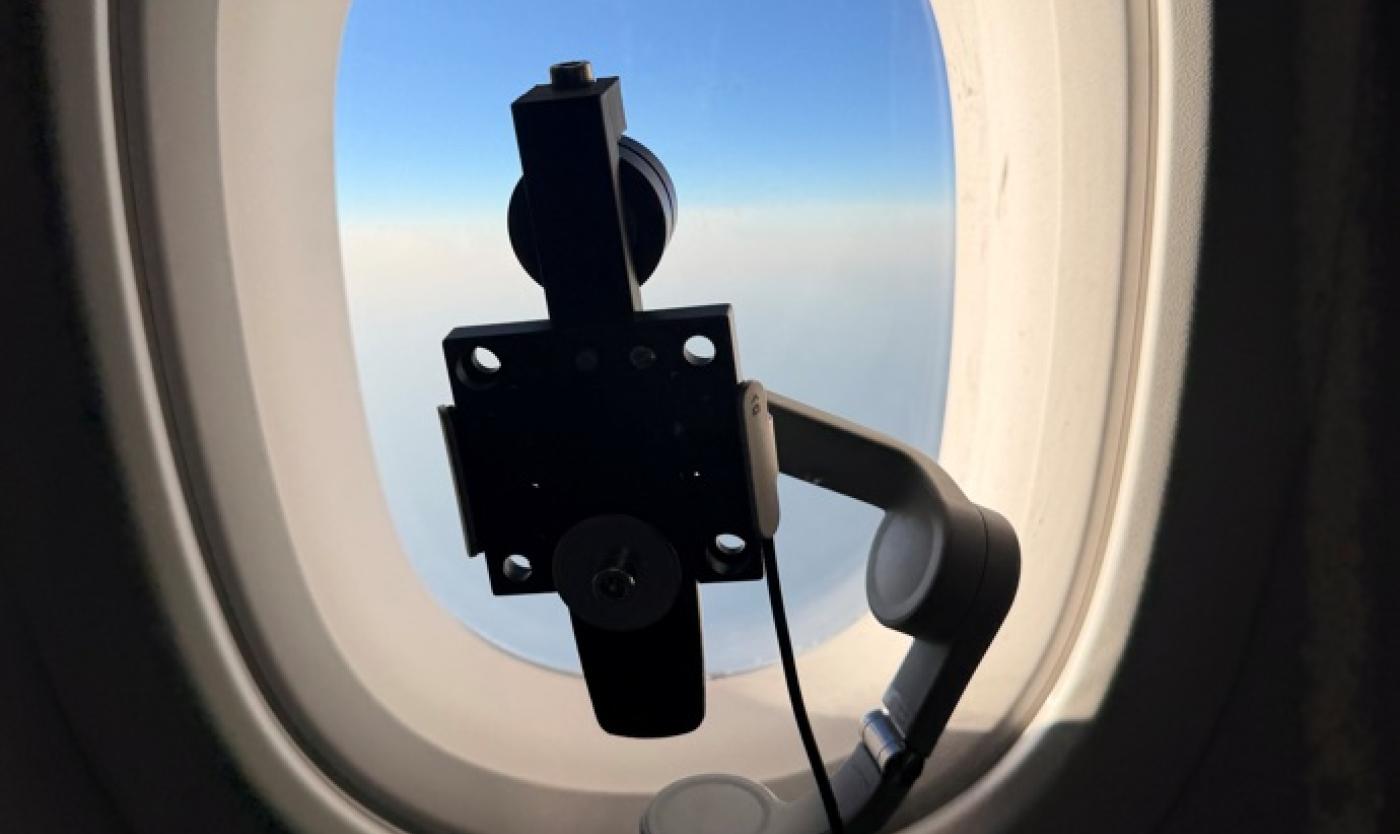
This proved more technically challenging than expected. After all, an Airbus A320 is not a laboratory. On paper, it seemed straightforward: bring a few light meters aboard, install a spectrograph and record what happens. In reality, every device had to be approved in advance, sensors could not simply be attached to the windows, and tripods had to be stowed away during take-off and landing. On top of that, an aircraft is constantly moving. It makes course corrections, turns and slight banking movements. "For an instrument that wants to know exactly which patch of sky it is looking at, that is no easy task."
Nevertheless, the team succeeded in setting up measuring equipment on both sides of the aircraft. Lux meters recorded the amount of light, while the spectrograph mapped the composition of the light. Afterwards, all data will be linked to the aircraft’s exact position and movements. Jacobs even suspects that one of the flight’s most important outcomes may be a practical guide for future researchers wishing to carry out the same measurements.
As if the technical challenges were not enough, the flight plan also changed shortly before departure. The aircraft had originally been due to fly towards Nantes, but the airspace above France was expected to become too crowded because of other eclipse flights. "It turned out we were not the only ones who had come up with the idea of viewing the eclipse from an aircraft."
The Airbus eventually followed a westerly route over the North Sea and London towards Plymouth and the far west of the United Kingdom. There, an eclipse of approximately 96 per cent would be visible. During the maximum phase of the eclipse, the aircraft completed several turns so that passengers on both sides of the cabin could see it. Throughout the flight, people had been talking, photographing, filming, measuring and conducting interviews, but at that moment they were all staring at the same patch of sky. “It became completely silent.”
"The wonderful thing about science is that your personal observation does not necessarily have the final say"
"When we say that the sun is 96 per cent eclipsed, it is tempting to draw a direct conclusion about how much light remains. But it is not that simple." For Jacobs, this was the most interesting question of the experiment: what does such a percentage of obscuration actually mean? That figure tells us nothing about how much light ultimately reaches landscapes, clouds, buildings or people. It is precisely this ambient light that determines how bright an eclipse feels to those observing it. Using the collected measurement series, the team now hopes to determine how quickly that light actually diminished during the flight. To measure this, colleague Katrien Kolenberg was stationed on the ground.
Equally intriguing is the blue-green glow that eclipse observers sometimes describe. According to Valéry, both the atmosphere and our own eyes could be responsible. She herself did not see any blue-green sky. "The wonderful thing about science is that your personal observation does not necessarily have the final say. Fortunately." By comparing measurements taken at cruising altitude with those taken on the ground, the researchers hope to gain a better understanding of whether such a colour shift is truly present in the light itself, or whether it is mainly produced by our brains.
Many people on the ground also report that it suddenly becomes colder during an eclipse. That sounds logical enough: when less sunlight reaches the Earth’s surface, the air immediately above it is warmed less as well. But it is up to science to confirm that. From the cockpit, the team monitored the outside temperature at altitude throughout the flight. The researchers did not observe any notable decrease. "That fits nicely with our hypothesis that the typical temperature effect of an eclipse is mainly something that occurs close to the Earth’s surface." However, the full dataset will first need to be analysed thoroughly before that can be confirmed responsibly.
Science does not take away the sense of wonder. While busy measuring and recording, Valéry was invited by the pilot to sit beside him in the cockpit jump seat. Suddenly she had a panoramic view of the eclipse. As an inhabitant of Earth, it is difficult to get much closer to such a natural phenomenon. "For a brief moment, I did nothing. No graph. No measurement. No cable. Just looking." In her determination to carry out the experiment as perfectly as possible, she had almost forgotten how unique the eclipse was. "The more I understand about light, the more fascinating I often find it."
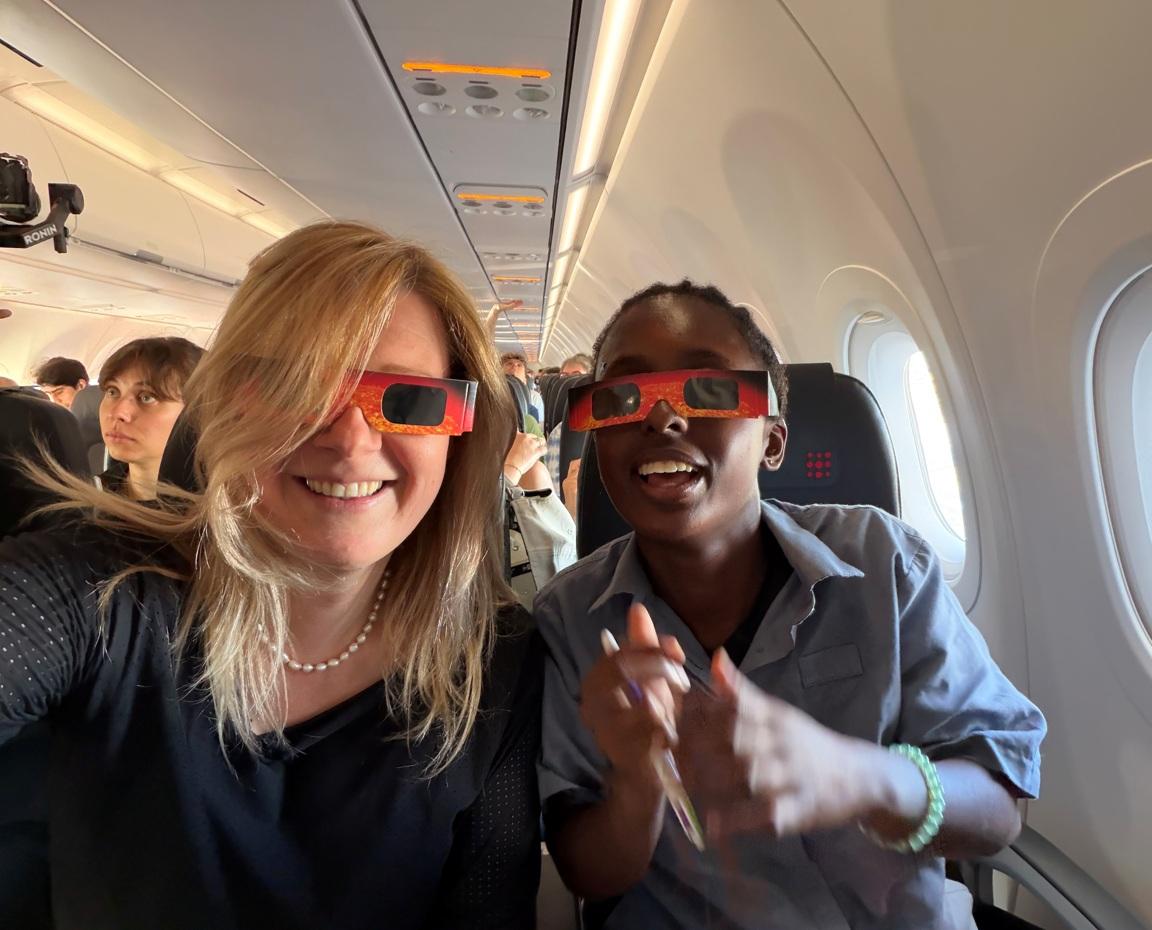
Valéry Ann Jacobs with student