
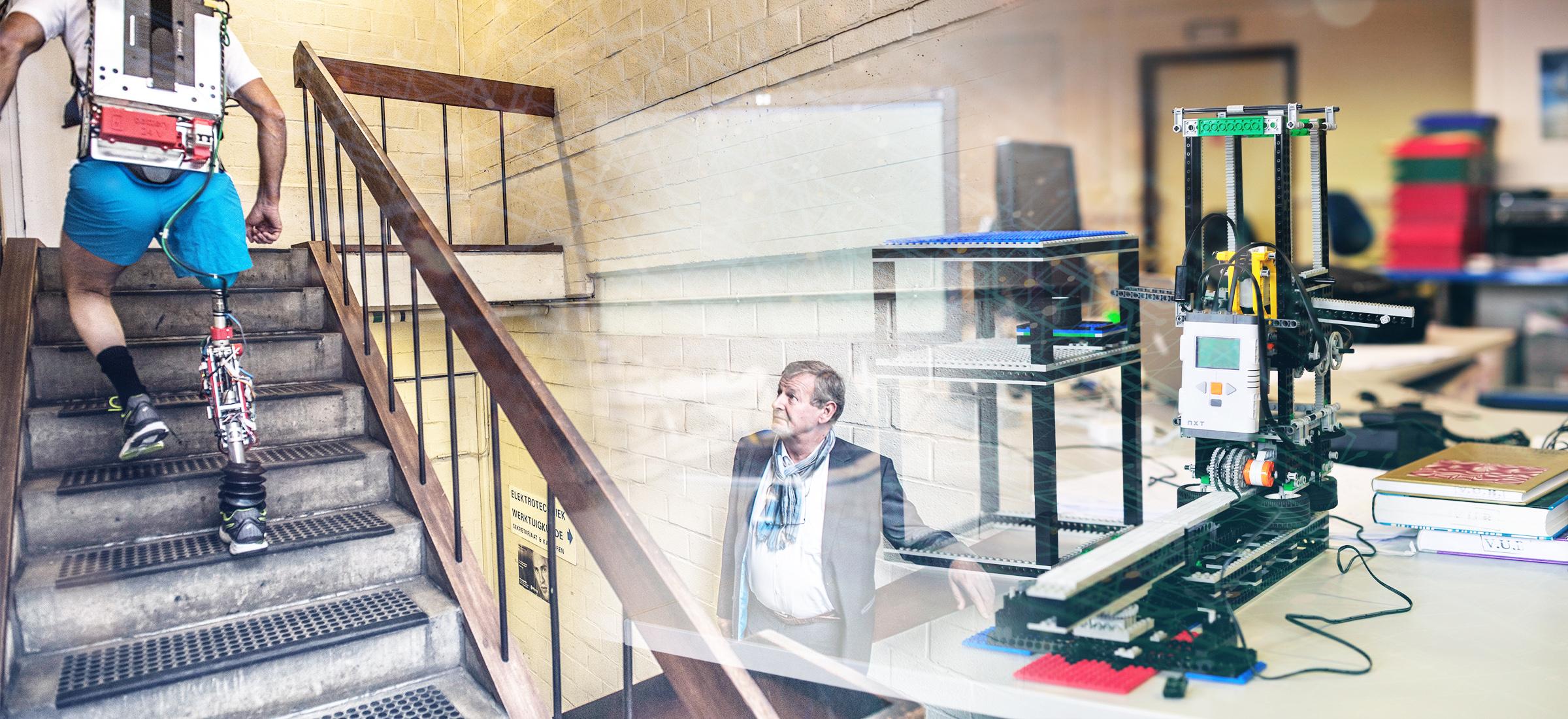
Multimedia

All students study a core programme of 30 ECTS-credits; do a research training of 6 ECTS-credits and a master thesis of 24 ECTS-credits. Students SHOULD choose one OUT of four specializations: Artificial Intelligence, Multimedia, Software Languages and Software Engineering or Data Management and Analytics. 30 ECTS-credits should be spent to mandatory and optional courses within the chosen specialization. The 24 remaining optional ECTS-credits can be taken within the specialization or from other specializations. Finally, 6 ECTS-credits can be freely chosen from any master level VUB course. This free choice of 6 ECTS-credits has to be specified through the form (see facultary web site). Here is also an interuniversity offer of elective courses announced by the department. This brings the total to 120 ECTS-credits. The master thesis as well as the research training need to be related to the chosen specialization.

Master of Science in Applied Sciences and Engineering: Computer Science Multimedia

Compulsory courses: year 1

Methods for Scientific Research
3
Declarative Programming
6
Philosophy of Science
3
Software Architectures
6
Data and Information Management
6
Theory of computation
3
Information Theory
3

Compulsory courses: year 2

Research Training
6
Master Thesis Computer Science
24

30 ECTS-credits should be spent to mandatory and optional courses within the chosen specialization. The 24 remaining optional ECTS-credits can be taken within the specialization or from other specializations. Finally, 6 ECTS-credits can be freely chosen

Compulsory courses: year 1 & 2

Image and Video Technology
3
Computer Vision
4
Capita Selecta Multimedia
3
Image Processing
5
3D graphics in VR
5

Electives: Profile Multimedia

You choose a total of 10 credits of courses from the following options

Machine Learning for the physical layer: design and analysis
3
Computational Geometry
5
Hands-on channel coding - towards maximal capacity
6
Biomedical Signals and Images
3

Electives from other profiles

Statistical Foundations of Machine Learning
6
Current Trends in Artificial Intelligence
6
Heuristic Optimisation
5
Scalable Data Management Systems
6
Advanced Topics in Software Engineering
6
Multicore Programming
6
Programming Distributed and Replicated Systems
6
Compilers
6
Programming Language Engineering
6
Software Quality Analysis
6
Processus dynamiques
5
Big Data Processing
6
Functional Programming
6
Meta Programming and Reflection
6
Evolution of speech
6
Reinforcement Learning
6
Database Systems Architecture
5
Next Generation User Interfaces
6
Geo-Spatial and web technologies
5
Information Visualisation
6
Formal Verification of Computer Systems
5
Advanced Databases
5
Advanced Topics in Programming Languages
6
Advanced Topics in Natural Language Processing
6
Scalable Analytics
6
Fundamentals of programming languages
6
Discrete Modeling, Optimization, and Search
6
Computational Creativity
6
Advanced Topics in Big Data
6
Security in Computing
6
Advanced Topics in Symbolic AI
6
Advanced Topics in Subsymbolic AI
6
Performance Analysis and Evaluation
6
Advanced Methods in Bioinformatics
6
Swarm Intelligence
5
Kernel Methods: Principles, Multi-Modality and Deep Learning
6
Adaptive Systems Seminar
6
Computational Game Theory
6
Real-Time Operating Systems
5
Introduction to Cryptography
5

Other electives

Cryptography
3
Capita selecta Telecom
3
Information Theory
3
Multiprocessors and Reconfigurable Architectures
3
GPU Computing
3
Distributed Computing and Storage Architectures
4
Coding Theory
6
Signal Theory
5
Digital Signal Processing
4
Design and Implementation of Digital Circuits
4
Telecommunication Networks
3
Internship Computer Science
6
Total number of ECTS
120