

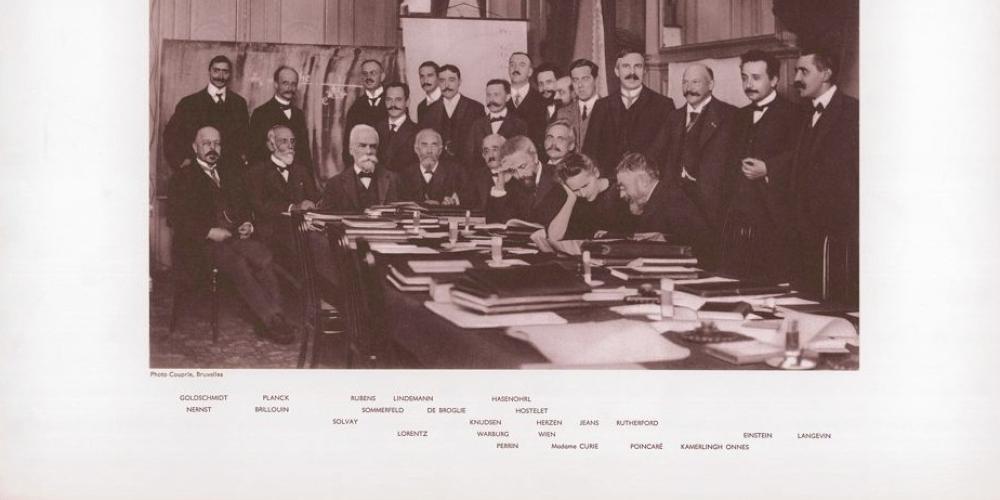


On 22 October, dozens of the world's leading scientists will gather in Brussels for the 30th Solvay Conference. Every three years, the International Solvay Institutes bring together leading figures in physics, chemistry and biology, in turn, to debate the most pressing questions in their respective fields. VUB professor Alexander Sevrin is Vice-President of the Solvay Institutes and Scientific Secretary of the Solvay Physics Committee, which is organising this year's conference. “This will be a particularly special conference, especially for me. The theme is right at the heart of my own field of research: gravitational waves.”
How does such a prestigious conference work?
“The Solvay Conferences are unique. The scientists, all leading experts in their fields, sit together around one large table. Participation is strictly by personal invitation. Around them sit the auditors, scientists who are allowed to follow the discussions but not take part in them. Even that is a tremendous honour.
This year, the conference is devoted entirely to gravitational waves. The subject has been divided into five major questions, with half a day dedicated to each. Every session is chaired by a distinguished scientist who guides the discussion.
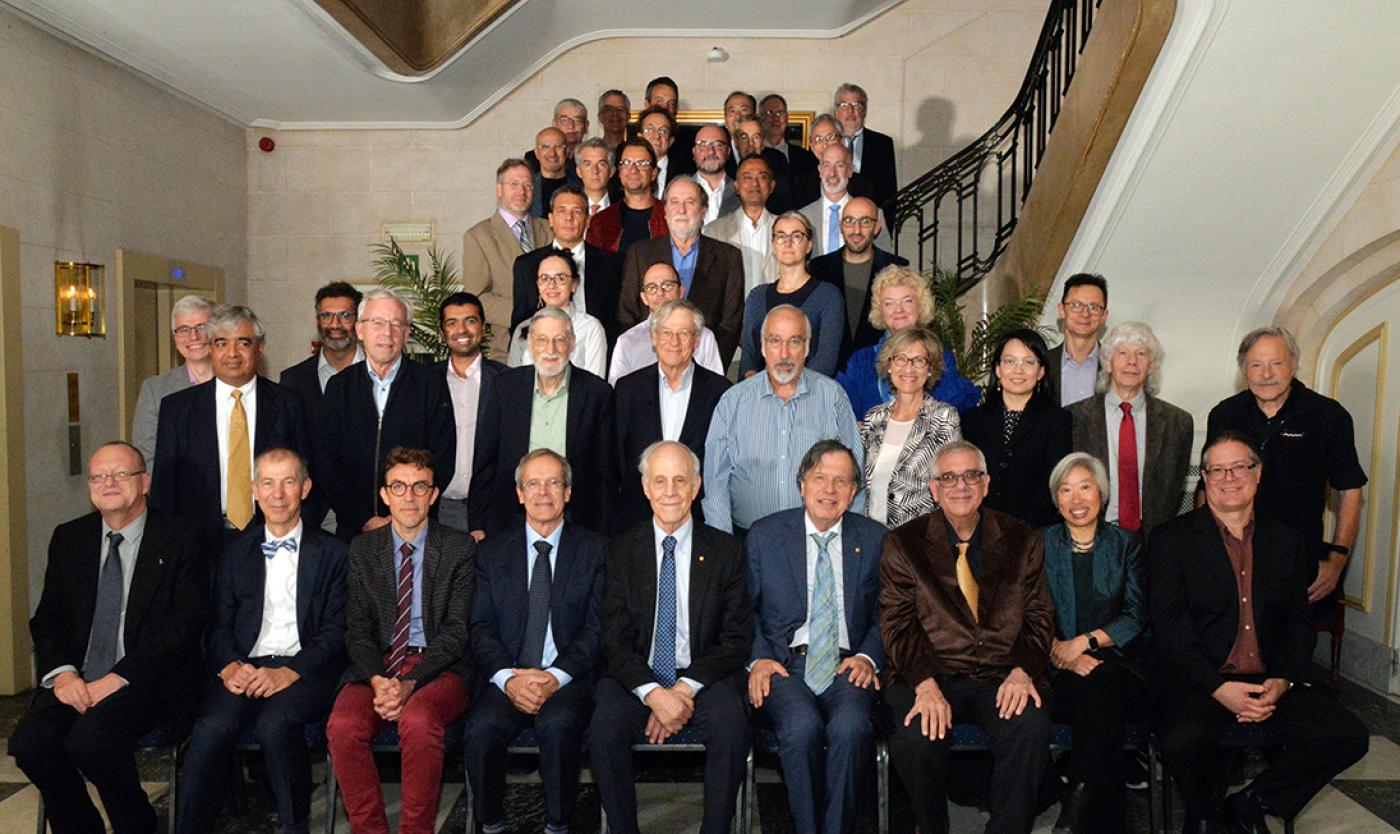
What makes Solvay special is what doesn't happen. There are no presentations, no PowerPoint slides and no lengthy introductions. The conference is entirely about discussion.
When the first conference took place in 1911, there were around twenty participants. Today, there are between forty and forty-five. Of course, the number of scientists worldwide has grown exponentially. That's why we now have screens positioned in the middle of the table, so everyone can follow the speakers clearly.”
“I have overall responsibility for the proceedings, the official record of the conference. The Solvay Institutes also take care of all the practical arrangements, from audiovisual support to technical infrastructure. This means I get a front-row seat at the conference.”
How did you become involved with the Solvay Conferences?
“Following the death of Ilya Prigogine in 2003, the future of the Solvay Institutes was uncertain. A committee was therefore established, with VUB's renowned scientist Irina Veretennicoff and former ULB rector André Jaumotte among those leading it. The distinguished Belgian physicist Marc Henneaux was entrusted with modernising and revitalising the institution. Thanks in no small part to the moral and financial support of the Solvay family, VUB and ULB, this was achieved in a remarkably short time. I was involved in this endeavour from the very beginning.
Since then, we have expanded our activities considerably. Alongside the conferences, we now organise international research chairs, workshops and public lectures. The Institutes have grown into an exceptionally dynamic institution with a worldwide reputation.”
What makes this edition special?
“Every Solvay Conference is special in its own way. But this one has particular significance for me because it focuses on gravitational waves. These were first detected only in 2015 and are now one of the fastest-growing areas of research in physics. We're also at a turning point. Projects such as the Einstein Telescope are ushering in a new era of research. That makes this the ideal moment to reflect on the major questions that remain unanswered.”
Can someone without a scientific background follow the public lectures by Kip Thorne and Claudia de Rham, which are already fully booked?
“Absolutely. That's precisely why we launched these lectures in 2004. We want to make science accessible to a wider audience by giving people the opportunity to hear directly from the world's very best scientists. With Kip Thorne and Claudia de Rham, we're once again welcoming two truly outstanding figures this year. Thorne is not only a Nobel Prize laureate but also a brilliant storyteller. Lectures like these often offer surprising insights and fascinating stories.
The lectures will be followed by a panel discussion featuring leading researchers. It will be moderated by theoretical physicist and Nobel Prize laureate David Gross, who chairs our International Scientific Committee for Physics.”
Will there be scientists around the table this year who might one day become as famous as Einstein or Curie?
“That's impossible to predict, of course. But I'm sure some of the great names of the future will be among them. Take the 2011 conference, for example. Around ten Nobel Prize laureates were already among the participants. Since then, several others who attended have also gone on to win the Nobel Prize. In that sense, Solvay is often a good indicator of future Nobel Prize winners. Once again this year, there will be researchers around the table whose work many consider worthy of a Nobel Prize.”
What will you be doing during the conference?
“Mostly enjoying myself, while keeping an eye on things at the same time. I'll be making sure everything runs smoothly, both organisationally and technically. But the best part is being able to experience the discussions up close. By now, I know many of the participants personally, and it's always special to see them gathered here again. And, of course, there's the science itself. Spending hours listening to the world's finest physicists debating with one another is a privilege that never loses its appeal.”
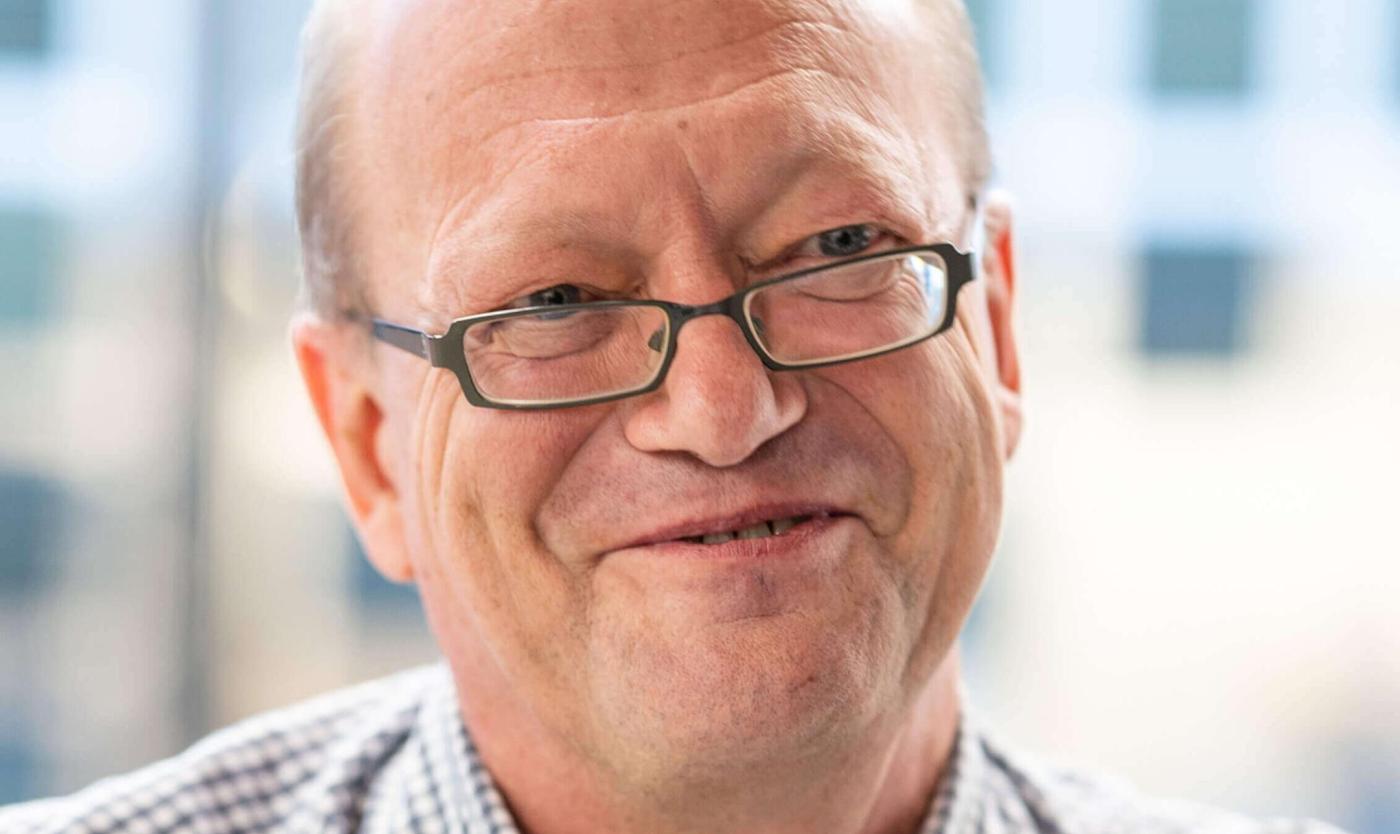
Alexander Sevrin
From Einstein to the present day: the Solvay Conferences
For more than a century, Brussels has brought together some of the greatest scientific minds in the world. Founded by Belgian industrialist Ernest Solvay, the Solvay Conferences rank among the most prestigious scientific gatherings in history. What began as an experiment in 1911 has evolved into a meeting place that has helped shape the future of science.
1911: the beginning of a scientific revolution
At the very first Solvay Conference, legendary figures such as Albert Einstein, Marie Curie, Ernest Rutherford and Max Planck gathered around the same table. Their discussions about radiation, atoms and quanta helped lay the foundations of modern physics.
1927: the most famous photograph in the history of science
The fifth Solvay Conference went down in history thanks to its iconic group photograph, featuring Albert Einstein, Niels Bohr, Marie Curie, Erwin Schrödinger, Werner Heisenberg and many other pioneers. Their debates about the emerging field of quantum mechanics helped shape the way scientists understand reality today.
1933: the dawn of the nuclear age
Shortly after Adolf Hitler came to power in Germany, participants at the seventh Solvay Conference gathered to discuss a new subject: the atomic nucleus. Scientists were beginning to realise that nuclear reactions could release millions of times more energy than chemical reactions. The conference highlighted both the enormous potential of nuclear physics and the dangers it could pose.
1958: exploring the universe
The eleventh Solvay Conference focused on the structure and evolution of the universe. Scientists explored questions that continue to capture our imagination today, including the origins of the universe and the mysterious objects we now know as black holes. Belgian cosmologist Georges Lemaître, the father of the Big Bang theory, played an important role in the conference.
1967: searching for the fundamental building blocks of nature
The fourteenth Solvay Conference focused on elementary particles, the fundamental building blocks of matter. Belgian physicist François Englert, then a professor at ULB, also contributed to the discussions that would ultimately lead to the Standard Model of particle physics. In 2013, he was awarded the Nobel Prize in Physics for his work.