

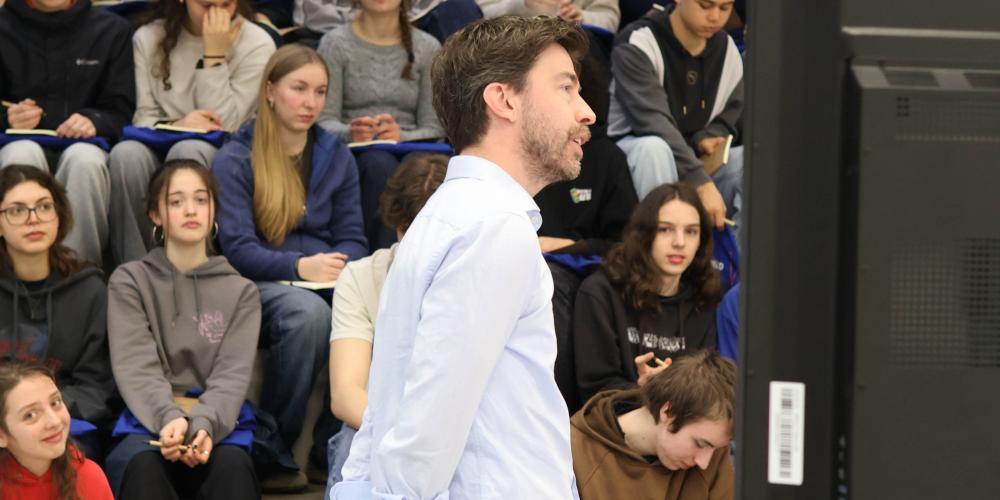


Last Tuesday, VUB professor Vincent Ginis kicked off the VUB School Tour 2026 with a guest lecture on AI. Over the coming months, around 60 of these sessions will take place, with VUB professors and student representatives joining forces to give lessons in secondary school classrooms. The aim is to introduce approximately 2,500 secondary school students to campus life, the challenges of university studies and the opportunities offered by higher education.
This was not exactly the kind of slide the 70 final-year students from Go! Atheneum Comenius in Koekelberg had expected to see when they sat down for a guest lecture on AI. But for VUB professor Vincent Ginis, it conveys one of the most important messages he wants to share with them: “You are currently developing all kinds of skills, and AI can help you with that. But don't use it to do the very things you are still learning to do yourself.”
Before Vincent began his presentation, student representative Hakima Markab had already shared some insights into university life – and more specifically, life at the VUB. She graduated earlier this year with a master's degree in Political Science, and her eyes light up as she looks back on the special graduation ceremony at the VUB: the iconic Graduation Ceremony at Brussels' Grand Place. Her tone becomes considerably more serious when she explains the differences between studying at secondary school and at university. When she starts talking about study credits and the infamous 'hard cut-off' system, quite a few eyebrows are raised. Fortunately, however, there is the prospect of three months of holidays after the June exams. “Enjoy it, because this might be the last time you get such a long summer break!”, she concludes.
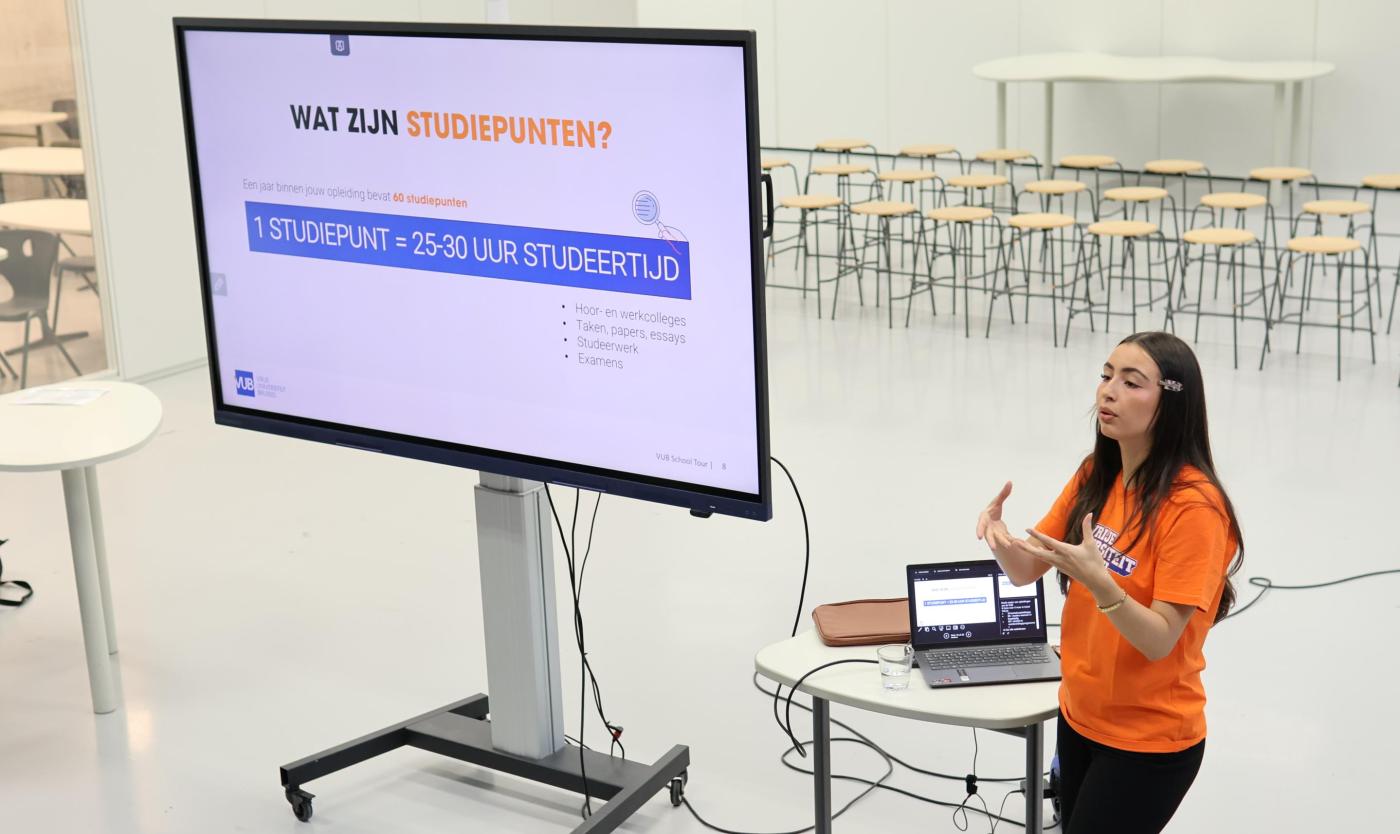
Student representative Hakima Markab
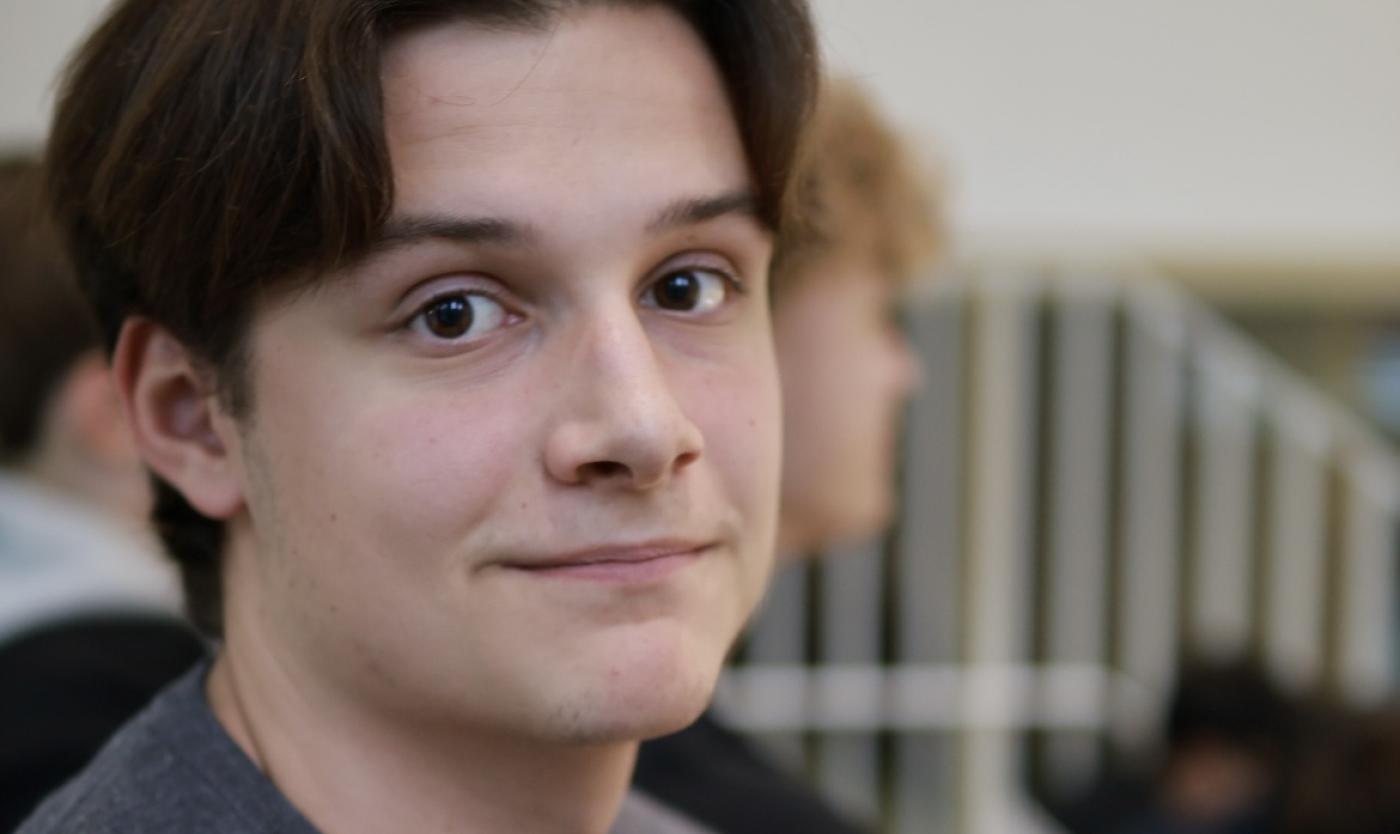
Marcel
Marcel, one of the students at Atheneum Comenius, has heard it all before, and it is gradually starting to have an effect. “I want to become a civil engineer, and initially I only had TU Delft and KU Leuven on my shortlist. But by now, the VUB also seems like an interesting option. I definitely think university studies are worthwhile, and I think most of my classmates feel the same way. We're studying Science and Mathematics, which might have something to do with that…”
Quiz
For most of Vincent's lecture, the students listen attentively, with concentration and in silence, to what the professor has to say. Most of them diligently take notes in the notebooks they received just before the lecture. Some seem to be dreaming about all the things they could do with AI, but most are actually quite critical. In general, they are rather wary of this new technology, which contrasts sharply with Vincent's enthusiasm. “This is an incredibly exciting time for people your age,” he tells them. “I'm extremely jealous of you. The most exciting thing happening online when I was your age was the launch of Wikipedia.”
“No one takes a scooter to the gym”
The remark is typical of Vincent's style: his presentation is packed with interesting and entertaining anecdotes and is highly interactive. He regularly asks the students questions or invites them to take part in a little quiz. “When do you think an AI model will win a gold medal at an international Mathematics Olympiad?”, he asks, for example. When it turns out that the answer is “last year”, many of the students are left open-mouthed.
His story about Paul Cunningham, who managed to find a treatment for his terminally ill dog with the help of AI, brings the entire room to silence. A clever move: in the final part of his guest lecture, when some of the students are beginning to struggle to maintain their concentration, he focuses specifically on what AI means for the young people in the room, how best to use it and what they should watch out for.
This is where the slide featuring the scooter and the gym makes its appearance, followed by some practical study advice: don't shy away from AI. Apparently, many final-year students are keen to avoid study programmes that are likely to be significantly affected by AI. “You can look at it the other way around,” says Ginis. “Look specifically for a field in which you can make a difference, make progress and push boundaries by using AI.”
Sceptical
Those words certainly made an impression on Merel, one of the other students who attended the guest lecture and who spent almost the entire session diligently taking notes. “I learned an enormous amount from this,” she says afterwards. “I think it's also necessary, because we can already see the impact AI is having on schools, the workplace and even society as a whole. Learning how to work with it is going to be really important, in my opinion. I don't think many teachers have given this enough thought yet either.”
Vincent himself is quite pleased with the students' reactions afterwards. “What surprised me somewhat was how little hesitation they showed when talking about their use of AI. I also thought it was great to see that they are quite critical, while remaining open to arguments. I do feel that some of them may now think about AI in a different way.”
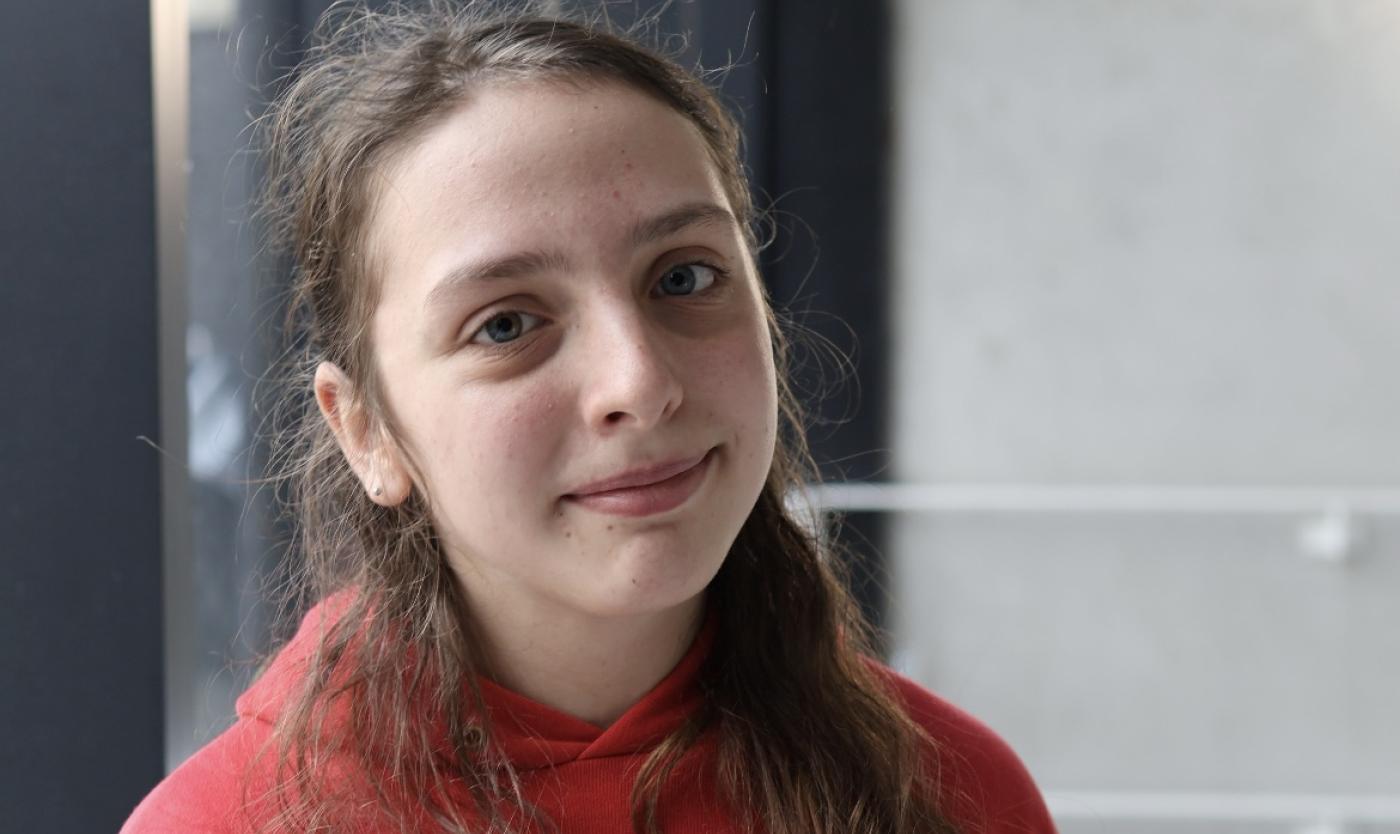
Merel
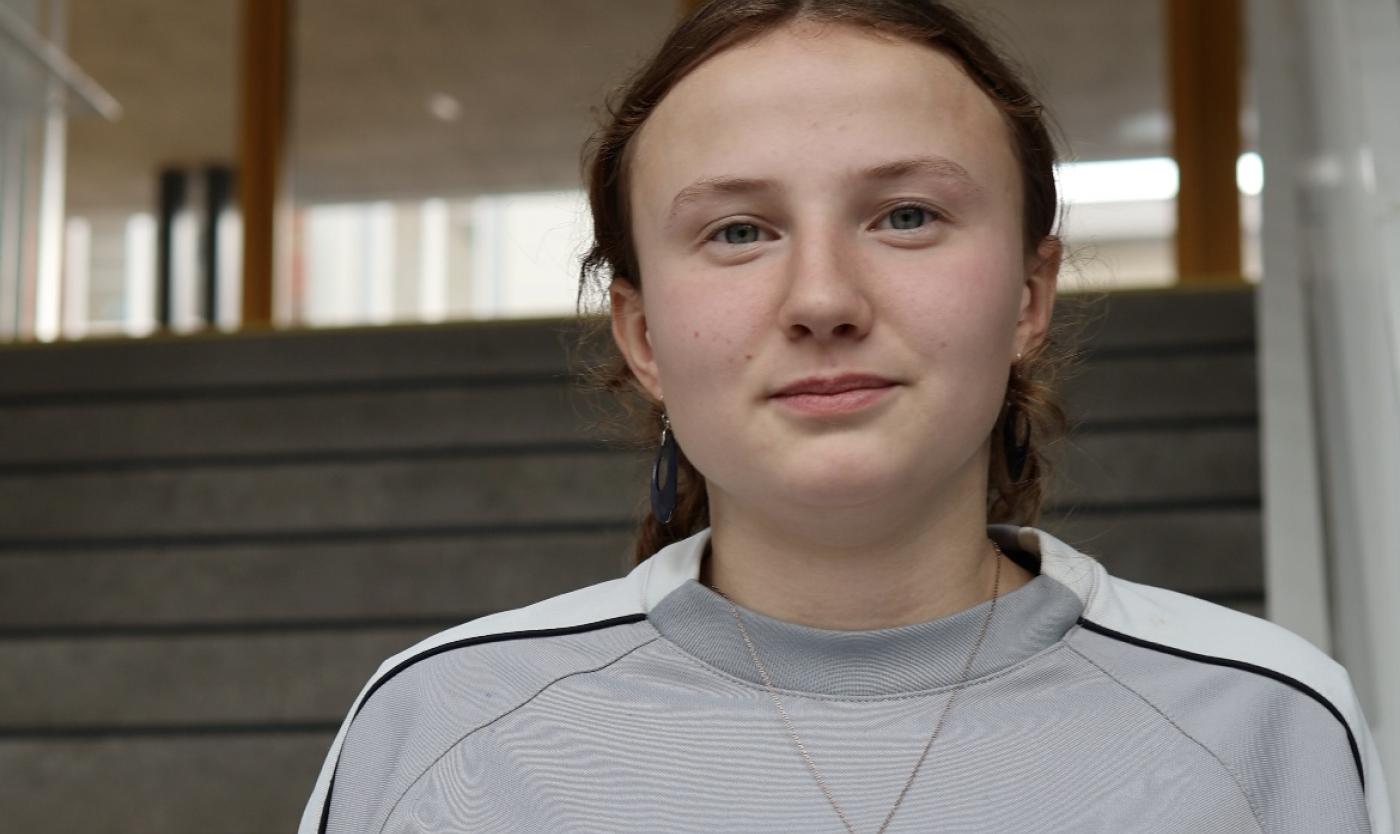
Zelda
Zelda, the last student to leave the lecture hall, nevertheless remains concerned about the consequences of AI after the guest lecture. “I learned a lot today, but I think we need to be even more critical. Sometimes I get the impression that we are being brainwashed in this respect. AI is being presented as some kind of miracle solution to all our problems. Fortunately, this guest lecture did pay some attention to the negative aspects, but personally, I wasn't really satisfied with the professor's answer to the question about AI's environmental impact.”
After this school year, Zelda wants to study psychology or educational sciences, but she hasn't decided where yet. Following the student representative's explanation, the VUB is certainly an option. With her critical mindset, she will undoubtedly feel right at home there.
Would you also like to offer a guest lecture by a VUB professor to the final-year students at your school?
Then sign up quickly via this link: VUB School Tour 2026-2027 – Vrije Universiteit Brussel. The schools that the VUB School Tour will visit over the coming months have already been confirmed, but you can still register for the February–April 2027 period.