

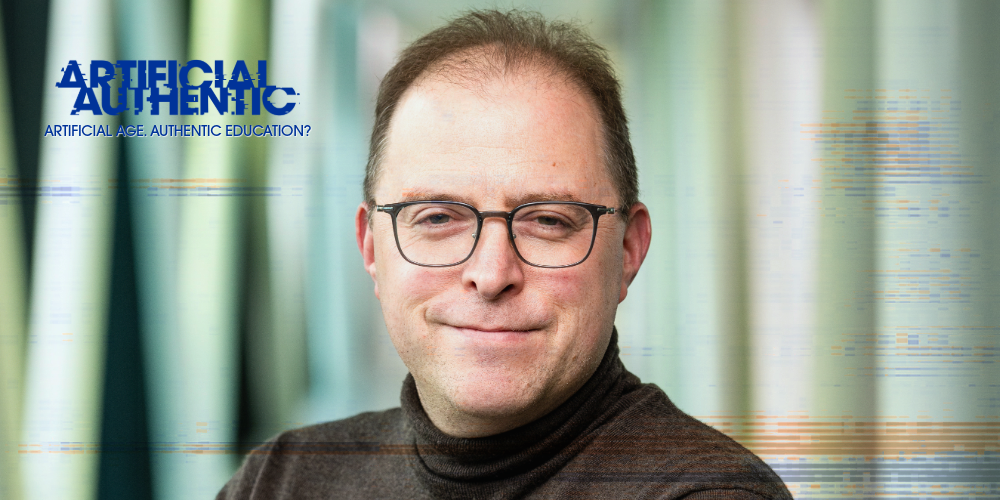


Does the world still need doctors? “AI will increasingly automate routine tasks and support doctors in complex decisions,” says Prof. Dr Mark De Ridder, CEO of UZ Brussel and professor at VUB. “But the more powerful the technology becomes, the more important it is for doctors to critically assess information, translate it to the unique patient, and take responsibility for that decision themselves.”
Article series
AI is changing work. How is it changing education?
Artificial intelligence will fundamentally change the way we work. But what does that mean for students who are building their careers today? In this series, VUB professors explain how AI is affecting their field, which competencies will become important in the future, and how degree programmes are adapting to a labour market in full transition.
What does AI mean for medicine at a macro level? Where are the major breakthroughs and benefits?
Mark De Ridder: “AI is actually used today as an umbrella term, but you have to distinguish between two major things. On the one hand, you have large language models, such as the ChatGPTs and Claudes of this world, which help us analyse information, search the literature and automate routine tasks. On the other hand, you have machine learning: algorithms that can help us predict what might happen to a patient. For example, you can load all the clinical parameters from an electronic patient record to predict whether someone will develop pneumonia or thrombosis during a hospital stay. Or you can combine genetic data and radiological images to determine which treatment is most appropriate. In this way, AI can not only automate tasks, but also support doctors in their decision-making.”
“AI can not only automate tasks, but also support doctors in their decision-making”
What changes concretely for doctors? Which tasks are being taken over?
“Routine tasks will increasingly be automated. Think of administrative tasks, literature research or preparing reports. AI can also take a lot of work off doctors’ hands during a consultation: structuring information, preparing a prescription or scheduling an appointment. But that is precisely where an interesting paradox arises: the more intelligent the technology becomes, the more important the human qualities of the doctor become. An algorithm can, for example, calculate which cancer treatment statistically offers the greatest chance of success. But that does not mean the medical decision has been made. Is that treatment appropriate for this patient? Given their age, life expectancy, values and wishes? What level of toxicity is acceptable to them? As a doctor, you must not only process information, but also give it the correct meaning. And ultimately, responsibility remains with the doctor. AI can advise, warn, suggest alternatives and help us become better doctors, but we cannot outsource responsibility for the patient to an algorithm.”
“AI can help us become better doctors, but we cannot outsource responsibility for the patient to an algorithm”
How does this change the doctor-patient relationship?
“For years, there were two chairs in the consultation room: one for the doctor and one for the patient. Today, a third chair is, as it were, being added. AI sits between the two. That third chair works both ways. Before the consultation, the patient will already look up information and ask AI what their symptoms might mean or what treatment might be possible. In the past, there was a large information gap between doctor and patient. That gap is becoming smaller. But doctors will also use AI to make administration and information processing, for example, faster. Today, a doctor is still often looking at their screen or at papers. AI could ensure that they have more time to talk to the patient and look them in the eye. To see whether someone is struggling, whether a tear appears, or whether there is a moment of silence. As a doctor, you have to take that information into account in your decision.”
Which skills will therefore become more important for doctors?
“We need to make a shift in our education from acquiring knowledge to learning how to deal critically with knowledge, especially when it is provided to us by AI. When I graduated in 1998, a disease would sometimes be covered on one page. For my daughter, who will graduate in 2027, it takes several pages. We cannot keep trying to give students more knowledge than AI. That does not mean knowledge becomes unimportant. On the contrary. Basic knowledge and readily accessible knowledge must be immediately usable. If someone suddenly needs to be resuscitated outside the hospital, you cannot first ask AI what you need to do. In other cases, for example complex cancer treatments that can change every six months, it is much more important for a student to know where to find up-to-date information, how reliable that source is and how to apply that knowledge. And once again, the human aspect is important here. When you tell a patient that they have cancer, you have to see how that message is received. Sometimes you need to explain further, sometimes use different words, and sometimes simply remain silent.”
Are there also dangers associated with AI in medicine?
“The greatest danger is that people will blindly believe AI and fail to approach it critically. AI can still make mistakes, confabulate or discriminate. A study on a treatment involving Europeans or Chinese people, for example, cannot simply be extrapolated to another population. A doctor therefore needs to be able to assess what AI can and cannot do. The question is not whether we will use AI, but how. We must avoid becoming complacent and continue to ask ourselves at all times: is this correct, has the quality been checked, and have our students been sufficiently trained to deal with it?”
Can you give a concrete example where AI is already making a difference today?
“A very concrete example is radiosurgery for brain tumours. There, you need to direct a very high dose of radiation at the tumour while sparing the brain and other critical structures as much as possible. Today, we use an AI-driven system for this. A treatment that previously required three to four hours of preparation can now be planned in half an hour. Moreover, the quality is much more consistent. The doctor and physicist mainly have to interpret whether the result is good. AI can also help automatically delineate anatomical structures, with a high degree of accuracy. If you compare the results, you sometimes see that AI corresponds more closely with the different doctors than those doctors do with one another.”
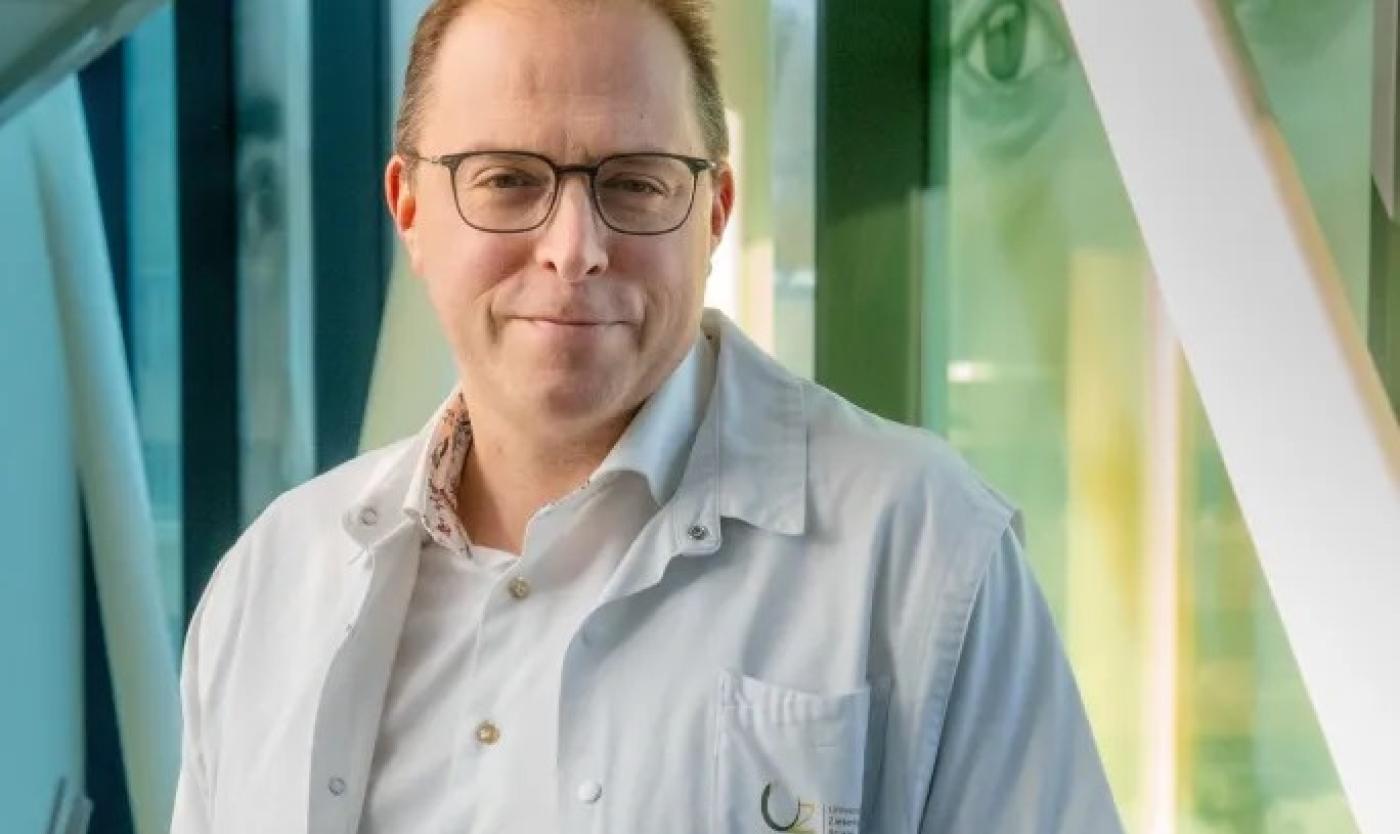
“We should not train students to avoid AI, but to work with it critically and responsibly”
What role does UZ Brussel play in this?“UZ Brussel really wants to play a pioneering technological role. Within radiotherapy, for example, we work closely with Brainlab as an alpha and beta centre. We implement new technology, provide feedback and optimise these systems together with the developers.
We also want to further develop this pioneering technological role in other disciplines, such as robotic surgery and imaging. Not because technology is an end in itself, but because it should help us provide patients with more individualised treatment.”
Does medical education also need to adapt?
“Absolutely. We are working on the education of the future. We need to clearly determine again which knowledge is essential and where we mainly need to teach skills. AI must also have a place in this. Today, we already have teaching in which students are given a case and have to look up information themselves. We assess not only the answer, but also the process leading to it: which sources do you use and can you explain why you use them? You should not teach students to fight against AI. You should teach them how to work with it.”
So what will the doctor of the future look like?
“I think of someone with a very good clinical instinct, who can quickly assess what is and is not cause for concern. Someone who keeps up with the times and can work well with AI, while remaining empathetic at the same time. AI may be able to provide 70 to 80 per cent of the available knowledge. But the doctor must be able to say: based on my knowledge, my clinical experience and this patient in front of me, we are nevertheless not going to choose that option. That clinical instinct, that basic knowledge, that intuition and listening must remain. And above all: responsibility for the patient remains with the doctor.”
Bio
Prof. Dr Mark De Ridder has been CEO of UZ Brussel since February 2025. He is also a professor at the Faculty of Medicine and Pharmacy at VUB. He teaches radiotherapy, clinical reasoning and management, among other subjects. His research focuses on the rapid implementation of new scientific and technological developments in patient care, with particular attention to data and AI.
In brief
- AI will both automate routine tasks in medicine and support doctors in diagnosis and decision-making.
- Doctors will remain necessary to interpret AI output and apply it to individual patients.
- AI can strengthen the doctor-patient relationship by speeding up administration and information processing.
- Critical thinking, clinical reasoning, empathy and responsibility will become more important.
- Basic knowledge remains essential, but students must above all learn how to use reliable information and AI responsibly.
- UZ Brussel wants to play a pioneering role in applying new technology to patient care.
Academic opening 2026-2027
How do we prepare young people for a world in which artificial intelligence and technological change are having an ever greater impact? That question lies at the heart of the VUB's Academic Opening on Tuesday 22 September in Aula Q on the Etterbeek campus. Under the theme Artificial Age. Authentic Education?, the university will bring together students, researchers, lecturers, policymakers and societal partners for a debate on the future of education, knowledge and society.
For more information and to register, visit: Academic Opening 2026
Also on 22 September: VUB Kick-Off
This year, the Academic Opening Ceremony and the VUB Kick-Off will take place on the same day at the Etterbeek campus. The Kick-Off is the annual welcome event that marks the start of the new academic year for students. Throughout the day, the campus will come alive with information stands hosted by VUB services, student associations and organisations from across Brussels. Students will have the opportunity to explore the wide range of services and activities available on and around campus, meet fellow students and take part in a variety of activities.