
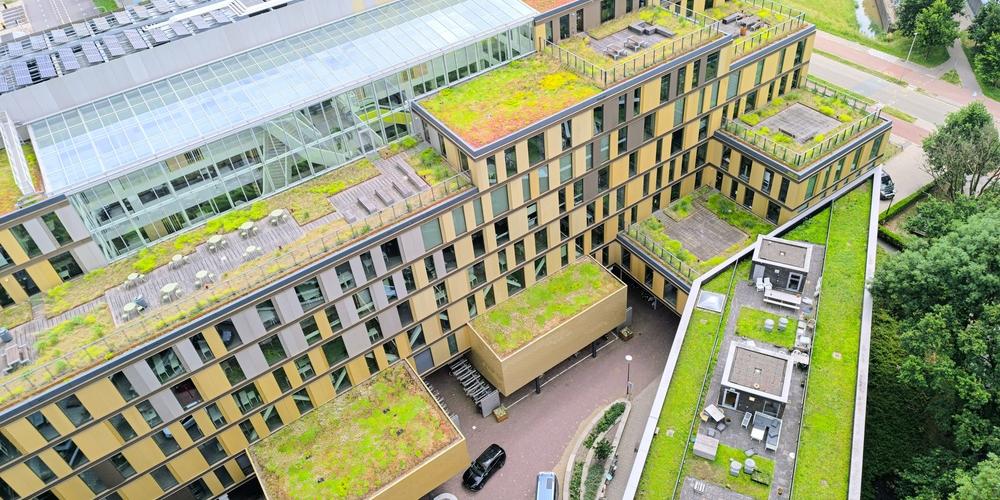


Four scientists from the Flanders Alliance for Climate Technology (FACT) are taking part in Brussels Climate Week. Engineers Maarten Messagie, Johan Stiens, Hubert Rahier and Christof Devriendt will share their expertise on sustainable mobility, innovation and entrepreneurship, climate-resilient cities, and offshore wind energy. FACT brings together more than 500 VUB researchers working on technological solutions to climate challenges.
Maarten Messagie: Technology offers hope for both climate and prosperity
How can we make mobility climate-friendly without sacrificing comfort or prosperity? At VUB, Professor of Sustainability and Renewable Energy Maarten Messagie studies how electric vehicles and batteries can contribute to a sustainable mobility transition.
What message does FACT want to convey during Brussels Climate Week?
Maarten Messagie: “Many people see the effects of climate change, but at the same time wonder whether solutions are really achievable. FACT wants to show that many technological solutions already exist today, and that many more are being developed. The climate transition is not only a challenge, but also an economic opportunity for innovation, industrial renewal and high-quality jobs.”
Why is that message important?
|Maarten Messagie: “We need to move away from the idea that climate policy is mainly about sacrifice. We do not have to choose between prosperity and the climate. The challenge is to develop technologies that make both possible. Researchers, businesses, policymakers and citizens will need to work together and demonstrate new solutions in practice.”
Where do you see this happening in practice?
Maarten Messagie: “At Research Park Zellik, FACT is helping to build a climate-neutral innovation campus. Researchers, businesses, policymakers and citizens work together there on solutions for a low-carbon economy. We do not only want to develop technology, but also make it tangible and demonstrate it so that people can see it works.
Renewable energy, batteries, electric vehicles, heat pumps and other climate technologies are evolving faster than ever. The challenge is to bring these innovations together into one coherent system and deploy them on a large scale.”
What is FACT’s core message?
Maarten Messagie: “The climate transition is not merely a cost or a sacrifice. It is above all an opportunity. An opportunity to create new economic activity, develop high-quality jobs and give Europe a leading role in technological innovation once again.”
Johan Stiens: Spin-offs are crucial to the climate transition
New technology only creates real value when it finds its way into society. At VUB, Professor of Electronics and Information Technology Johan Stiens focuses on sensors, innovation and entrepreneurship, and on bridging the gap between research and societal impact.
Why are you taking part in Brussels Climate Week?
Johan Stiens: “For me, climate change is first and foremost a challenge of system transitions. It is not about one technology or one sector, but about the way energy, industry, cities, nature, health, finance and policy are interconnected. The future lies in ecosystems where all these players work together.”
What change in mindset is needed?
Johan Stiens: “We still too often talk about climate as a problem of scarcity, as if we lack technology, funding or solutions. In reality, we have an enormous amount of knowledge and innovation. The real challenge is how we can translate that into societal impact more quickly.”
What role do spin-offs play?
Johan Stiens: “Spin-offs provide the bridge between research and society. They help bring innovations from the lab into practice, attract investment and scale up technologies. If we want to accelerate the climate transition, we need to invest not only in new knowledge but also in the mechanisms that turn that knowledge into impact.”
Why are spin-offs so important for universities?
Johan Stiens: “Universities are places where bold ideas can grow, often before a market even exists for them. Spin-offs give those ideas the opportunity to develop into solutions for major societal challenges. They also create an entrepreneurial culture that strengthens the entire innovation ecosystem.”
Hubert Rahier: Cooler cities for a warmer world
Hotter summers, prolonged droughts and more intense rainfall are creating new challenges for cities. At VUB, Professor of Materials Science Hubert Rahier studies how sustainable building materials and circular construction methods can contribute to climate-resilient cities.
Can we offer hope to residents of increasingly warmer cities?
Hubert Rahier: “Absolutely. European cities are already actively exchanging knowledge on how to adapt to a changing climate. We still see buildings that absorb large amounts of heat and too little greenery providing natural cooling. Yet there are already many solutions available, ranging from green roofs and green façades to reflective roofs, light-coloured façades, sun shading and shutters that keep the sun out. We do not need to reinvent the wheel. Many techniques already exist today and are ready to be implemented on a larger scale.”
What do you hope to achieve during Brussels Climate Week?
Hubert Rahier: “I want to inspire people to design more intelligently and make better use of existing techniques. Sometimes it comes down to simple measures such as keeping sunlight out more effectively. We also need to be far more conscious about materials. The more we can reuse, the fewer raw materials we need and the lower our CO₂ emissions will be.”
Do cities such as Brussels need to be completely reinvented?
Hubert Rahier: “Not necessarily. We can already achieve a great deal through relatively limited interventions. Larger redevelopment projects allow us to go even further. In doing so, we need to consider not only heat, but also drought, heavy rainfall and the growing electrification of our society.”
Where do you see opportunities for innovation at VUB?
Hubert Rahier: “The greatest opportunities lie in collaboration across disciplines. Climate and urban development challenges are not only technical. Economic, social and educational aspects also play a role. FACT helps bring that expertise together and create new collaborations.”
What gives you hope for the future?
Hubert Rahier: “That we remain open to new ideas. Innovation sometimes comes from unexpected directions. Researchers are currently exploring how concrete could function not only as a construction material but also as a form of energy storage. Ideas like these show that there are still many possibilities that we are only beginning to discover.”
Christof Devriendt: Making offshore wind farms work smarter
Wind energy plays a key role in the energy transition, but existing wind farms must also be used as efficiently as possible. Professor of Structural Integrity Monitoring Christof Devriendt studies at VUB how offshore wind turbines can be operated longer, more intelligently and more safely through the use of sensors and artificial intelligence.
Why are you taking part in Brussels Climate Week?
Christof Devriendt: “The energy transition is not only about how many new wind turbines we build. It is equally important to operate existing wind farms safely, efficiently and for as long as possible. For more than fifteen years, VUB has been researching how to do this, and through our spin-off 24SEA we are also putting that knowledge into practice.”
What exactly does your research focus on?
Christof Devriendt: “We study how offshore wind turbines actually age. By continuously measuring vibrations, loads and deformations, we gain a much clearer picture of a turbine’s condition. This allows us to estimate its remaining service life more accurately and plan maintenance much more effectively.”
What role does AI play?
Christof Devriendt: “By combining measurement data with physical models and AI, we can monitor the condition of wind turbines more effectively than ever. This helps operators manage installations more intelligently and may enable them to keep turbines in safe operation for longer than originally anticipated.”
What is the next step for VUB?
Christof Devriendt: “We want to make much more active use of monitoring data in the management of entire wind farms. Using a limited set of sensors combined with AI and physical models, we aim to map the condition of a complete wind farm. That information can then be used to optimise turbine operation.”
What do you see as the most important contribution to the energy transition?
Christof Devriendt: “A sustainable energy transition is not only about building new infrastructure. It is also about making smarter use of what is already there. If we can operate existing wind farms for longer, more efficiently and more economically, that makes a direct contribution to affordable and sustainable energy.”
FACT at Brussels Climate Week
Monday 12 October to Thursday 15 October
12 October
• Johan Stiens will speak during Tech & Innovation Day about the multidisciplinary climate challenges posed by data centres and cloud technologies. 2.05–2.10 pm, Ticket Window Hall, Maison de la Poste.
13 October
• Christof Devriendt will discuss the role of offshore energy in the future European energy mix during Energy Day. 3.05–3.10 pm, Ticket Window Hall, Maison de la Poste.
• Maarten Messagie will present on the societal and economic impact of the energy transition. 3.35–3.40 pm, Ticket Window Hall, Maison de la Poste.
15 October
• Hubert Rahier will moderate a session on housing and the built environment during Urban Day. 12.15–1.00 pm, Ticket Window Hall, Maison de la Poste.
Throughout the week
• Visit FACT and VUB at stand 3G in the Gare Maritime. From 12 to 15 October, daily from 9.00 am to 5.30 pm.