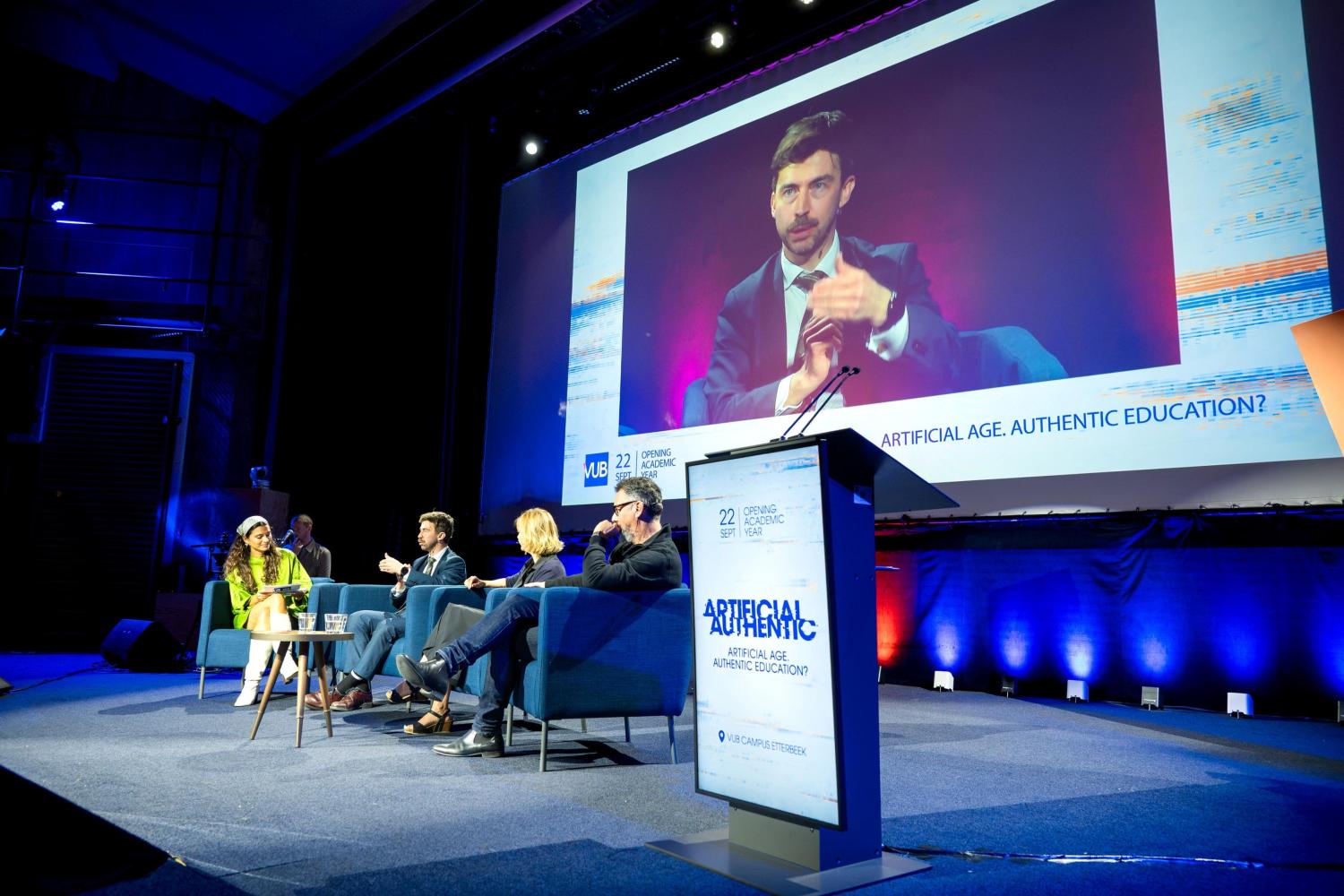
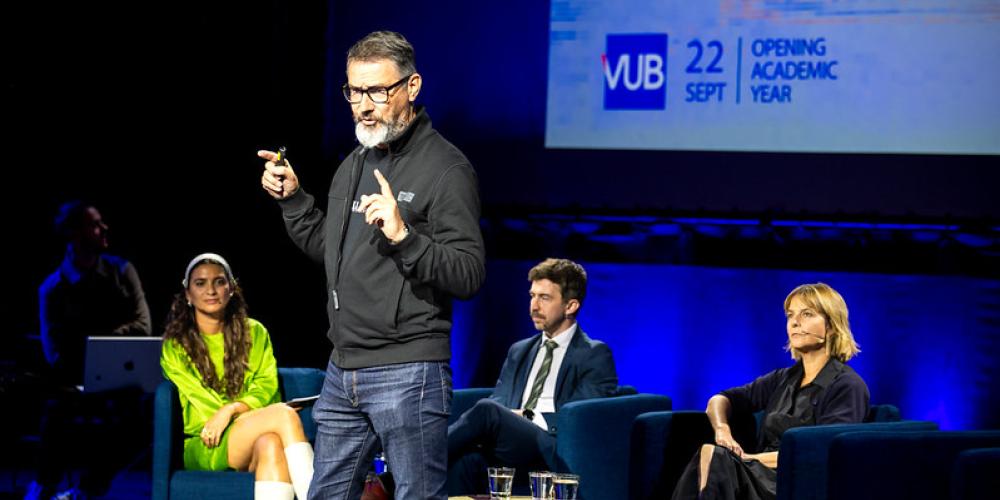


Aula Q served as the venue for a debate on AI during the Academic Opening of Vrije Universiteit Brussel. Panellists Jo Caudron, Vincent Ginis and Cathy Macharis reflected on whether Europe can hold its own in the age of artificial intelligence. Apocalyptic scenarios were not on the table, but there was a strong emphasis on taking control of the technology ourselves. The key question was: what do we as a society want from this runaway technology?
“Europe must step out of the AI race.” With this broadside, transformation strategist Jo Caudron opened the discussion on AI. Moments earlier, Rector Jan Danckaert had outlined what students at VUB could expect regarding AI. They should become AI-literate, learn to use AI sustainably, be transparent about its use, and ensure that AI does not contribute to inequality among students.
But what kind of world awaits graduates beyond the safe boundaries of the campus? To tackle that question, serial entrepreneur and AI guru Jo Caudron, AI lead Vincent Ginis and sustainability lead Cathy Macharis took their places in the blue armchairs on stage.
The point Caudron wanted to make during his CEO Walk before the university audience was that Europe should not compete in the race to build the best AI tools, quite simply because it is already too far behind. But there was no need for despair, he reassured the audience: “We don’t need the top models.” Europe, he argued, should pursue a different goal. “It’s about achieving the best societal integration and adaptation. You don’t need the leading-edge applications for that, but the right tools, and they do not necessarily have to be the most advanced ones. In that respect, Europe is actually ahead.”
Did the academic world agree? Once Caudron had settled into his seat alongside the other panellists, the audience was asked: “Is there enough AI talent in Europe?” No fewer than 75 per cent answered yes. Vincent Ginis responded thoughtfully, as befits a professor. “The question is how you define AI talent. Large organisations rely not only on ICT specialists but also on outstanding people from other disciplines: philosophy, psychology and more. The key is asking the right question. For example, how do I train an AI tool to stop simply telling me what I want to hear?”
Cathy Macharis called for a different perspective. “AI is trained on Western, and more specifically American, knowledge and on their way of viewing the world. Yet those worldviews are precisely what have led us into the polycrisis. AI is good at reproducing things from the past, but what we need now are new ideas and imagination to help us out of this crisis, and AI will not provide that. Human creativity and sustainability are essential at this moment. A European AI could integrate those ethical values more effectively.”
Caudron then stressed that the future remains in our own hands. “Will AI make Europe stronger by increasing productivity, or will AI become a job killer that causes production to decline?”
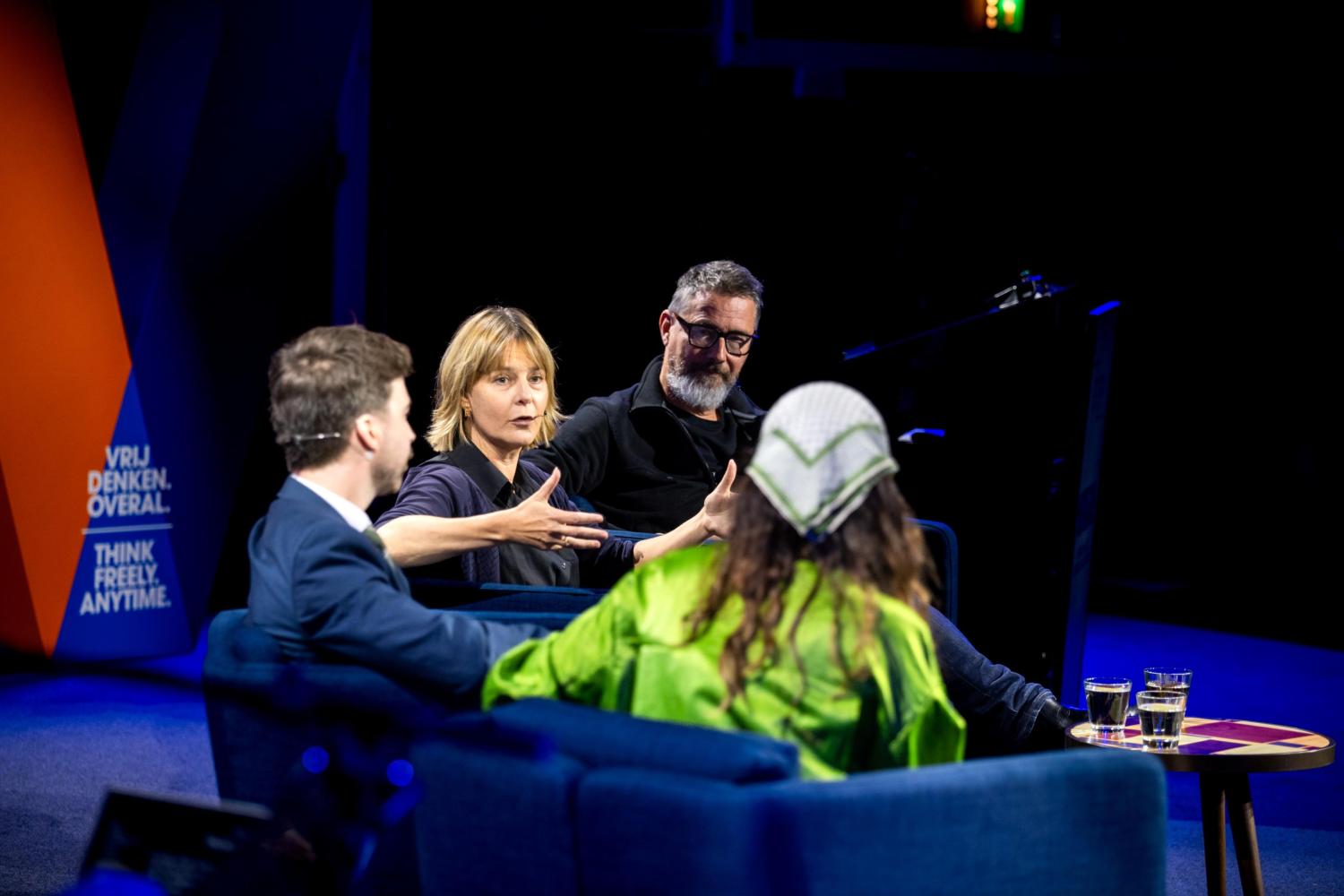
What effect AI has on students’ intelligence was the next topic of discussion. The audience was asked via a QR code whether AI makes students smarter or less intelligent. “Less intelligent,” was the verdict of most people in the room, even though the overwhelming majority were professionally engaged in helping students become smarter. “At the very least, lazier,” Caudron remarked from the stage. His fellow panellist Vincent Ginis, however, remained unshaken. “AI can have a positive impact on the learning process. You should not use it merely as a conduit for knowledge. That gets you nowhere. But if you use it to question yourself in a Socratic way, you can truly master the material. AI can help when you get stuck. Recent research shows that, when applied properly, AI can give you the equivalent of an extra year of learning.” Cathy Macharis wholeheartedly agreed. “This is about skills.” But she expanded on the point. “Let us start from what makes us human, from what distinguishes us from technology: human connection. Let AI be a tool that helps us collaborate and strengthens our physical interactions with one another.”
No respectable university shies away from the great questions of meaning and purpose, and VUB is no exception. “Does AI make us better human beings?” was the final question put to the audience. A quarter of the attendees answered “No”. Caudron was once again the first to respond and expressed sympathy for the scepticism. “We do not know what to expect. Take Neuralink, Elon Musk’s company that wants to connect our brains to AI. Are we ready for that? The pace of change is the problem. Society struggles to keep up. Do we really want to keep pushing ourselves ever faster?”
Cathy Macharis did not answer the question directly, but pointed to the enormous energy consumption of all these accursed tools. “We need to use them responsibly from an ecological perspective. Every prompt consumes energy at the expense of our planet. The emissions are enormous.” It was a particularly uncomfortable point. In the end, however, she did arrive at a verdict on what we at VUB can do: “As a university, we can be the place where students are encouraged to be authentic. We can support them in thinking critically and systemically, in connecting, engaging in dialogue, collaborating, and standing firm in these challenging times. The development of AI should not make us forget that we are human.”
With those words, the panel discussion came to a close and the participants were rewarded with warm applause from the audience. Afterwards, attendees were treated to a reassuring rendition of “You’ve Got a Friend” by guest musician Pieter Schrevens at the Academic Opening, serving as a gentle reminder of what truly matters in life.