

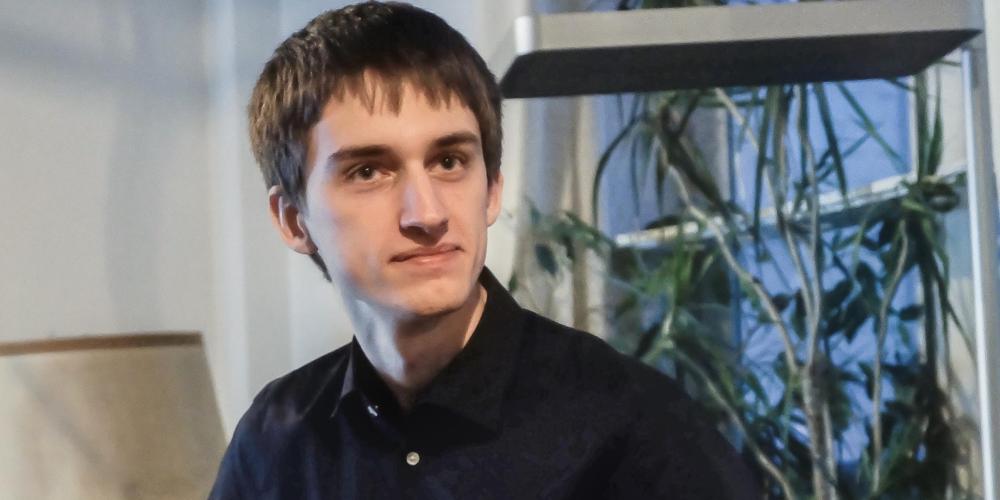


Engineer Bram Huygens (29) recently won the Pavel Jandera Award, an international prize for young researchers who distinguish themselves in chromatography and separation science. It was the latest in a long series of awards that Bram Huygens has collected in a short period of time. What makes a talented scientist such an award magnet, and how does it benefit him professionally? “In my experience, the VUB is not only a springboard, but also a second home.”
Explain it to me: what kind of research allows you to win so many awards?
“My colleagues and I study chromatography, a chemical technology whose cryptic name unfortunately says little about what you can do with it. Scientists from different disciplines use chromatography to analyse complex mixtures. For example, to determine the composition of food, test the purity of medicines, or detect toxins in the environment.
At the VUB, in the group of Professor Gert Desmet, we look at chromatography a little less as chemists and a little more as engineers. How can we make it more efficient? How can we make it more sustainable? How can we analyse even more complex mixtures in the future? I contribute to this through mathematical models and simulations of chromatographic processes. These describe where the technology falls short and where improvements can be made.”
Do you have to be competitive in science?
“I don’t think so, but a healthy dose of ambition can serve as a driving force. The goal can take different forms: contributing to a technological development, solving a complex problem, or sharing insights.
Above all, I think you need to be stubborn enough not to give up when a project runs into difficulties and to keep going until the end. Perhaps stubbornness is one of the most defining characteristics of scientists, much to the delight of the people who live with them.”
How far do your ambitions reach?
“In the long term, I hope to contribute to more than one discipline. As children, we have a thousand and one interests; as scientists, we are forced to make choices between those interests. But science is also far too tempting a buffet to sample only one dish.”
Is the VUB a good springboard for that?
“That is certainly how I experience it. When I studied bioscience engineering here, I came into contact with numerous disciplines and found my way to the Department of Chemical Engineering. Here I can count on the support of an excellent professor, Gert Desmet, and on collaboration with many colleagues. In my experience, the VUB is not only a springboard, but also a second home.”
“And then impostor syndrome kicks in”
How does a good professor guide a young researcher?
“I do not believe there is one universal magic formula for that. But when I look back on how Gert supervised me, I am grateful for the way he stimulated my ambition and interests. By challenging me with different projects and introducing me to other experts both within and beyond the field of chromatography. And by striking a balance between investing sufficient time in supervision on the one hand and allowing enough freedom to explore side paths on the other.”
Not all awards carry the same weight. What does something like a poster award involve, for example?
“Poster presentations at symposia are an opportunity to put young scientists in the spotlight. While professors present their research in detailed lectures, doctoral researchers summarise their work on a poster, using just a few figures and key points. These posters are then evaluated by an academic jury.
For young researchers, a poster award is encouragement from experts in the same field to continue along the path you have chosen.”
And the Pavel Jandera Award you have just received?
“It bears an important name from the field of chromatography: that of the renowned Czech chemist Pavel Jandera. A world authority in chromatography. The value of an award is also determined by its previous winners. The list of recipients of the Csaba Horváth Award includes many names from the field of chromatography whom I admire. The names I circle in the symposium programme booklet, the lectures I do not want to miss. And then impostor syndrome kicks in: how did my name end up on that list?”
Were you already interested in science as a boy?
“Absolutely. My first fascination was astronomy, with a poster of the solar system on the wall of my bedroom. My love of chemistry developed later. But there was also an obsession with mathematics, from the numbers about planets on that poster to the differential equations in the notes now lying on my desk.
My parents, both art historians, have their own obsessions. However, they always encouraged me to be curious. And perhaps curiosity is the one quality that matters even more than stubbornness when it comes to becoming a scientist.”
Awards
Ilya Prigogine Award (2019) – VUB prize for an outstanding master’s dissertation in the sciences.
Third Place Poster Award (2022) – Third prize for the best scientific poster at the international HTC-17 congress on chromatography and separation techniques.
LCGC International Rising Stars of Separation Science Award (2024) – International award for young researchers carrying out exceptional work in separation science, in this case liquid chromatography.
LCGC Science Slam Winner (2024) – Award for the best short and accessible presentation of scientific research during the Science Slam at ISC 2024.
ULB-VUB Syensqo Award for Doctoral Thesis (2024) – Award for an outstanding doctoral thesis by a researcher from VUB or ULB.
2nd Prize Separation Science Slam (2025) – Second prize for the best short and accessible presentation on research in separation science during HPLC 2025, in collaboration with VUB colleagues Kristof Vynckier and Quang-Dong Bui.
Csaba Horváth Young Scientist Award (2025) – Award for the best oral presentation by a young scientist during HPLC 2025.
Pavel Jandera Award (2026) – International award for a young researcher who distinguishes themself in the field of chromatography and separation science.