

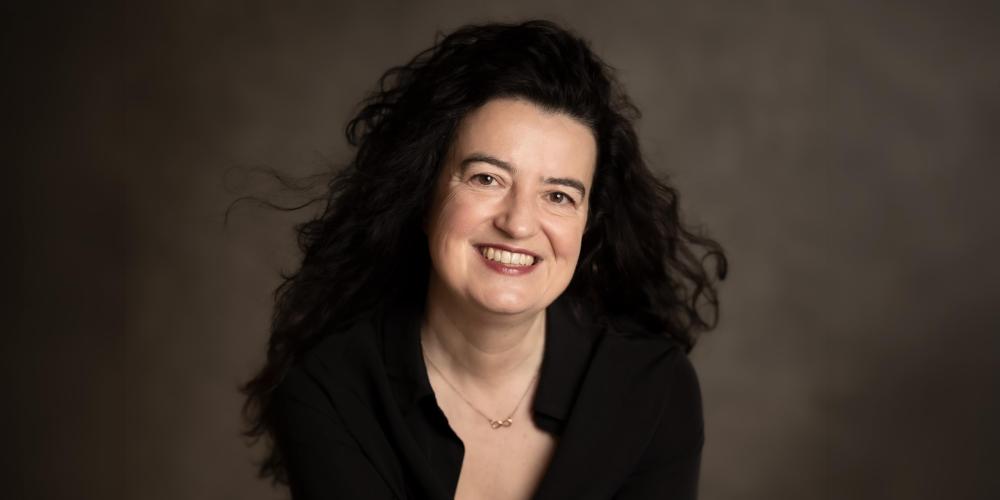


How can we use AI without losing valuable skills ourselves? In her column for De Tijd , mathematician Ann Dooms offers an answer. Use AI to outsource cumbersome tasks, but remain the creator yourself. Then use AI as a critic.
How is AI affecting education, and how should we deal with it? Recently, I invited the Australian mathematician Terence Tao to discuss these questions. His insights, however, extended well beyond education.
Tao began with an intriguing comparison between the impact of today’s technological breakthroughs and that of earlier ones in the Western world. The Industrial Revolution brought railways, international trade and improved agricultural techniques in the 19th century, gradually reducing food shortages. The World Wars slowed progress, but from the 1950s onwards we steadily moved towards the abundance of food we know today. At the same time, the mass production of affordable cars enabled people to travel long distances, and eventually even short ones, with little effort. The result has been an increasingly sedentary and often unhealthy lifestyle, frequently leading to obesity. This helps explain the popularity of fitness centres and influencers promoting exotic diets.
According to Tao, a similar shift is now taking place, but from the physical to the cognitive realm. We are moving from a world in which using our minds was unavoidable to one in which AI can take over much of that work. This cognitive abundance clearly brings many benefits. Large language models can save considerable time by automating data entry and repetitive tasks, writing autonomously and carrying out complex analyses. These systems are steadily becoming more reliable by collaborating with one another and making use of external tools.
An exercise in patience
This creates several risks in education. One widely discussed issue concerns the assessment of a purely written final product. Yet even if we move towards process-based assessment and oral examinations, there remains the danger of what Tao calls deskilling: the loss of intellectual skills. And this applies not only to students.
If we continually outsource our thinking, our performance may initially improve. Over time, however, we weaken not only our knowledge and expertise but also the essential underlying skills that support them. When solving a problem independently, we often get lost along the way, yet gradually discover what matters through constant judgement, perseverance and experience. If AI removes those efforts, we risk losing our capacity for judgement, our ability to cope with failure and our patience. Eventually, we may become unable even to begin a cognitive task without assistance, thereby unlearning the ability to learn. Solutions may also become less creative and less diverse, as all models tend to generate similar “average” answers.
In addition, today’s language models are highly accommodating and affirming during interactions. We encounter very little disagreement, making us less accustomed to receiving critical feedback and adjusting our views accordingly. Convincing-sounding errors, which still occur, may further undermine our trust in genuine expertise.
For that reason, Tao argues that we should consume AI in much the same way we consume food. Overindulgence is unwise, but an outright ban makes little sense in a society where AI is becoming ubiquitous. He recommends using AI according to the blue team-red team principle from cybersecurity. In this approach, the blue team builds something that the red team then tries to break down. If AI serves as the blue team, a result will likely be produced much faster than if you create it yourself. But you must still be capable of taking on the role of the red team. That is only possible if you can fully evaluate and refine the end product yourself.
A safer approach is to be the blue team yourself, while using AI in a controlled manner to outsource specific cumbersome tasks. In that scenario, you remain the creator, and AI takes on the role of the red team by acting as a critic. According to Tao, this is a more valuable way of using AI and one that minimises deskilling as much as possible.
I am curious to see whether, in a few years’ time, we will witness a shift among influencers. Perhaps the next generation of mathematics students will be the ones promoting enjoyable cognitive exercises and AI diets. A potentially lucrative suggestion for the 18-year-olds currently deciding what to study.