

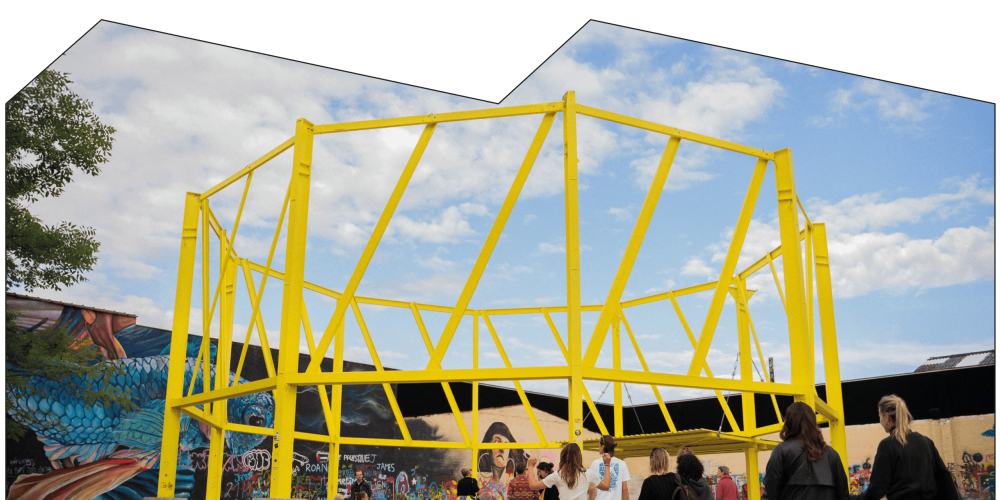


Vilvoorde, 10 November – How can architecture bring people, places and ideas together? This question is at the heart of an architecture workshop organised by bru:tecture, the student association for Architectural Engineering at Vrije Universiteit Brussel (VUB). From 9 to 12 November, students and lecturers are swapping their familiar campus design studios for Asiat Park in Vilvoorde.
This year's architecture workshop is more than an educational activity in an unusual setting. It reflects the shared ambition of VUB and Horst – the cultural platform behind the eponymous arts and music festival and a key partner in the development of Asiat Park – to strengthen their collaboration and create space for research and experimentation on pressing issues such as wellbeing, nature and architecture. Bringing more than 100 students to Vilvoorde, the bru:tecture architecture workshop marks the official launch of this partnership.
Niels De Temmerman, Professor of Circular Design and Construction at VUB, is enthusiastic about the new partnership: “A university does not exist in isolation from its surroundings. We want to actively share our knowledge and expertise with society, while also learning from what happens beyond our campus. A place like Asiat Park allows our students not only to study and design temporary architecture, but also to experience and test it in a real-world setting. In this way, the site becomes a laboratory for ideas and, in a sense, an extension of our campus. It is also fantastic to discover how closely the vision of our Architectural Engineering programme aligns with that of Onkruid Studio: a strong focus on temporary interventions using reclaimed materials and close collaboration between everyone involved. That is why this partnership feels so natural.”
Re:Connect: building bridges, literally and figuratively
Students from the Department of Architectural Engineering Sciences are putting this approach to the test this week. Under the title Re:Connect, they are exploring how to create a crossing towards Darse. Using a small stream as their test site, they will build a prototype bridge to discover first-hand just how challenging such a project can be.
“That is exactly the kind of experimentation we want to encourage here,” says Jochem Daelman, Managing Director of Onkruid, the organisation behind Horst and a partner in the development of Asiat Park. “Over the past year, Asiat Park has really taken shape as a place full of entrepreneurship, nature and social initiatives. But we always want to leave room for experimentation. There is no single right way of doing things at Asiat Park. And that is the blank canvas we are delighted to offer VUB and its students.”
This approach is rooted in the City of Vilvoorde's ambition to transform the former military site into an open space for people to meet, create and experiment, while its long-term future is still being determined. Through this investment, the city aims to give the site renewed significance for Vilvoorde and its residents, even before its permanent purpose has been decided. By welcoming initiatives in culture, entrepreneurship, nature and research, Asiat Park is becoming a place where new ideas can emerge and be put to the test.
The partnership with VUB fits perfectly with this ambition, according to Mayor Jo De Ro, himself a VUB alumnus: “As a former VUB student, I find it particularly rewarding to see the university establish a presence in Vilvoorde. We want Vilvoorde to be a city where new ideas can flourish. Asiat Park offers a unique environment for that: a place where research, creativity and social engagement come together. It is therefore the ideal setting for connecting theory with practice. Here, students have the opportunity to learn, experiment and contribute to a site that is undergoing an exciting transformation. This is a first step towards giving higher education a place in our city. We will do everything we can to encourage more universities and universities of applied sciences to discover Vilvoorde and Asiat Park.”
Further initiatives focusing on mental wellbeing and nature are planned for the coming months. On 10 December, Asiat Park will also host the Islands of Hope conference, featuring educator, author and activist Rob Hopkins as keynote speaker. VUB will bring together leading researchers, civil society organisations and businesses to create new 'Islands of Hope'. It is an ambition that VUB also sees reflected in Asiat Park itself.
Partnership with Horst
The collaboration between VUB and Horst first took shape in 2026 through an academic partnership with Horst Festival. Under the guidance of Niels De Temmerman and his team, Architectural Engineering students developed designs for stages and pavilions at Asiat Park. Drawing inspiration from the site's history and distinctive character, they explored how existing materials could be given a new lease of life. Architecture thus became an exercise not only in design and construction, but also in circularity, adaptability and social engagement.
For Managing Director Jochem Daelman, strengthening VUB's connection with Horst Festival was an obvious next step. “Horst is the main driving force behind the park, giving it a fresh architectural boost every year. By connecting students with this expertise and know-how, they gain direct insight into the processes behind the festival's temporary architecture and how it can be linked to infrastructure that serves the local community throughout the year.”
Students will also take to the stage at the festival's Speaker's Corner, where they will deliver short, thought-provoking speeches on social or political issues, challenging audiences to question their assumptions and consider new perspectives.
All partners see this collaboration as the beginning of a relationship that can continue to grow in the years ahead. By combining the university's expertise with Asiat Park's spirit of experimentation and Horst's cultural energy, they aim to inspire new generations of students and bring research closer to society.