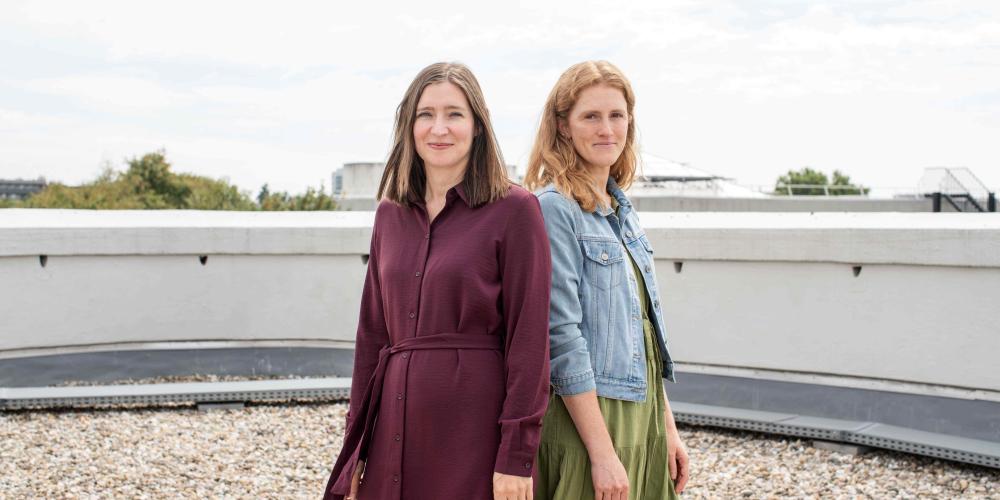


How are you doing at work? Do you feel good in your job, safe and supported by your colleagues and line manager? From 26 October to 15 November, all VUB staff and PhD students will have the opportunity to share their experiences in a new well-being survey. Why is VUB conducting the survey? What about your privacy? And, most importantly, what will happen to the results? Noëmi Verreyen, Well-being Team Coordinator, and Elly Audenaert, Coordinator for Psychosocial Matters and the VUB Report It Helpline, explain.
What do you hope to uncover through this well-being survey?
Noëmi: “Above all, we want to gain a clear picture of how our staff and PhD students are feeling at VUB today, and identify where we need to focus more attention, both across the university as a whole and within individual departments and units. Well-being surveys traditionally draw on the five areas set out in the Belgian Code on Well-being at Work: work organisation, job content, terms and conditions of employment, working conditions and interpersonal relationships at work. Research and our own experience show that well-being is influenced by a wide range of work-related factors. That is why we are conducting a broad survey that also explores psychosocial well-being in depth.”
What do you expect to gain from this joint approach with other universities?
Elly: “We also conducted a well-being survey in 2022, but this is the first time we have joined forces with other universities. This collaborative approach gives us the opportunity to compare our results with those of the Flemish university sector for the first time. Most well-being surveys use the general working population as a benchmark, whereas the university sector has its own distinctive context. This gives us a more relevant point of comparison.”
Noëmi: “Universities can also learn from one another. The survey may reveal differences, but it can also highlight issues that affect several institutions. If multiple universities turn out to be facing the same problem, for example, it could be addressed at the level of the Flemish Interuniversity Council (VLIR) or raised with the government.”

“A great deal of work has gone into developing a strong well-being policy for VUB. What was previously somewhat fragmented has now been brought together in a single vision with clear objectives.”
Elly Audenaert, Coordinator for Psychosocial Matters and the VUB Report It Helpline
What specific VUB priorities are reflected in the survey?
Elly: “In recent years, a great deal of work has gone into developing a strong well-being policy at VUB. What was previously somewhat fragmented has now been brought together in a single vision and policy framework with clear objectives. We are incorporating several key themes from this framework into the survey. This will give us a baseline against which we can assess progress in the years to come.
One important focus is leadership, both in terms of managing others and personal leadership. We also want to continue building a strong feedback culture at VUB. That is why we are asking questions about giving, receiving and asking for feedback.”
Noëmi: “We are also looking at staff onboarding and development, as well as awareness of the well-being support available at VUB. There is a wide range of support services, but we find that not enough people know about them. If something is troubling you, you need to know where to turn.”
How will the survey work in practice?
Elly: “Every VUB staff member and PhD student will receive an email from Pulso, the organisation conducting the survey, containing a personal link to the online questionnaire. Pulso manages this link, not VUB, so we cannot link your answers to you personally. You can complete the questionnaire on your computer, smartphone or tablet. You do not have to finish it in one sitting: you can pause at any time and return to it later.”
Noëmi: “For anyone who needs it, we will provide access to a computer in a quiet space, with additional assistance nearby if required. Completing the questionnaire takes around 15 minutes. A well-being survey gives us a broad overview, but it cannot explore every topic in detail. Where necessary, we will follow up on the findings through focus groups.”
What about privacy?
Elly: “You are being asked by your employer to complete a questionnaire that covers potentially sensitive topics, such as your relationship with your line manager and colleagues or experiences of inappropriate behaviour. You need to be able to trust that your answers cannot be traced back to you. Privacy is extremely important. We noticed concerns about this during the previous survey, so we are taking extra steps to address them this time.
All raw data will remain with Pulso. VUB will only receive results at group level. We will ask for some personal characteristics, such as age, gender and employment status, but these details will never be used to create individual profiles. They are needed to identify patterns across groups. For example, if the results show that a particular age group is experiencing greater difficulties, we can take more targeted action. In addition, VUB will only receive results for a department, faculty or research group if at least 10 people have completed the questionnaire. This ensures that individual responses cannot be identified.”
Noëmi: “We are providing a comprehensive information page that explains as clearly as possible how your data will and will not be used. When the survey opens, you will receive all the information about privacy and data processing again. And, of course, anyone with questions can always contact us.”
What will happen to the results?
Noëmi: “We will share the overall findings across VUB through our internal councils and communication channels. We will then look at the results in more detail and share them with faculties and directorates, giving them insight into the issues affecting their respective units.
The most important thing, of course, is what happens next. We want to maintain and, where possible, strengthen what is working well. Where areas for improvement are identified, we need to take action. Managers can discuss possible approaches with Elly and me, and we will also involve our HR business partners.
The previous survey taught us how important follow-up is. Actions will be monitored in 2027 and 2028, and a shorter follow-up survey will take place in 2028.”
“The results will also be reviewed by faculty and directorate, giving you the opportunity to make a difference in your own working environment.”
Noëmi Verreyen, Well-being Team Coordinator

Why should I take the time to complete the survey?
Elly: “Because it gives you a real opportunity to influence VUB’s well-being policy. You can highlight what is working well, but also where you think change is needed. Once you have completed the survey, you will also receive a personal feedback report providing an overview of your well-being at work. This report is for your eyes only: VUB will not have access to it. It can offer valuable insights and point you towards support services if needed.”
Noëmi: “Making an impact at university-wide level may seem like a big undertaking, but the results will also be reviewed by faculty and directorate. So you have the opportunity to make a difference in your own working environment, too. If we don’t know what people are experiencing, it is difficult to take targeted action.”
What would make the survey a success in your eyes?
Noëmi: “A good response rate is obviously important if we want to draw reliable conclusions. But it is also crucial that the different groups are well represented. If, for example, few PhD students take part, we won’t have a sufficiently clear picture of the issues that specifically affect them. I also hope that some of the concerns raised in the past, particularly around privacy, will be less of an issue this time. That would show that our communication has better addressed people’s questions and needs. And for me, the survey will only truly be a success when staff can see that an issue they have raised has been acknowledged and is on the agenda for action.”
Elly: “I agree. A good response rate is important, but ultimately, the results need to provide a basis for continuing to improve well-being, both within individual departments and across VUB as a whole.”
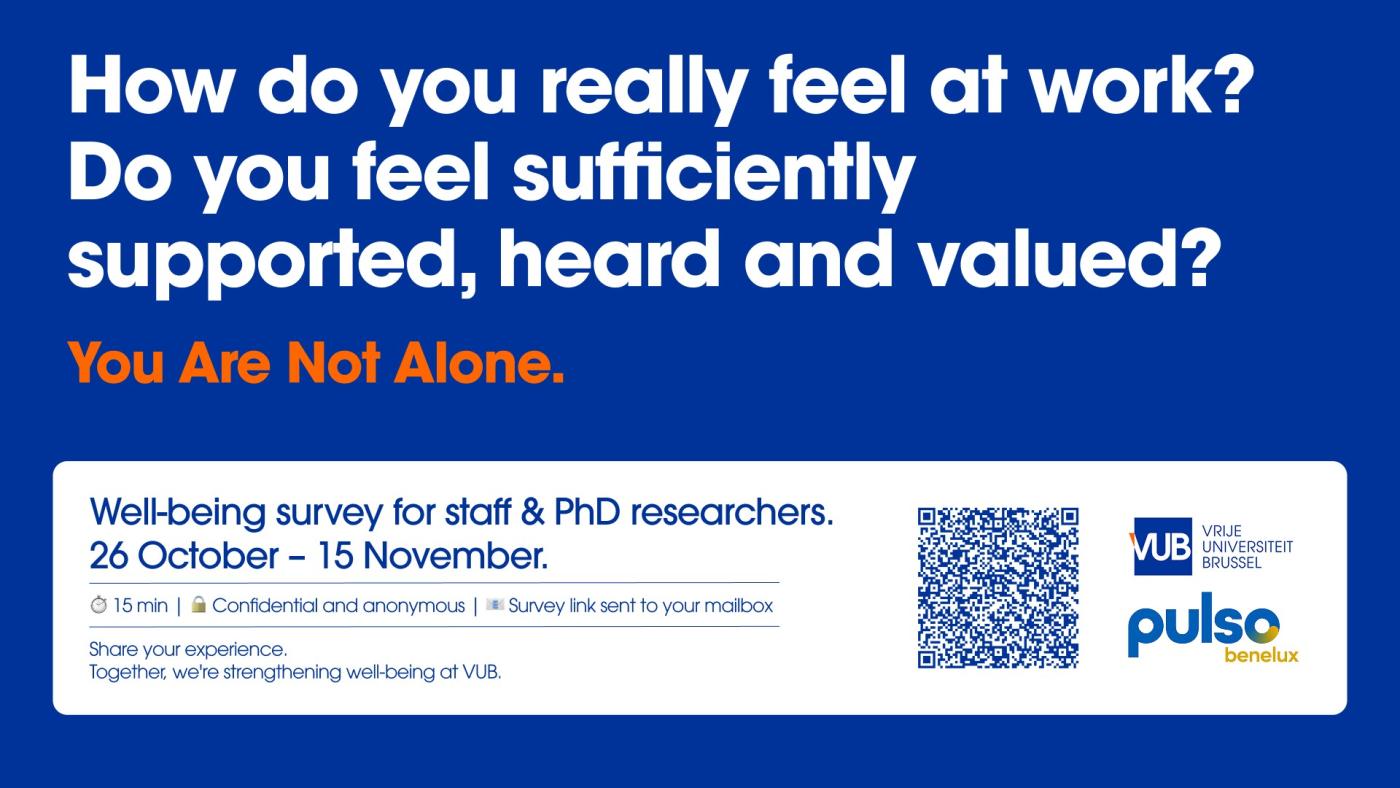
Well-being survey: 26 October to 15 November
From 26 October to 15 November, all VUB staff and PhD students will have the opportunity to share their experiences through our well-being survey. This will help us better understand how staff feel at work and where we can work together to make improvements.
The questionnaire takes around 15 minutes to complete, and responses will be treated confidentially and anonymously. Shortly before the survey opens, you will receive a personal participation link by email from PULSO.
You Are Not Alone
Well-being is about more than feeling good at work. It is also about feeling safe and supported, having room to grow, being heard and looking out for one another.
At VUB, we want caring about well-being to be second nature. Through YANA, we are making our existing psychosocial support services easier to find and access.