

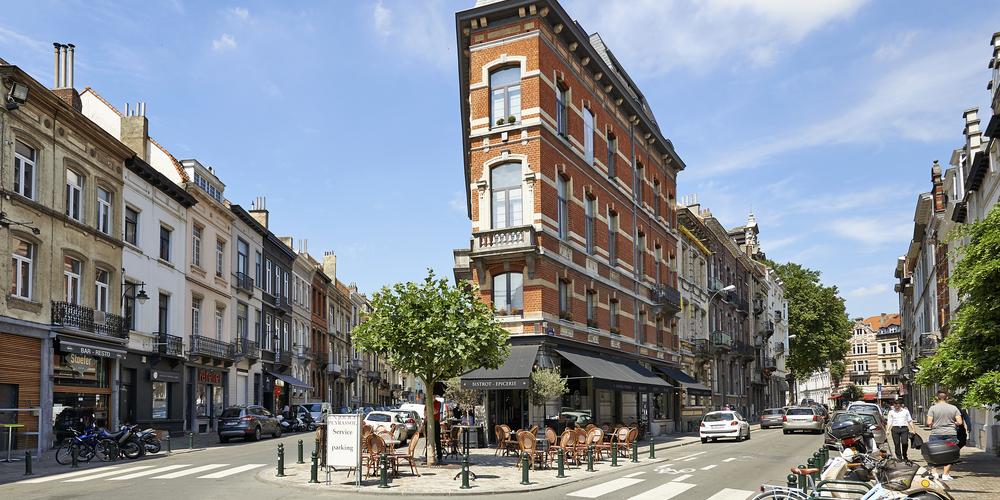


High property prices are pushing plumbers and other essential services ever further out of Brussels, thereby increasing social inequality. VUB researcher Sarah De Boeck sees a solution in government intervention: “If governments use their own property portfolios to provide spaces for consumption and production for the foundational economy, they make the city more liveable.” She received the Mercator Ortelius Prize for her research.
When VUB doctoral researcher Sarah De Boeck began her PhD, she was intrigued by the question of how it is possible that the Brussels-Capital Region, one of the wealthiest regions in the world, nevertheless displays such a high level of social inequality. To understand this, she delved into economics. Gentrification, whereby strong pressure on land results in high property prices, causes the disappearance of affordable space in the city and thereby jeopardises the foundational economy. This foundational economy, consisting of small utility businesses such as plumbers and other tradespeople, is being competed out of the streetscape by the property market and almost literally pushed out of the city, where they seek cheaper accommodation.
“The so-called pushing out of essential services and goods is a metropolitan phenomenon,” says De Boeck. “This property dynamic creates two major problems for cities. On the one hand, productive activities struggle to survive in an increasingly expensive property environment. They are pushed towards other locations, while under pressure from the market-driven dynamics in the property sector they sometimes themselves try to cash in through the sale of their real estate in inner-city areas. These spaces are subsequently bought up by developers, who convert them into more expensive lofts or apartments. The additional effect is that those who are already struggling in the metropolis come under even greater pressure. After all, those basic services are still needed in cities. In Brussels, you can easily pay up to €100 in travel costs to a plumber before they have even prepared a quote. Basic services therefore become considerably more expensive in turn, and part of the population struggles to bear this additional cost, causing inequality to grow. Moreover, it is not only plumbers who find it increasingly difficult, but also cities themselves, which are finding it harder and harder to purchase land, for example to build new schools or other facilities. As a result, public service provision comes under pressure.”
Many major cities have been trying for years to stimulate economic activity in their city centres. To do so, they mainly focus on the creative and innovative sectors. “These are less visible in the streetscape and are much easier to combine with residential functions,” De Boeck explains. “Yet the essential or foundational economy represents a large share of total economic activity. In cities such as London or Brussels, this accounts for 40 to 50 per cent, and these activities require affordable space. By pushing them out of the agglomeration, a whole series of jobs for lower-skilled people disappear, jobs that can be filled by more vulnerable urban residents. The disappearance of those jobs in turn further increases socio-economic inequality.”
“By using their own property assets, governments can buffer market prices”
De Boeck’s research shows that governments can play a significant role in combating this property dynamic.“I argue that governments should assume their responsibility in this matter,” says De Boeck. “Governments can support the economy in different ways. Public property strategies provide a substantial return on investment and ensure that taxpayers’ money returns to the city and its taxpayers, among other things through guaranteed access to essential services and goods. In cities with growing populations and increasing land scarcity, municipalities can use their property assets in the fight against high market prices. By focusing primarily on innovative activities, you reinforce that price effect instead of mitigating it. By deploying their own property assets, governments can buffer prices on the market. Unfortunately, not every government is yet convinced of this. Governments also face complex challenges. The financially precarious situation of many cities often drives them to sell public assets to plug budget gaps. Yet this buffer of affordable space is precisely what is needed to give basic services the opportunity to remain present within the city’s economic ecosystem.”
Because of climate objectives, it can sometimes be difficult for governments to retain their property assets, and they can find themselves in a nightmare scenario when they have to renovate a large property portfolio. Nevertheless, for De Boeck, preserving those assets and using them intelligently and appropriately is the best advice she can offer governments. “When I began my PhD, I thought the urban economy was a highly abstract phenomenon that consumers simply had to accept. Now, after completing my research, I am convinced that we can genuinely influence the economy and inequalities within society. A whole layer of the economy, the essential economy, is closely connected to our daily lives. Food, education, care, public transport and housing: these are areas over which we can exert influence collectively and as a society. Moreover, if governments decide to use their own property portfolios to provide consumption and production spaces for the foundational economy, it will become clear that it makes a major contribution to prosperity and helps make the city more liveable.”
Mercator Ortelius Prize
De Boeck received the Mercator Ortelius Prize for her doctoral research, an award that is granted every three years for research in the fields of economic geography, spatial economics, spatial planning, or urban economics.