

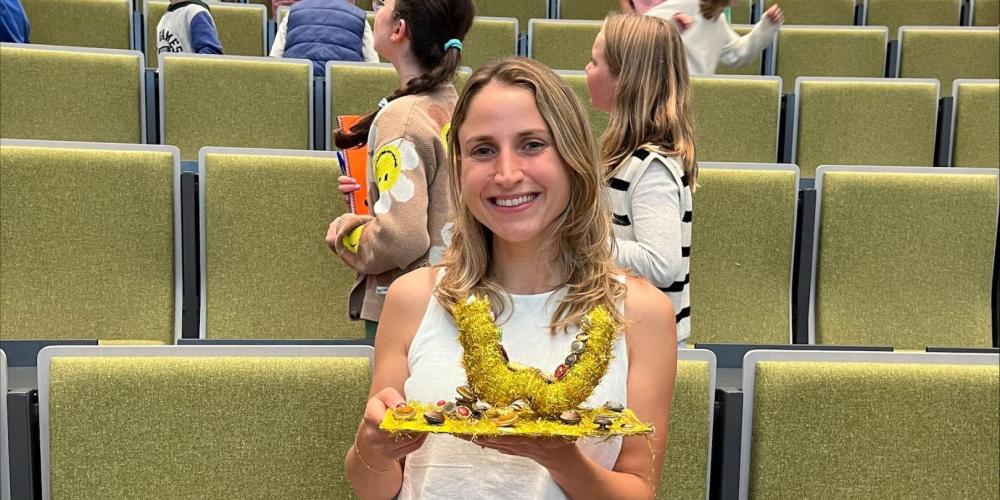


On 2 October, the annual Science Battle took place, an initiative organised by The Floor is Yours. Chronic pain was this year's theme. In the auditorium of AZ Groeninge, 200 children from Kinderland primary school in Kortrijk had gathered, while another 2,000 children of the same age from across Flanders followed the presentations of four young scientists online. VUB researcher Zoë Maebe was one of them and won the award.
PhD student in Health Sciences Zoë Maebe is affiliated with Pain in Motion, an international VUB research group that focuses on pain and lifestyle factors such as exercise, stress, sleep and nutrition. Zoë trained as a physiotherapist and osteopath.
"Within my PhD research, I am looking for the link between sleep and pain. That has of course been studied before, but I investigate how we can influence that pain by improving sleep. Existing sleep therapies are often inaccessible because there are very few therapists and the therapy is expensive. Through our step-up study, we have opted for a low-threshold, stepwise approach. This includes interventions that can also be provided by a physiotherapist. And only if it is really necessary can a patient then follow sleep therapy."
How do you explain that to children?
"In a slightly simpler way, but I also used that stepwise approach. In my presentation, I used the fictional Omi, who is too tired to follow sleep therapy. She has been suffering from back pain for a very long time. Together with the children in the audience, we helped Omi sleep better. I gave the children a few tips, the same ones our physiotherapists give participants during our first sleep therapy session. These are basic tips: do not eat a heavy meal before going to sleep, put your mobile phone away... What we call sleep hygiene."
"It may sound strange, but I really missed science as a child"
Did you find it difficult to make that clear to such a young audience?
"Very difficult. Healthy children aged six to twelve are not really familiar with chronic pain. The difficult thing is that a child questions things very quickly. Something that seems very obvious to us is not necessarily obvious to a child. It was not simply a matter of putting together a PowerPoint presentation. The candidates had to make a video about their presentation themselves, from which the children's jury selected the four speakers. Fortunately, we received a short training session from The Floor is Yours on how to make research accessible. We really had to think carefully several times about how best to present it. After that, there was also a try-out in which you had to present the concept."
Why do you think it is important to explain something like this to children?
"It may sound strange, but I really missed science as a child. We sometimes went to Technopolis with school, but that was about it. When children come into contact with scientists and research at a very early age, it can spark their interest more quickly. And that can only be a good thing for later."
How did the children react?
"Very enthusiastically. In fact, it was thanks to the children that my stress disappeared. My biggest fear was that I would forget my text, because there were no notes to fall back on. But as soon as I started, the children were immediately fully engaged. At the slightest question, all 200 hands would shoot up in the air straight away."
What were the most remarkable questions or reactions you received?
"Because I gave them a sort of exam, they felt like sleep doctors themselves by the end. I really enjoyed seeing their enthusiasm. They became very engaged with a question that seemed quite silly to me, about sweets or fruit before bedtime. The children really got into that discussion. And then I thought, oh, you genuinely enjoy this. I had not expected that at all."
Why do you think you won the battle?
"That is a difficult question, because I thought the others were just as good. From the feedback I received afterwards, what stood out most was the structure of the presentation. Thanks in part to the exam at the end, the children became very involved. I gave them something they could actually take home and use."
What is The Floor is Yours?
A number of science communicators felt that life is too short for boring and unclear presentations. Research can make the world a better place, but many researchers and professionals struggle to communicate their research or project and create impact. Through training, publications and events, The Floor is Yours aims to provide an answer to that challenge.