

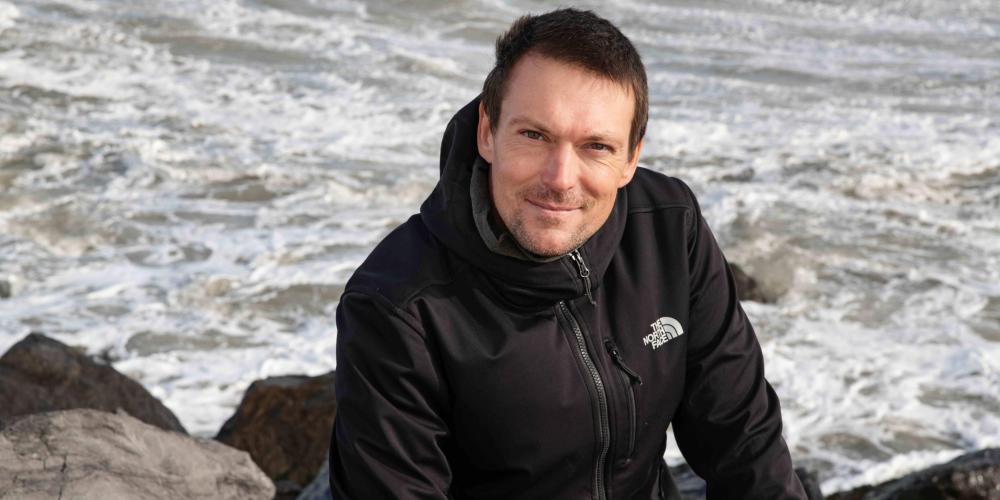


Strengthening ties and creating cross-pollination between the university and the rest of the world: that is the philosophy behind the VUB fellows. Every month, we give a voice to one such fellow. This time, it is Peter Landschützer, marine researcher and Research Director at VLIZ, the Flanders Marine Institute in Ostend. He has been a VUB Fellow since June 4th.
On November 16, the VUB, with OceanConnect XL at VUB aan Zee in Ostend, brings together VUB alumni from marine biology from all over the world to strengthen ties for more international cooperation. That same week, from November 17 to 20, the 7th World Congress on Marine Biodiversity will take place in Bruges. A great opportunity to speak with Peter Landschützer, a specialist in the field and on-site.
You specialize in CO₂ measurements in the ocean via big data and artificial neural networks. How does that work?
"Our team performs in-situ measurements to estimate the total CO₂ uptake of the global ocean. This is difficult because you cannot monitor the ocean 24/7, which creates many data gaps. There are ways to solve this, for example, with satellites. The problem with that is that they cannot measure carbon dioxide in the ocean. Therefore, we use machine learning to link satellite measurements to our in-situ measurements. But because it is machine learning, there is no classical linear regression, meaning there is no straight-line relationship between the variables. Precisely because the algorithm learns so quickly, it becomes a complex relationship. We learn from the comparison between satellite data and available measurements. Once we have insight into this comparison, we can also apply it to places where we have no measurements. In this way, we filter the data gaps and fill them in to estimate the exchange of CO₂ between the air and the sea."
“The ocean helps us with the climate: it absorbs 30% of all the CO₂ we emit”
And how are the oceans doing?
"To be honest, not so well. But there is also a positive side. The ocean helps us by absorbing 30% of all the CO₂ we emit. If that didn't happen, there would be much more CO₂ in the atmosphere and climate change would proceed even faster. That is the positive side. The downside of this story is that the ocean is acidifying precisely because it absorbs carbon dioxide. Carbon dioxide dissolves in seawater and forms carbonic acid, bicarbonate, and carbonate ions, thereby changing the pH of the ocean. And that is obviously not good for organisms."
What is your broader vision for marine research?
"We work in a very small and niche field. There are many excellent scientific modelers worldwide. They create numerical models that result in large reports, such as those from the IPCC (Intergovernmental Panel on Climate Change, the UN organization that evaluates scientific knowledge on climate change). Additionally, there are observers who develop new technologies and new sensors. My research group is located somewhere in between: we try to connect both worlds. It is not strictly modeling, but it is not strictly measuring either. That is where I see my role, not only here at VLIZ, but also on a global scale. Thanks to my work, we can link observations to the models and subsequently compare them. We can test models, check their predictions, and even evaluate their past predictions. Conversely, we can also use the models to check the observations. This way, we can determine where more observations are needed and where the observation system needs to be strengthened."
You mentioned the breakthroughs you have achieved with AI. Are there any risks involved?
"Not the classic AI risks. We work exclusively with open-access data; there is no sensitive data involved. And we do not use generative AI, like those large language models that can create false images or data. We do indeed use machine learning, which is a part of AI, but we work in a closed environment with open-access models and open-access input to create open-access output. In that respect, we cannot be misled by the system."
“The ocean is being chemically treated in such a way that it absorbs more CO₂”
Do you think there will be many opportunities for students in marine biology in the future?
"I do think so, because climate change won't solve itself. We understand the climate system and the response of that system quite well. But there is one aspect that we still barely understand: how climate and biodiversity are connected. There will be many opportunities in that area in the coming time. Because even if we reduce carbon dioxide emissions now, the warming of the planet will continue as long as the concentration of greenhouse gases in the atmosphere rises. In studies, we see an increase in non-native species and a shift in the habitats of species. We need to understand that better, because it has direct consequences for us. There are so many people worldwide dependent on the ocean and on the food it provides."
Can marine biology be part of the climate solution?
“If we managed coasts in such a way that they extract extra carbon dioxide from the air, for example by planting mangroves, it would provide climate gains and perhaps also gains for biodiversity. It might sound somewhat abstract, but our new energy systems can also be part of the climate solution. Think of offshore wind farms with those enormous pillars. For example, algae are already growing on some of them. Some literature suggests that this even has a positive effect on biodiversity and the climate. Naturally, we must test that; these claims are not yet fully substantiated at this moment. There are still alternative scenarios through which we can capture extra carbon dioxide, such as ‘fertilizing’ the ocean with iron to stimulate the growth of phytoplankton. In combination with emission reductions, this allows us to realize negative emissions. Marine biologists play a crucial role in understanding the responses of ecosystems to such scenarios.”
"The second is the removal of carbon dioxide. This happens on land and in the ocean. A well-known example is the alkalinity enhancement of the ocean: we spread finely ground alkaline minerals such as olivine, limestone, or basalt over the ocean surface via ships, or add this to coastlines. The ocean is thus chemically treated so that it absorbs more CO₂. This chemical weathering of rocks is an intensification of a natural effect that naturally enters the ocean via rivers. On a scale of hundreds of thousands to millions of years, this weathering governs the carbon cycle. The idea of alkalinity enhancement is that we do not have to wait so long for it to happen naturally, but do it now, within a few years. But as I said: CO₂ absorption by the ocean leads to acidification and has an impact on ecosystems. While we are doing something positive for the climate by removing carbon dioxide, we often overlook the negative effects on ecosystems. To understand the ecosystem effects of climate interventions, we also need marine biologists."
“I saw the sea for the first time when I was 12”
How did you become a VUB fellow?
"Tom Van der Stocken is a professor of ecology at the VUB. We have collaborated in the past and he nominated me because we highly value each other's work. And since last year, I have also been a lead author at the IPCC. The plan is to intensify our collaboration and meet each other personally at VUB aan Zee. It is an advantage for the VUB to be by the sea if you want to maintain connections with institutes like ours. Thanks to VUB aan Zee, it becomes more logical to work together more closely."
What is your personal connection to the sea?
"A very strange one. I am Austrian, so I come from a land without a coastline. I saw the sea for the first time when I was 12. I never intended to study it: I studied environmental sciences in Graz, very much focused on land and land measurement methods. Later, during my master's, I spent a semester in Bergen, Norway, as part of Erasmus. There were courses about the ocean in the program; I took them and found them so amazing that I decided to stay and write my master's thesis there. I did my doctorate at the University of East Anglia in Norwich. During my PhD research, I traveled on a 130-meter long container ship full of bananas between the Caribbean and Portsmouth in the UK. On that ship, we installed an instrument in the engine room to measure dissolved CO₂ in the surface layer of the ocean. That research made a deep impression on me, so after my PhD, it was certain for me: I want to stay in this field."
BIO
Peter Landschützer is a marine researcher and Research Director at the Flanders Marine Institute (VLIZ) in Ostend. Since June 4, he has been a VUB Fellow, nominated by VUB professor Tom Van der Stocken, with whom he has collaborated previously. As a fellow, he aims to further strengthen this collaboration, including through VUB aan Zee in Ostend. Landschützer researches the role of the ocean in the carbon cycle and the climate and is lead author of the seventh IPCC Assessment Report (AR7), within Working Group I.
OceanConnectXL Alumni Event
On November 16, 2026, alumni of marine and freshwater programs from various generations will gather at VUB aan Zee in Ostend. The OceanConnectXL Alumni Event focuses on career development, research collaboration, partnerships, and project development. The exchange between different generations of ocean professionals is also part of the program. OceanConnectXL is a VUB initiative funded by the FWO ICA program. The event is primarily aimed at alumni of Oceans & Lakes, IMBRSea, TROPIMUNDO, and previous programs. Alumni of other master's programs with a strong link to marine or freshwater science are also welcome to participate.
