

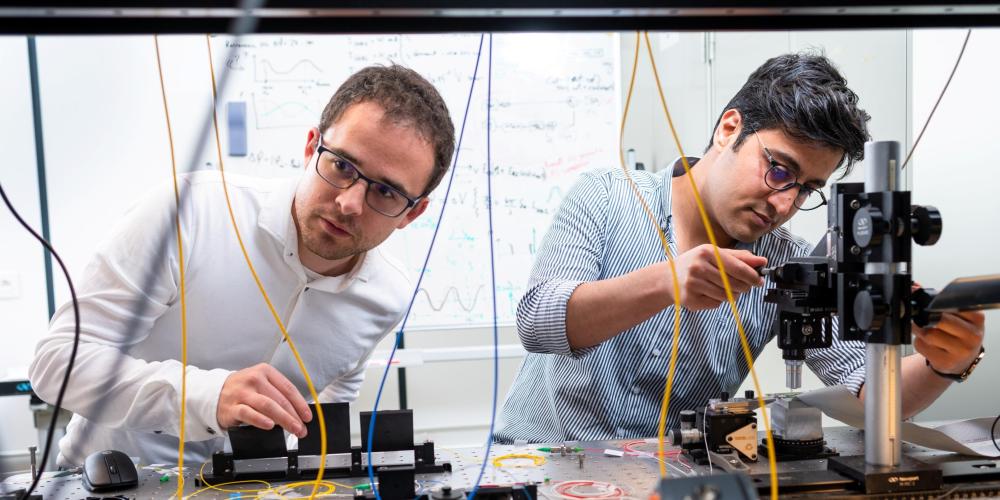


Modern computers work with binary signals: zeros and ones. Pablo Marin-Palomo of the VUB research group B-PHOT is exploring a very different way of transmitting information. By using different colours of laser light, multiple data streams can be transmitted in parallel. With his ERC Starting Grant for his research project COMBYNE, he aims to investigate whether a single compact photonic chip can generate and control many of these different colours simultaneously. The ultimate goal is to make digital communications more compact, scalable and energy-efficient.
Are you working on a revolution in the digital world?
Pablo: “That is the ambition. We want to rethink a fundamental building block of the digital world: the lasers that produce the light used to transmit data through optical fibres. If a single compact device can generate many controllable colours at once, future networks could carry more data in parallel with even less hardware and less energy. Electronics has transformed everyday life through computers and smartphones. It has also enabled life-saving technologies such as pacemakers and defibrillators. In the same way, advances in photonics can improve communications, sensing, healthcare and industry while creating possibilities that do not yet exist today.”
The world is already developing incredibly quickly. Will technologies like this accelerate that development even further?
Pablo: “Technologies like this can help accelerate progress even further, with an impact that extends far beyond AI.”
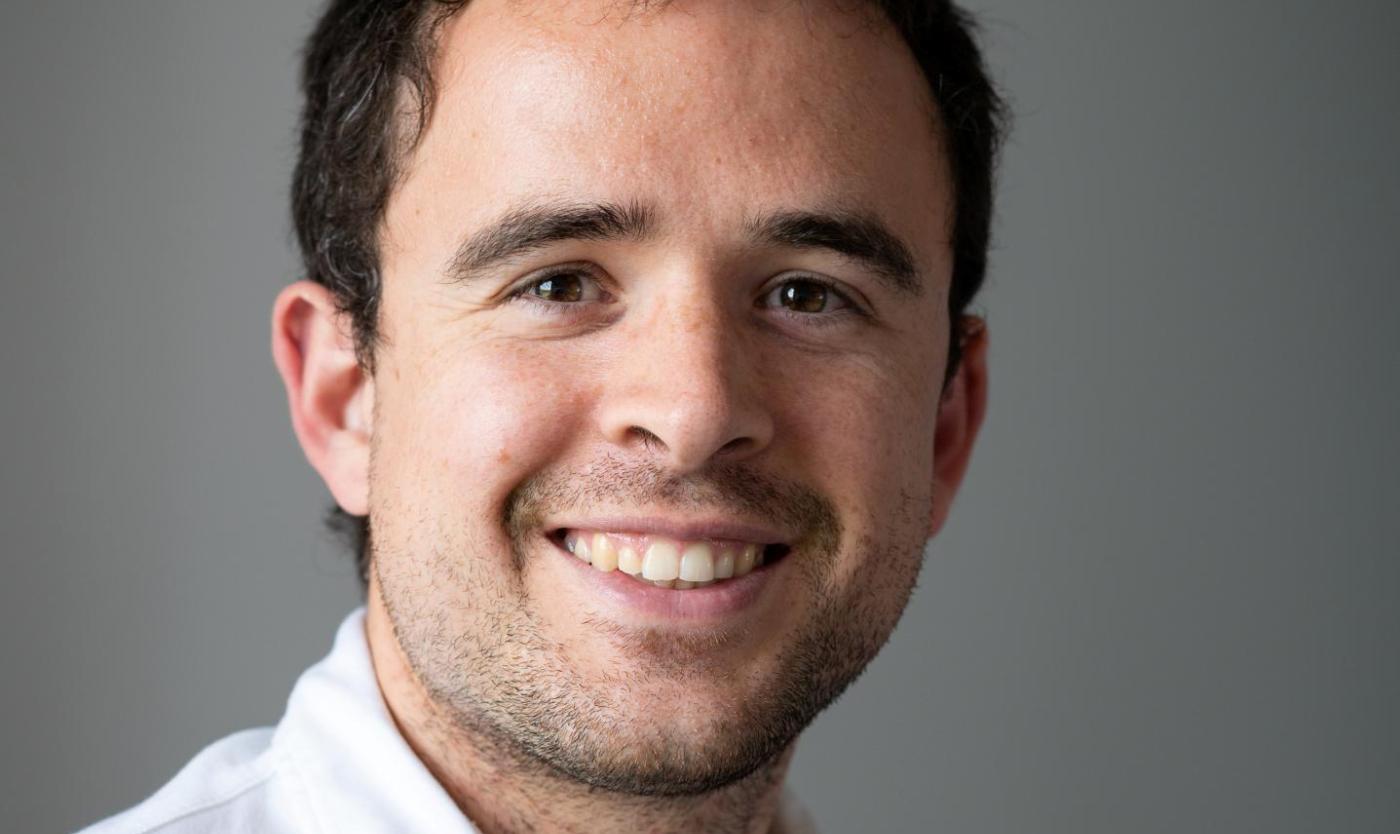
Pablo Marin-Palomo
What exactly are you trying to achieve?
Pablo: “My research group COMBYNE focuses on a fundamental question: can we make lasers on a single photonic chip work together and control them so that they produce many different, tunable colours of light at the same time? Each colour could carry an independent data stream. This would allow a single compact device to support many parallel communication channels, rather than requiring a separate laser for each channel.”
What convinced the ERC panel to fund your research?
Pablo: “I think the panel was convinced by the combination of a fundamental, largely unexplored question and its broad technological potential. Integrated photonics is becoming increasingly important, but we still do not fully understand or know how to control networks of lasers that interact with each other on a chip. If COMBYNE succeeds, it could provide a new toolkit for creating reconfigurable light sources on chips for a wide range of applications.”
Where do you hope your research will be by the end of the five-year ERC funding period?
Pablo: “I hope we will have developed a solid framework for understanding and controlling how lasers on a chip interact with each other. We also want to translate that knowledge into proof-of-concept experiments demonstrating the technology’s potential for optical fibre and wireless communications.”
“The importance of laser technology will continue to grow”
When do you expect the first practical applications of your own work?
Pablo: “We expect the first proof-of-concept demonstrations during this five-year project, in a controlled laboratory environment. If they confirm the technology’s potential, the next step will be to scale them up and develop a robust device for real-world use and ultimately for the market.”
More generally, when do you expect light-based technology to be widely used in the digital world?
Pablo: “Light-based technology is already essential to the digital world: laser light carries terabits of data through optical fibres every second. (One terabit of data is roughly equivalent to 30,000 to 40,000 photos or around 25 to 30 films in the very highest quality, ed.) The importance of laser technology will continue to grow, as the increasing demand for data drives the transition from copper connections to optical fibres and waveguides.”
As a boy, could you ever have imagined the digital world we live in today?Pablo: “I was born in 1990 and grew up with science fiction such as The Matrix and Stargate, full of teleportation, superhumans and robots. Often in dystopian stories, because disasters simply sell better... At the same time, I grew up with the World Wide Web and watched the digital world evolve. Yet I could never have imagined how profoundly it would shape our lives today. What excited me then still excites me now: turning science fiction into reality, step by step.”