

How our quality assurance works
Central to this quality cycle is the three-yearly strategic plan. It acts as a framework for planned management and future-oriented study programme policies. In this framework, the course council formulates its longer-term objectives and identifies a limited number of priorities, in line with central or faculty educational policy.
The faculties are responsible for continuous monitoring of the strategic plan. The strategic plan is reviewed at least every three years: internally through the follow-up meeting and externally through the peer review and Education Quality Council. The schedule of each programme's quality cycle is set out in the calendar (download at the bottom of this page).
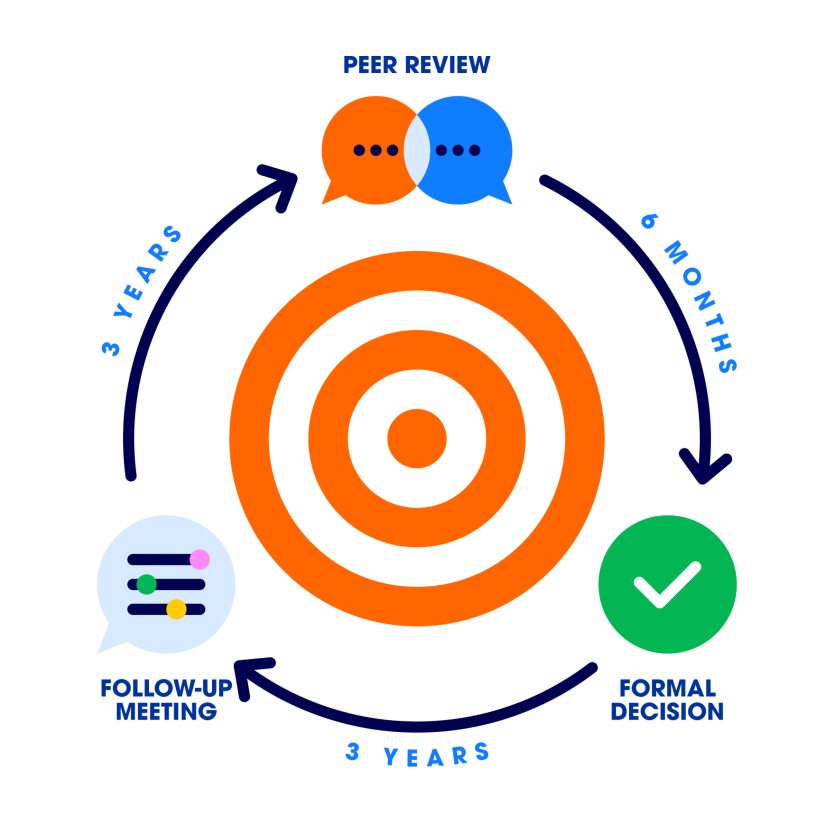
The peer review (every six years) focuses on discussing, monitoring, and possibly revising the strategic plan. Representatives of the programme engages in dialogue with internal peers and external experts to obtain substantive feedback on the profile, the programme, and the final level of the programme. The outcome of the peer review is not a judgement, but a report with recommendations. The programme updates its strategic plan based on this input.
A semester following the peer review, the Education Quality Council advises on the formal decision about the quality and management of a programme. This decision is the final component in the quality cycle and indicates the institution's confidence in the policy-making capacity of the course council. A formal decision can be either of the following: “Good", “Satisfactory with recommendations" or "Unsatisfactory".
In between two peer reviews, the chair of the course council and the Vice Rector for Education and Student Affairs (OS) discuss the progress of the strategic plan as well as central policy issues. This is done during an internal follow-up meeting, which can conclude in an adjustment or revision of the strategic plan.
Support and advice is available from Education & Student Affairs and tailored to the strategic plan. That support combines as much as possible the use of quality assurance instruments and initiatives from educational professionalisation, innovation, and student guidance.
In addition to being transparent about its quality assurance system, VUB is also transparent about the quality of its study programmes and publishes Public Information about this for each programme.
Strategic plan
The central process in the quality cycle and in the functioning of the course councils is the strategic plan. The three-yearly strategy plan urges study programmes to formulate longer-term objectives and identify a limited number of priority topics around which a programme intends to work over a three-year period. The strategic plan also allows for the explicit indication of how the programme responds to the central or faculty educational policy.
The quality assurance tools (focus discussion, benchmarking, fieldwork survey, etc.) are utilised based on the priorities defined in the strategy plan. The support offered by Education and Student Affairs is also customised according to the strategic plan.
The strategic plan serves as a framework for planned management and future-oriented educational policy. It is the basis for the various core processes in the cycle. Discussion, monitoring, and possible revision of the strategic plan are the focus of the 6-yearly Peer Reviews, the follow-up meetings with Education and Student Affairs, and the formal assessment of the quality of individual study programmes (formal decision).
Six-yearly Peer Review
Since academic year 2021-2022 the quality cycle consists of a Peer Review every six years, the planning of which is set out in a calendar. We emphasise dialogue with peers in the Peer Review. The purpose of the Peer Review is to obtain substantive feedback on the profiling, the programme and the final level of the programme. The study programme is therefore the result of dialogue with internal peers and external experts related to the professional field.
During the Peer Review, plans for the future (i.e., the strategic plan) are also discussed. In preparation for a planned Peer Review, a course council evaluates its strategic plan (what action has been taken, what is still planned, have other priorities arisen,...) and, if applicable, draws up an adjustment of the strategic plan for the coming three-year period. The evaluation of the current plan and any proposals for revision are presented during the Peer Review.
The outcome of the Peer Review is not a judgement, but takes the form of a report with recommendations with which the course council can set to work. Based on the input and the recommendations of the Peer Review panel, the programme updates its strategic plan if necessary.
In consultation with Education & Student Affairs, course councils can also opt for a review by an external quality assurance and/or accreditation body. These programmes still follow the quality cycle, but external visitation takes the place of the Peer Review.
Formal decision & Education Quality Council
General
The Education Quality Council has been mandated by the Academic Council to periodically formally assess the quality of individual study programmes and to record this assessment in a proposal for a formal decision. The purpose of the Education Quality Council (KRO) is thus to assist the institution's management in taking a formal decision about the quality and management of a study programme. With this, the institutional assumes final responsibility for the quality of the study programmes. This formal decision is the final component in the quality cycle and indicates the degree of confidence in the policy-making capacity of the course council.
Formal decision & Education Quality Council
Formal decision
The Education Quality Council (KRO) comes to a conclusion on the basis of a dossier of the programme. This dossier consists of existing documents:
- the report of the recent Peer Review (or, if applicable, a recent report of an external review body),
- the strategic plan,
- the proposal for the public information,
- programme-related data from central monitoring instruments, and
- the minutes of the course council of the last 3 years.
The KRO deliberates on the basis of this dossier and drafts a proposal for the formal decision. The formal quality assurance decision can take one of three forms: “Good", "Satisfactory with recommendations" or "Unsatisfactory":
Formal decision 'Good' : There is no reason to question the established quality of the programme and the quality of education is being actively monitored by the responsible course council. The programme can continue its planned policy and can therefore continue to implement the strategic plan without substantial revision. The KRO can attach suggestions if required.
Formal decision 'Satisfactory with recommendations': There is no reason to question the established quality of the programme and the quality of education is being monitored by the responsible course council, but, on the basis of the information collected, urgent action is needed. The KRO then includes specific recommendations that must be addressed by the course council as a priority. During the internal follow-up interview after max. 3 years, the course council is expected to provide an evaluation of the implementation of the strategic plan with a focus on the priority recommendations, as well as an updated strategy plan for the next 3 years. The results of the follow-up meeting are submitted to the KRO, based on which they draft a new proposal for formal decision.
Formal decision 'Unsatisfactory': Major quality issues are detected and/or the quality is insufficiently monitored by the relevant course council. The KRO proposes one or more of the following mandatory measures to the Academic Council:
- A guidance committee is appointed, consisting of internal and possibly also external experts, who draw up an improvement plan together with the course council and supervise the implementation of that plan. The guidance committee reports on progress to the KRO. The KRO drafts a new proposal for formal decision within two years at the latest.
- The study programme is screened in the next year by an ad hoc panel of external experts. The result of the external review is submitted to the KRO, which drafts a new proposal for formal decision based on this within 2 years of the first decision.
- If there is a major substantive quality issue that affects the value of the diploma awarded, the study programme is temporarily frozen.
Formal decision & Education Quality Council
Composition
- Chairman: senior academic staff member, with prior experience as dean, vicerector or rector.
- 2 external members, with governance experience related to quality assurance
- 4 VUB senior academic staff members, not members of the Academic Council
- 1 staff member with educational expertise
- 1 VUB research/assistant academic member
- 1 VUB student
The council is assisted by:
- Secretary from the department of Education and Student Affairs
- Ex officio observer - Head of Educational Support
Formal decision & Education Quality Council
Responsibilities
The Education Quality Council is responsible for:
- periodically determining the quality of the individual study programmes on the basis of the various elements of the VUB quality cycle;
- recording the findings of each study programme in a proposal for formal decision and a proposal for public information to the Academic Council;
- proposing binding measures to the Academic Council if the quality of a study programme is unsatisfactory;
- advising the Academic Council on revisions of public information;
- proposing themes for university-wide analyses to the Academic Council;
- carrying out an urgent quality assessment at the request of the Vice Rector for Education.
- reflecting on VUB's quality assurance system and making possible revision proposals to the Academic Council.
Internal follow-up meeting
Between two Peer Reviews, an internal follow-up meeting is scheduled with Education and Student Affairs. The planning is delineated in the calendar.
The purpose of the internal follow-up interview is to discuss the progress, in consultation with the Vice Rector for Education and Student Affairs, of the strategic plan and whether and how themes from the central policy are reflected in the strategic plan. In preparation for the internal follow-up meeting, the course council takes stock of the implementation of the strategic plan over the past three years and, if applicable, draws up an update for the coming three-year period.
The outcome of the internal follow-up meeting is not an assessment, but results in specific feedback for updating the strategic plan. The public information can also be updated to reflect the latest developments.
Public information
Public information on the study programme
The information on our educational quality is publicly available and collected in these pages. In addition, each individual study programme has publicly accessible information that reflects the quality of the programme. We call this 'public information'. This information sheet contains concise descriptions of the study programme's strengths and mentions priority actions and development opportunities. The public information sheet can be found on the programme page of the relevant study programme, via the 'quality tab'.
Specifically, you will find the following information on the sheet:
- a brief description of the strengths of the study programme
- a brief description of the development opportunities of the study programme
- a brief description of priority action points on which the study programme is or will be working.
- the date of publication or of the last update of information
- a timeline of the quality cycle of the study programme
- a link to the webpage on Educational quality and VUB's quality cycle
- a link to official data on higher education provided by the goverment
- if applicable, the formal decision
Public information
Why?
The Flemish Quality Assurance System for higher education assigns a crucial role to information about the quality of education that must be made public. Universities and colleges of higher education are given more autonomy than before to guarantee the quality of their own study programmes, but this is balanced by a clear duty of accountability: each institution is required by decree to be transparent about the quality of its study programmes. A sufficient amount of correct information on the quality of education must be made publicly available for each study programme. In the words of the Explanatory Memorandum to the Quality Care Decree:
"Transparency within the system and towards broader society is an essential part of the quality assurance system. The obligation for institutions to make information on the quality of study programmes public is one of the qualityfeatures. Thus, making information public will also be subject to constant review in the new system."
Public information
What sources is the information based on?
The tone of the text is constructive. The stated strengths, development opportunities, and action points can be traced back to at least one of the following sources:
- previous public information
- the report of the peer review and/or relevant discussion in the course council;
- the report of the internal follow-up meeting and/or relevant discussion in the course council;
- the SWOT analysis carried out by the study programme in preparation for the peer review;
- the results from the student feedback and/or focus discussion with students and/or relevant discussion in the course council thereof during the course council meeting;
- the results from the latest benchmarking, professional field survey and/or alumni questionnaire and/or relevant discussion in the course council;
- reports of the course council;
- the (draft) strategic plan
How does the text come about?
The public information is reviewed and updated at least in once every 6 years in the light of the peer review and the subsequent formal decision. To reflect the latest developments an update is also possible after e.g. the internal follow-up meeting and an updated strategic plan. The quality assurance advisor prepares a draft. After approval by the course council, it is presented to the Education Quality Council. After final ratification by the Academic Council, the text is published on the programme's page.
Calendar per course council
Here you can consult the planning per course council for the period 2021-2027.