

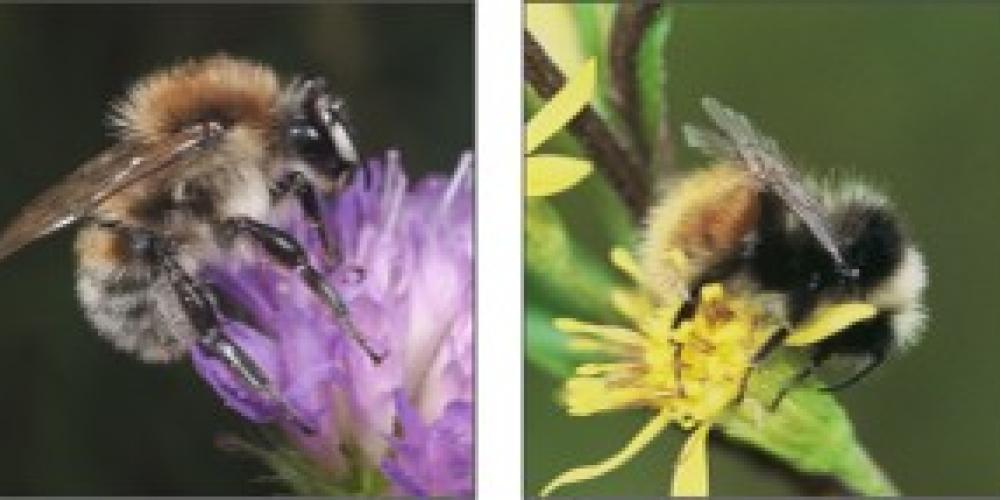


In a study recently published in *Nature Climate Change* , led by the Spatial Epidemiology Lab (SpELL; Bastien De Tandt, Simon Dellicour), Belgian researchers (ULB, UMons, VUB, UCLouvain, KU Leuven, UAntwerp) have investigated how climate change is affecting the ecological habitats of European bumblebees. Bumblebees are a crucial group of pollinators in temperate and cold ecosystems. The scientists found that climate change, on average, has reduced suitable habitats by 5 per cent, with local declines of up to 19 per cent. Their analyses show that the impact has become increasingly evident since the 1980s. Southern and central regions are particularly affected, meaning that the habitats of European bumblebees are already undergoing drastic changes. The results underline the urgent need for targeted conservation measures and an ambitious global climate policy.
Globally, biodiversity is declining rapidly due to various human factors, including overexploitation, pollution, invasive species and climate change. Although more and more research is being carried out into the impact of climate on nature, there are still very few studies that formally attribute an observed decline to climate change or compare its precise contribution with that of other factors. In the new study, the Belgian researchers specifically isolated and quantified the impact of climate change on the habitats of European bumblebee species — a group of important pollinators whose populations have declined sharply in recent decades.
To investigate this, the scientists used more than 800,000 georeferenced observation records from 47 species. They used these to train ecological niche models for each species, which they then projected onto two different climate scenarios: the actual climate as observed between 1901 and 2019, and a control scenario in which all long-term trends related to global warming had been removed. By calculating the difference between the two projections, the researchers were able to determine the specific effect of climate change on the habitats of European bumblebees.
The results show that climate change has already significantly affected suitable habitats for bumblebee species in Europe: on average, there has been a 5 per cent decline in habitat suitability directly attributable to the climate, with localised declines of up to 19 per cent. The analyses also demonstrate that this effect has been intensifying since the 1980s — coinciding with the accelerated rate of global warming — and that the impact is greatest in southern and central regions. However, the results do show that the expansion of suitable habitat to higher-altitude areas in the Alps and the boreal regions partially offsets the loss at lower latitudes and altitudes, leading to minimal net changes there.
The researchers conclude that climate change is already altering the suitable environmental conditions for European bumblebees and that the pressure will only increase if global warming continues. They emphasise that climate mitigation, combined with active habitat management and nature conservation, is essential to limit further shifts in insect distribution — particularly for pollinators, which are indispensable to our ecosystems.
“Global warming has already caused a measurable loss of habitat for European bumblebees. Creating insect-friendly gardens buys us some extra time and is a simple step that anyone can take, but only by reducing fossil fuel emissions can we truly halt species extinction,” says Rosa Pietroiusti, co-author of the study and a researcher at the Vrije Universiteit Brussel.
Reference
De Tandt B, Serres K, Pietroiusti R, Erazo D, Massonnet F, Michez D, Thiery W, Ghisbain G, Dellicour S (2026). Declines in European bumblebee habitat suitability attributable to climate change. Nature Climate Change, DOI: s41558-026-02734-6
Funding: this research was primarily supported by the Fonds de la Recherche Scientifique (FNRS, Belgium).
Contact:
-
Lead Author: Bastien De Tandt, Spatial Epidemiology Lab, Université libre de Bruxelles, bastien.de.tandt@ulb.be.
-
Senior Co-author: Dr Simon Dellicour, Spatial Epidemiology Lab, Université libre de Bruxelles, simon.dellicour@ulb.be.
-
ULB Press Office: presse@ulb.be
-
Co-author: Rosa Pietroiusti, Department of Water and Climate, Vrije Universiteit Brussel; rosa.pietroiusti@vub.be, +32 496 83 66 63.
-
Senior Co-author: Prof. Dr Wim Thiery, Department of Water and Climate, Vrije Universiteit Brussel; wim.thiery@vub.be, +32 2 629 30 29.
-
Bclimate policy impact manager: Dr Marie Cavitte, Department of Water and Climate, Vrije Universiteit Brussel; marie.cavitte@vub.be, +32 470 19 24 15.