

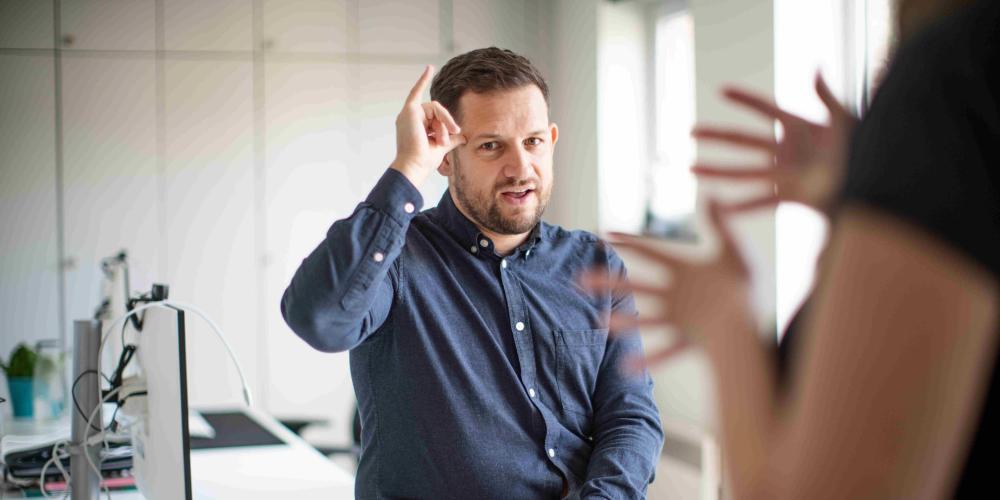


Building stronger links and creating cross-fertilisation between the university and the wider world: that is the philosophy behind the VUB fellows. Every month, one of these fellows is invited to share their views. This time it is Hannes De Durpel, coordinator of the Flemish Sign Language Centre (VGTC). He stresses the importance of co-creation between researchers and deaf people. “It works both ways. We can learn a great deal from each other.”
I do not know Flemish Sign Language. That is why interpreter Chloë joins us for this interview. She translates my questions from spoken Dutch into Flemish Sign Language (VGT), and translates Hannes’s answers from VGT into spoken Dutch. First question – and just to be sure: we can indeed call Hannes ‘deaf’? It does not have to be ‘a person with a hearing impairment’?
Hannes De Durpel: “You can say ‘person with a hearing impairment’, but to deaf people it sounds somewhat cumbersome and overly cautious. As though you need to tread carefully around us. We do not think that is necessary. Just say deaf. We do not regard that word as harsh or offensive. It describes who we are.”
Were you born deaf?
“Actually, I am deafblind. I have Usher syndrome, a hereditary condition that affects the functioning of the inner ear and the retina. As a result, I was born deaf and my eyesight is gradually deteriorating. For example, I suffer from night blindness, tunnel vision and blind spots in my field of vision.”
You learnt sign language as a child. Flemish Sign Language, because there are hundreds of sign languages.
“That’s right, every country or region has its own sign language.”
“Flemish Sign Language has much more in common with Walloon Sign Language”
Do Dutch-speaking Belgians use the same sign language as their French-speaking compatriots?
“Not quite; they are two different languages. But they have a lot in common. The sign vocabulary of Flemish Sign Language corresponds to around 65% of Walloon Sign Language (LSFB). But sign language is about more than just the hands. Expression, facial expressions and mouthing – the way the mouth and lips move – also play an important role in sign languages. One difference, therefore, lies in the mouth patterns that accompany certain signs: ours are often derived from Dutch, while in LSFB they are derived from French. We carried out our own etymological research into this, and further research is still under way. That historical link is fascinating.”
Is Flemish Sign Language similar to Dutch Sign Language?
“No, much less so. The mouth patterns are similar, though. In principle, deaf Flemish people understand the signs used by deaf Walloon people much better than those used by deaf Dutch people. You therefore have to see the origins and evolution of sign languages separately from what you know about spoken languages.”
Aren’t some signs universal?
“Not necessarily. It is true that sign languages often imitate what things look like in real life. But that is not the same everywhere. This, for example, is our sign for house” (he uses his hands to form the two sloping sides of a pitched roof). “I was recently talking to a deaf Maltese person, and in Malta they sign house with a flat roof. Houses there rarely have pitched roofs because it rains less there than it does here.”
And drinking – surely that must be a universal sign?
“There are variants of that too, even within Flemish Sign Language. Drinking from an imaginary glass with one hand is the standard sign for drinking. But if you want to be more specific, you adapt the sign. It can become a large beer mug, with a fist around one ear, or a bowl of soup held in both hands. Form and meaning are connected.”
How many people use Flemish Sign Language?
“There are between 5,000 and 6,000 deaf sign-language users in Flanders. But, of course, there are also hearing people who know sign language and consider themselves part of the deaf community. My wife and I are deaf, for example, but our children are hearing. Flemish Sign Language is our home language; at school they speak Dutch. They are proud of being bilingual.”
It must also be fun to exchange secret messages at school that the other children cannot understand.
“Or at home. They know very well that Mum and Dad cannot hear them and that they can discuss all sorts of things behind our backs.” (laughs)
“Facial expressions are part of our language. So deaf people certainly pay attention to them”
Many people are not born deaf but gradually lose their hearing as they get older. By then, is it too late to learn sign language?
“Never say never, but at an older age I do think it is more difficult to learn a new language, especially when it involves a different modality. It is also important to come into contact with other sign-language users in order to maintain the language. This is not always easy for people who lose their hearing later in life. You should not underestimate that social aspect.”
Deafness causes social isolation, which according to recent research increases the risk of dementia. Is there anything we can learn from sign language in that respect?
“I cannot comment on dementia; that is not my area of expertise. I do think that visually accessible communication can help people participate fully in conversations and maintain social contacts. In sign language, eye contact, articulation and expression play an important role. Paying attention to the visual aspect as well as the auditory one can certainly help when talking to people who are hard of hearing. Make sure your face is clearly visible, look at each other and ask what the other person needs in order to follow the conversation. That way, they can put the whole puzzle together, with less effort.”
Are people who are born deaf better at reading faces and emotions?
“We are indeed better trained in that, more so than hearing people. Facial expressions are an important aspect of our language. So deaf people certainly pay attention to them.”
What is it like between hearing parents and deaf children?
“About 95% of deaf children grow up with hearing parents. They often do not know sign language when their child is born. Fortunately, we are seeing growing interest in and awareness of the importance of visual communication. Nevertheless, spontaneous conversation within the family is not always straightforward, particularly when it comes to feelings or complicated subjects. When children do not have sufficient access to communication and have little contact with other deaf children their age, this can affect their self-confidence and identity development and can lead to language deprivation.”
“In Norway, parents of deaf children can take paid leave to learn sign language”
What does this mean for education?
“Parents should immediately be given the opportunity to learn sign language. In Norway, they can take paid leave to do so. There have also been initiatives in Flanders in the past to establish such a scheme, but unfortunately they have not resulted in a permanent solution.”
And what about the children?
“There are three options for deaf children when it comes to education. They can either attend special education, type 7, also known as a school for deaf children. These schools now cater for pupils with a wide range of educational needs, including children who require additional care and support. The challenge is to provide every child with an education that is both sufficiently accessible and suitably challenging. Other deaf children attend mainstream schools, with support from, for example, an interpreter and/or assistive hearing technology, such as a cochlear implant or an FM amplification system for their hearing aid. I myself attended a school for deaf children until I was ten, and then moved into mainstream education.”
And the third option?
“That is bilingual education. In practice, this means a class or language section within mainstream education where lessons are taught in both Dutch and Flemish Sign Language, to deaf and hearing children alike. After years of lobbying, a decree was recently introduced to make this possible. Two Flemish schools had prepared to offer this form of education, but unfortunately were unable to get started because of insufficient funding and support. Hopefully this will be possible in Flanders in the future. Wallonia has shown that it can be done: in Namur, a school has been providing bilingual education in French and LSFB for more than 25 years.”
“Google’s latest smartphone converts American Sign Language into written English in real time”
You are involved in research into artificial intelligence. What is the aim?
“Technology has been a major step forward for deaf people, with the advent of smartphones, social media and video calls. We can now communicate with deaf people all over the world in real time. In the past, that was almost unthinkable. With the rise of artificial intelligence, new possibilities are emerging. Think, for example, of an app that recognises sign language and converts it into text or speech. Deaf people could use such a system as a dictionary when they do not know a neologism, while hearing students could use it to learn new signs, with the system providing feedback on whether or not they are performing them correctly. Thanks to AI, you can already look up signs in our online Flemish Sign Language dictionary by recording a sign yourself via your webcam. We developed this innovative feature together with Ghent University.”
And could it work the other way round too: converting written or spoken language into sign language?
“That is also being worked on. I recently saw that researchers in the Netherlands, together with the Dutch national railway company, had developed a prototype of a digital 3D avatar that converts public-address announcements into Dutch Sign Language. Applications like these still need to be developed and tested further, but they could be used to inform deaf people about possible delays or changes to platforms.”
Simultaneously interpreted conversations between deaf and hearing people will soon no longer be science fiction?
“They are furthest ahead in the United States. Google’s latest Pixel smartphone can convert American Sign Language into written English in real time: the front-facing camera records the hands, facial expressions and body movements, after which an AI model translates that information into text. But it requires enormous amounts of data to train such a model; you need huge numbers of sign-language videos and the corresponding descriptions to make it work. For Flemish Sign Language, that is still a long way off. The translations can still contain errors. So we should remain cautious and critical about the results.”
“Co-creation can only succeed if deaf people are involved”
You are a VUB fellow at the invitation of Proxima Professor Beatrijs Wille. Do you already have any plans?
“It was an honour to be asked, and I am very pleased. Especially because it fits perfectly with the mission of the Flemish Sign Language Centre. We want to connect the academic world and the deaf community by bringing scientific research on deaf people to the deaf community and by closely involving deaf people in research.”
You often stress the importance of co-creation.
“Absolutely! If you are conducting research or developing new applications for deaf and hard-of-hearing people, involve them from the outset. Work together, ask what they really need and use their feedback. Otherwise, you may end up creating something that is of no use to deaf people. The same applies to linguistic research. For example, very little is still known about how children acquire sign language. We are happy to contribute our perspective when students or researchers want to work on this.”
Anyone old enough to remember 1986 was introduced to deaf culture through the film Children of a Lesser God. Which film would you recommend today?
“CODA, from 2021. The main character is a young woman who is the only hearing person in her family. CODA stands for Child of Deaf Adults. I thought it was a wonderful film that gives a good picture of the deaf community, its language and culture, and the position of hearing children in a deaf family. Just as it is in my family.”
Bio
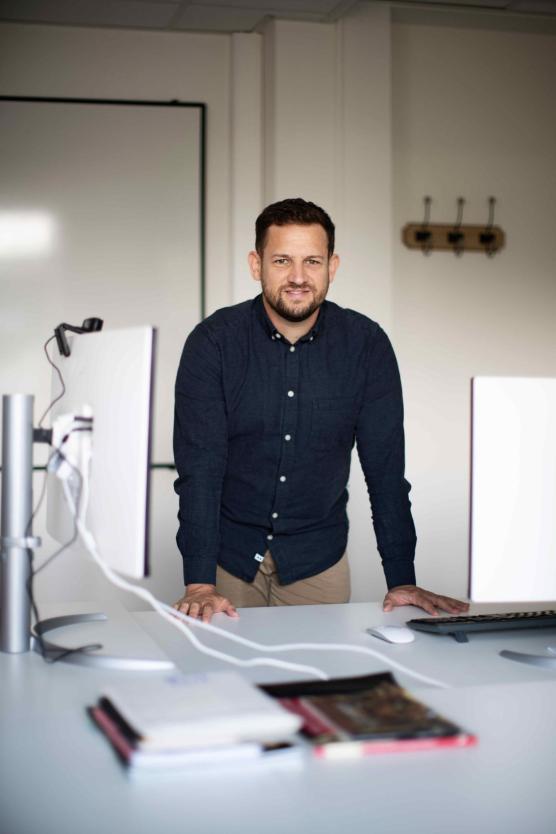
Hannes De Durpel (born 3 December 1986) is coordinator of the Flemish Sign Language Centre (VGTC), the knowledge and expertise centre for Flemish Sign Language (VGT). He leads a team of sign-language users working on linguistic research, training, promotion and expertise. His work focuses, among other things, on the social representation and position of VGT and sign-language users in education, the media and society as a whole.
As a VUB fellow, Hannes wants to contribute to greater knowledge and expertise about Flemish Sign Language and to a more inclusive academic environment. Among other things, he can give guest lectures and workshops, help facilitate research into Flemish Sign Language, and advise on policy, communication and accessibility within VUB, both in education and at large-scale events. His Proxima is Professor Beatrijs Wille of the VUB’s Brussels Centre for Language Studies (BCLS).