




Three years ago, an influential study published in the leading journal Nature claimed that science was becoming less and less innovative. That conclusion made headlines worldwide and found its way into science policy, including Flemish innovation policy. However, new research by the Vrije Universiteit Brussel (VUB) and KU Leuven now shows that this conclusion was largely based on errors in the underlying data. According to the researchers, there is currently no convincing evidence that scientific research is less groundbreaking than it used to be. And that could have important implications for how research is funded and evaluated.
The original study from 2023 analysed millions of scientific publications and patents and concluded that the disruptive nature of research has declined sharply since the middle of the last century. The study attracted a great deal of attention worldwide because it appeared to answer a fundamental question: are scientists still managing to achieve genuine breakthroughs? The message that innovation was slowing down was picked up more than 300 times by the international press, cited more than 1,000 times in the scientific literature and incorporated into various policy documents. A research team led by the VUB has now discovered that this conclusion was largely due to incomplete data in scientific databases. Older publications, in particular, are more likely to contain missing references, leading them to be incorrectly classified as exceptionally groundbreaking. This created a distorted impression that recent research was less innovative.
“When we correct these errors, almost the entire decline reported in the original study disappears,” says Professor Vincent Ginis (VUB), who led the research. “That does not mean we can now conclude that science is actually becoming more groundbreaking. It does mean, however, that the earlier conclusion does not provide a reliable basis for such a claim.”
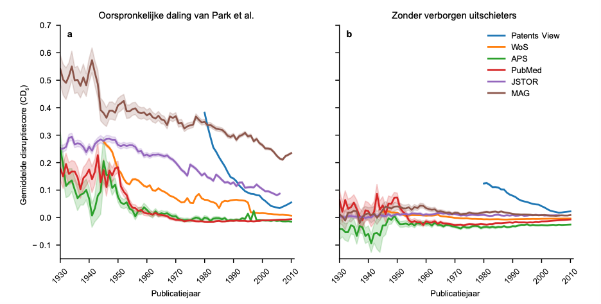
The measured decline in groundbreaking science (a) largely disappears after correcting for misclassified outliers (b).
From newspaper headlines to science policy
According to the researchers, the significance of the study extends beyond an academic debate. After all, if policymakers believe that scientific breakthroughs are becoming increasingly rare, this could have consequences for the way in which research is funded and evaluated.
“Our study shows just how important the quality of research data is,” says lead authorVincent Holst (VUB) of the . “Even small errors in large databases can lead to conclusions that influence the global debate.”
The Belgian researchers submitted their critique to *Nature*as early as 2023 . It was only after almost three years that the Matters Arising was published. In the meantime, the original study continued to exert influence worldwide. Whilst the criticism was under review, Nature itself devoted another editorial and a news article to the original paper.
“ Whilst the software error was rectified within a few months by the open-source community, it took years for the Matters Arising to be published, ” says Professor Ginis.“And all that time, the journal’s guidelines prevented us from speaking to the press whilst our critique was under review.”
The researchers are pleased that the Matters Arising is now being published and emphasise a positive message above all. “Science has a built-in system of self-correction,” concludes Ginis. “New analyses, independent reviews and critical researchers ensure that previous conclusions are constantly re-examined. That is precisely how science progresses.”
Publication and contact
Vincent Holst, Andres Algaba, Floriano Tori, Sylvia Wenmackers and Vincent Ginis, “Dataset artefacts can partially drive the measured decline in disruption”, Nature (2026), https://www.nature.com/articles/s41586-026-10787-y
Dr Vincent Holst, vincent.thorge.holst@vub.be
Prof Dr Vincent Ginis, vincent.ginis@vub.be