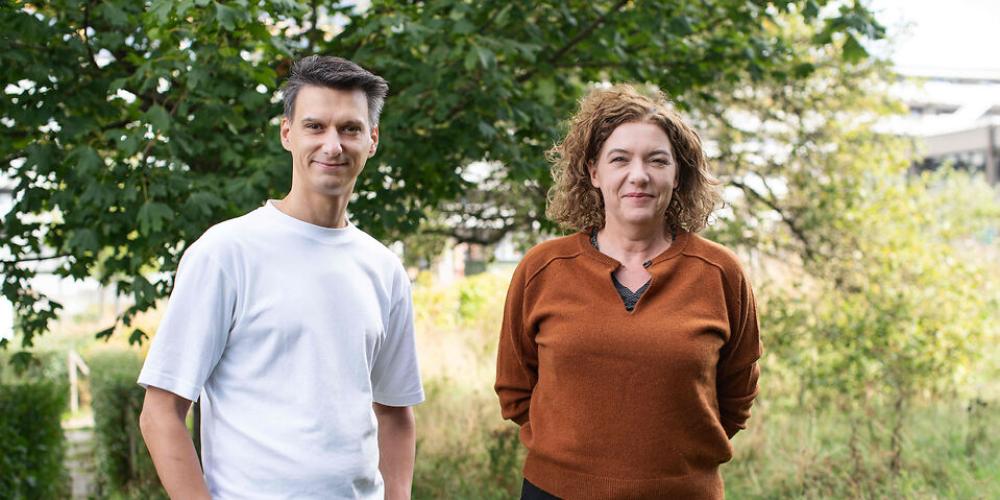


Four leading researchers from American universities will strengthen VUB’s climate research over the next three years. One of them is Belgian dendrochronologist Valerie Trouet. Her expertise in tree rings and past climate change is a fantastic addition to the existing VUB research, says VUB climate scientist Wim Thiery. A joint interview.
Professor Valerie Trouet quickly finishes an apple-raisin pastry. She spent her morning in the basement of the Water & Climate department, where she is setting up a new laboratory. The funding comes from the VUB-US Research Chair programme, which brings leading American scientists to Brussels to work with VUB research groups on climate and sustainability issues. Valerie’s next step is to find funding to recruit PhD students and postdocs. In the United States, the latter has become almost impossible.
Valerie Trouet: “I am keeping my position at my university, the University of Arizona. But the National Science Foundation’s paleoclimate programme has been discontinued. That programme funded research into past climate conditions using natural archives such as ice cores, sediments and tree rings. The latter is my field of research: dendrochronology. By studying tree rings, we can determine how warm and wet it was in the past. Without that programme funding, I cannot train master’s students, supervise PhD students or recruit postdocs. Fortunately, I now have the opportunity to set up a new lab in Brussels.”
VUB is a part-time position. Will you remain affiliated with the University of Arizona as well?
Valerie: “That’s right. As a professor in the US, you only receive a salary for nine months of the year. That stops between mid-May and mid-August, when there are no classes. I will spend part of those three months at VUB each year for the next three years.”
In an interview on VUB Today, VUB glaciologist Harry Zekollari complained that American researchers from federal institutions are no longer even allowed to contribute to the next IPCC report. This risks losing a great deal of knowledge.
Valerie: “Many climate scientists are at their wits’ end, especially younger researchers. Things are still relatively manageable at universities, but it is difficult for colleagues at government institutions such as the U.S. Geological Survey or the U.S. Forest Service. For example, they are no longer allowed to recruit Chinese students or have them as co-authors on a paper. That’s not how science works, of course. I advise my American PhD students and postdocs to go abroad. My own university was actually very enthusiastic about the opportunity I have been given at VUB.”
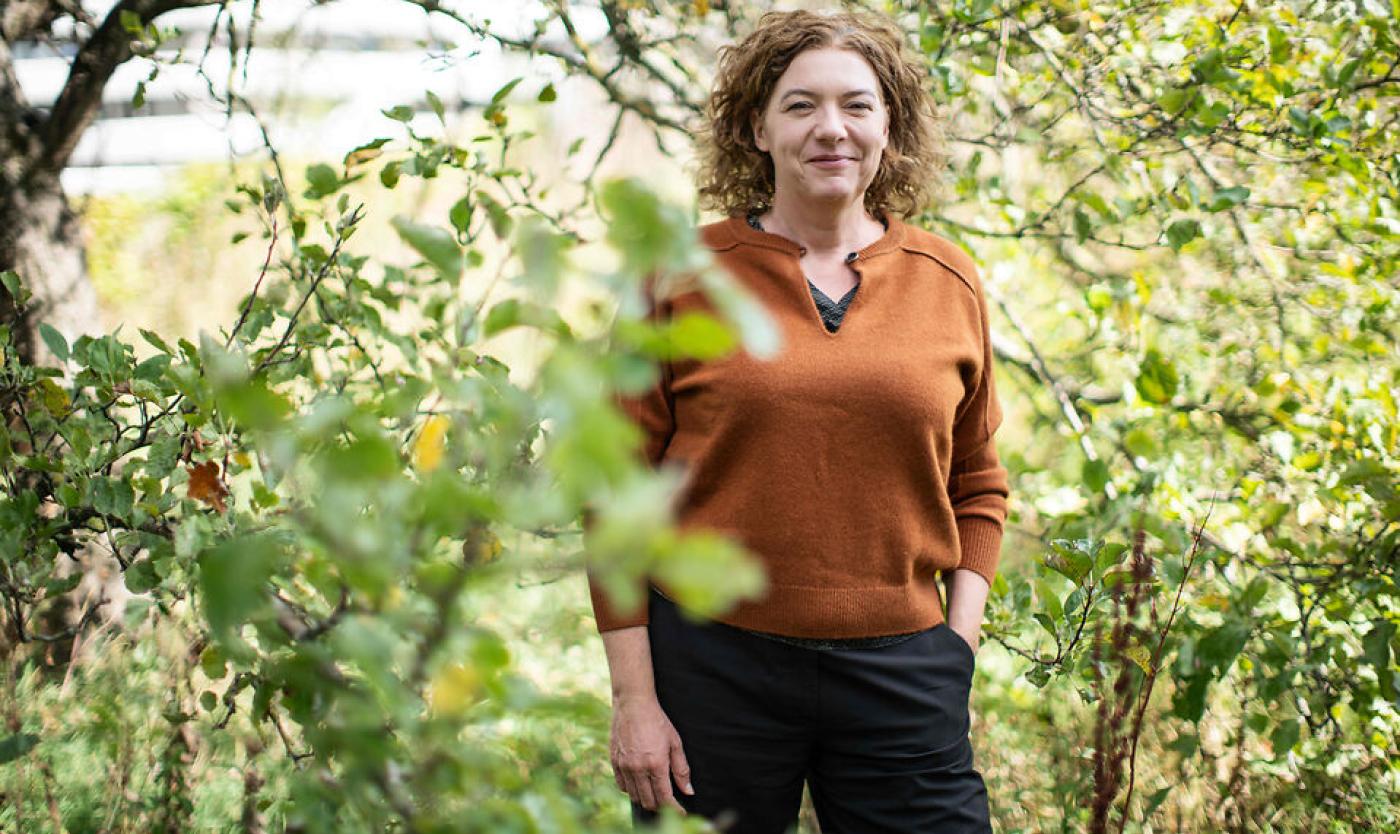
“As a climate university, VUB punches above its weight”
Vice-Rector Pieter Ballon hopes to turn VUB into a reference centre that builds a bridge between Europe and the US.
Valerie: “People in America hope for that too. International cooperation is essential, especially because we are dealing with a global problem.”
VUB describes itself as a European leader in climate, energy and sustainability. Are we allowed to say that?
Valerie: “I think so. You bring in prestigious ERC grants, contribute to IPCC reports with people like Harry Zekollari and Wim Thiery, educate a great many students… for a relatively small group, that is remarkable. As a climate university, VUB punches above its weight.”
The world is changing. Keep asking questions.
Follow VUB’s perspective on science, technology and society.
Stay up to date and book tickets for our public events.
SUBSCRIBE TO VUB'S NEWSLETTER AND INVITATIONS
You completed your master’s degree in Ghent and your PhD in Leuven. VUB is new to you.
Valerie: “Completely new. The campus is smaller than what I am used to. That means you get to know your colleagues quickly and administration is easier. At the same time, it is a very international and multicultural university, right in the heart of Brussels. I really like it here.”
“With tree rings in archaeological wood, we can go back several thousand years”
Besides Valerie, Sol Kom from the University of Chicago will also join the Water & Climate department. What does this mean for the group?
Wim Thiery: “Their work complements the research already being conducted here. We have people working on groundwater and surface water, climate extremes, wildfires, glaciers and climate legislation. Valerie and Sol bring in missing pieces of the puzzle: Valerie with her work on dendrochronology and paleoclimate, and Sol with his research into tropical hurricanes. This broadens the range of expertise within VUB and in our engagement with society.”
Where is there a lot of potential for collaboration?
Wim: “In the field of attribution. This means investigating whether, and to what extent, extreme weather events are caused by human-induced climate change. We can put a number on how much the likelihood of heatwaves, floods, wildfires or cyclones has increased. We would also like to look more closely at the concrete impacts. Think of the number of deaths during a heatwave, or the economic damage caused by a hurricane. Another challenge in attribution studies is to look further back in time than the period covered by meteorological measurements. Through her research into tree rings, Valerie brings a longer-term perspective, reaching back hundreds or even thousands of years.”
Valerie: “Temperature reconstructions based on tree-ring research are not yet widely used in attribution studies. In America, we have already done this for snowfall in the Sierra Nevada; in Europe, we now want to do it for heatwaves.”
How far back in time can you go using tree rings?
Valerie: “In Europe, trees naturally live for a shorter time than in America. With the trees in the Sonian Forest, we can go back to around 1800. That does not tell us very much, because meteorological measurements in Belgium go back to 1830. But Europe also has a great deal of archaeological wood that was used in buildings and ships. With a few adjustments to our equipment and techniques, we may be able to use that wood to go back as far as Roman times.”
Wim: “Valerie can also bridge the gap between the meteorological measurements of the past two centuries and the much older archives found in ice cores and sediments. These are areas of research in which colleagues such as Professor Philippe Claeys, Professor Steven Goderis and Professor Harry Zekollari work.”
“AI helps map the impacts of climate chance”
There also seems to be potential for collaboration on research into wildfires?
Wim: “We have two projects on this in our research group. The first is Wikimpacts, a European collaboration led by PhD researcher Ni Li. For this project, we used artificial intelligence to extract information from millions of Wikipedia texts about heatwaves, wildfires, hurricanes, droughts and floods. This information was then automatically converted into a database containing data on casualties, economic damage and other consequences.”
And the second research project?
Wim: “That was the work of PhD researcher Seppe Lampe. He trained a machine-learning model using satellite images to assess the risk of wildfires and natural fires based on data such as temperature, precipitation and vegetation type. The model can tell us which conditions frequently lead to fires, how much land is likely to burn and how much CO₂ will be released as a result.”
Could we have used this to predict the disaster in the High Fens?
Wim: “No. This model operates on a global scale, with one pixel representing an area of approximately fifty by fifty kilometres. It can, however, be used to estimate major climate trends, for example up to 2100. What is certain is that, without changes in policy, the risk of fires will increase as landscapes become warmer and drier.”
“American wildfire expertise is now coming to Europe”
What can dendrochronology tell us about wildfires, Valerie?
Valerie: “Tree rings provide information about how wildfires affected nature in the past and what role human influence played. With this knowledge, we can better protect our forests and ourselves.”
There seems to be much more expertise in this research field in America than here?
Valerie: “Wildfires have only become a relatively recent problem in Northern Europe. As a result, less research has indeed been conducted here. To give you an idea: in Canada, the US and Mexico, there is a network of 2,300 sites where researchers use tree rings to look for traces of past wildfires. In Europe, there are around fifteen, mainly in the Mediterranean region and Scandinavia. It is also more difficult here because European forests are smaller and more heavily influenced by humans, and there are fewer old trees.”
But this type of research is certainly possible here as well?
Valerie: “Absolutely. We are going to work on it. An American colleague of mine from another university in Arizona recently moved to the University of Marseille, as part of a programme similar to the VUB-US Research Chair programme. This is how American wildfire expertise is now coming to Europe.”
“Science has done its job; now policy is the bottleneck”
Climate science continues to be refined and improved, but the major insights will not change anymore. Now we need to get policy on board.
Wim: “There is support for this, though: a large part of the population is well aware of the seriousness of the situation and expects solutions to reduce emissions and increase our resilience. This is about the safety and viability of society, about our health and that of our children.”
And the solutions exist.
Wim: “Exactly. Twenty years ago, the technology either did not exist or was still too expensive. Today, wind turbines, solar panels, heat pumps, batteries and electric cars have become viable. Science has done its job; now policy is the bottleneck. It is up to policymakers to make these technologies affordable for everyone and reduce emissions in order to protect their populations.”
Renewable energy is gradually becoming cheaper than fossil fuels.
Valerie: “They have even realised that in Texas. The self-proclaimed proud oil state is now also the largest producer of wind energy in the US.”
Wim: “Some countries in Europe are leading the way. Denmark has been investing in wind energy for decades and has built a leading wind industry. They export that technology; we import it. Dragging our feet is not an option. Otherwise, after allowing our solar-panel and battery industries to decline, we will also let our car and heat-pump industries collapse. We produce renewable energy ourselves as well. At the moment, our money is flowing to Russia, America, the Arab countries and Norway.”
“Climate-conscious young people can study whatever they want”
What should climate-conscious young people study, in your view?
Valerie: “Anything they want. Climate change affects literally every aspect of society.”
Wim: “VUB trains STEM students who will develop and implement technological solutions, but also lawyers, sociologists and political scientists who work on legal and social policy frameworks, doctors who focus on the medical aspects, and so on.”
Valerie: “I myself studied bioscience engineering and only came into contact with climate science later on.”
Will you be taking part in the climate march on 11 October?
Valerie: “I will already be back in the US by then. Otherwise, definitely.”
Wim: “I feel obliged to do so, as a scientist and as a father. Our research tells me what extreme conditions my children will experience during their lives. Belgium promised in Paris to reduce emissions with the highest possible ambition. To be clear, that is not happening yet. Today, the warnings from climate science are being laughed off. Policymakers must do what is necessary to secure the future of all children in Belgium and around the world.”
22 October | So, will you live an unprecedented life? | Climate lecture by Prof. Wim Thiery | BOOK YOUR FREE TICKET
Bio
Prof. Valerie Trouet
Prof. Valerie Trouet is a bioscience engineer. She conducts scientific research in the field of dendrochronology, the dating of tree rings, and wrote the book Tree Story about her research. In 2011, she became an assistant professor and in 2020 a full professor of paleoclimatology at the University of Arizona. From 2022 to 2024, she was scientific director of the Belgian Climate Centre. Since September 2026, she has held a part-time position at Vrije Universiteit Brussel through the VUB-US Research Chair programme. There, she works with Wim Thiery in the bclimate research group.
Prof. Wim Thiery
Prof. Wim Thiery was appointed research professor at Vrije Universiteit Brussel (VUB) in 2017, where he leads the bclimate group. He was a co-author of the IPCC Special Report on Climate Change and Land (2019) and the Sixth Assessment Report (2021). His expertise includes climate change, climate extremes, regional and global climate modelling, land-atmosphere interactions, land management, early warning systems for storms, energy meteorology and modelling the impacts of climate change on a global scale.