



During an EUTOPIA exchange in Barcelona, students from the Vrije Universiteit Brussel (VUB) explored a pressing question under the guidance of Professor Frederik Dhondt: how does a war truly come to an end? Their inquiry led them through historical case studies as well as contemporary insights into law and society. The academic exercise highlighted that law plays a key role in achieving peace — not only in restoring order, but also in shaping how societies deal with responsibility, recovery and collective memory.
At the end of February, students and lecturers from across Europe gathered for the annual highlight of the EUTOPIA European University Alliance Connected Learning Community in legal history. During this international meeting, students from Brussels, Paris and Ljubljana worked closely together on a central theme: “The End(s) of War.” The topic quickly proved to be about much more than the formal conclusion of armed conflict. Through presentations and discussions, students examined how wars continue to shape laws, institutions and everyday life long after fighting has stopped. From the Eighty Years’ War to the aftermath of twentieth-century conflicts, the historical cases varied widely, yet all returned to the same central question: how do societies rebuild legally after violence? And who defines what justice means in the aftermath of conflict?
The answer, the students found, is rarely straightforward. In some cases, law is used to restore stability; in others, to prosecute those responsible — or sometimes to soften or even forget painful episodes.
Barcelona as a living classroom
VUB students also made an active contribution. Master’s student Galina Hermans, for example, examined how the First World War influenced Belgian private law, with consequences for family relations and property rights. For her, the project went beyond an academic exercise. Through presentations by fellow students from other countries, she became more aware that legal systems are always rooted in their own historical contexts. “It was particularly interesting to see how other countries view their history and their law,” she said. This international comparison made it clear that what seems self-evident in one context can have a very different meaning elsewhere.
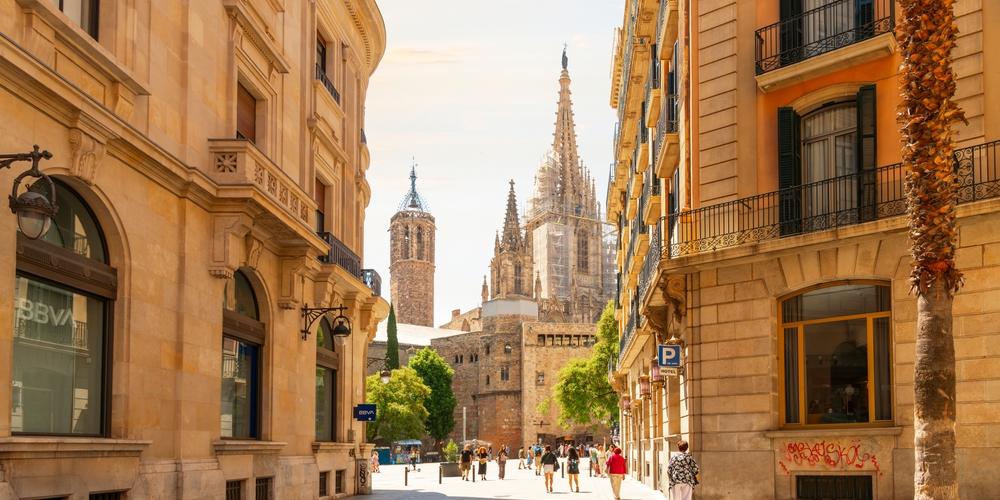
The fact that the meeting took place in Barcelona added an extra dimension. The city, with its rich and sometimes turbulent history, provided a tangible backdrop to the theme. Visits to historical sites and museums showed how war and memory are embedded in the urban landscape — and how law and history are intertwined far beyond the lecture hall. The experience in Barcelona offered more than academic knowledge. It highlighted that the end of a war is not a sharply defined moment, but a complex process that unfolds over years — sometimes decades.
For the participating students, one insight became particularly clear: anyone seeking to understand the present, or contribute to solutions for future conflicts, must first understand how the past has been legally processed.
EUTOPIA Connected Learning Community
The exchange is part of EUTOPIA, an alliance of European universities of which the VUB is a founding member. Within this network, students collaborate in international learning communities focused on complex societal challenges. An EUTOPIA Connected Learning Community (CLC) is an international learning group within the EUTOPIA network in which students, lecturers and researchers from different universities work together on a shared theme, combining education, research and practice. The legal history project is one such example: students work together across borders over several months, ultimately bringing their research together at a physical “peak event”. In Barcelona, this collaboration came vividly to life. Presentations flowed into discussions, perspectives were exchanged, and differences in legal traditions became a source of new insights.