


How large is the VUB today, where does it invest, and what does it deliver for students and society? The new edition of Facts & Figures, containing data from the 2025 calendar year, provides a clear answer. The overview brings together figures on research, education, innovation and societal impact. But behind those numbers lies a clear common thread: science is not a separate pillar, but the driving force behind the entire university. Rector Jan Danckaert: “We have reformed our research structures, professionalised innovation, renewed our education and made leadership more people-centred.”
The VUB’s research engine is running at full speed. In 2025, the VUB invested €155.1 million in research activities. These resources support a broad academic ecosystem comprising 2,650 scientific staff members and 2,326 PhD researchers across three doctoral schools. The result is a strong research output, with more than 2,600 scientific publications in a single year. Research increasingly leads to tangible applications as well, with 228 active patent families and 52 spin-off companies originating from VUB research.
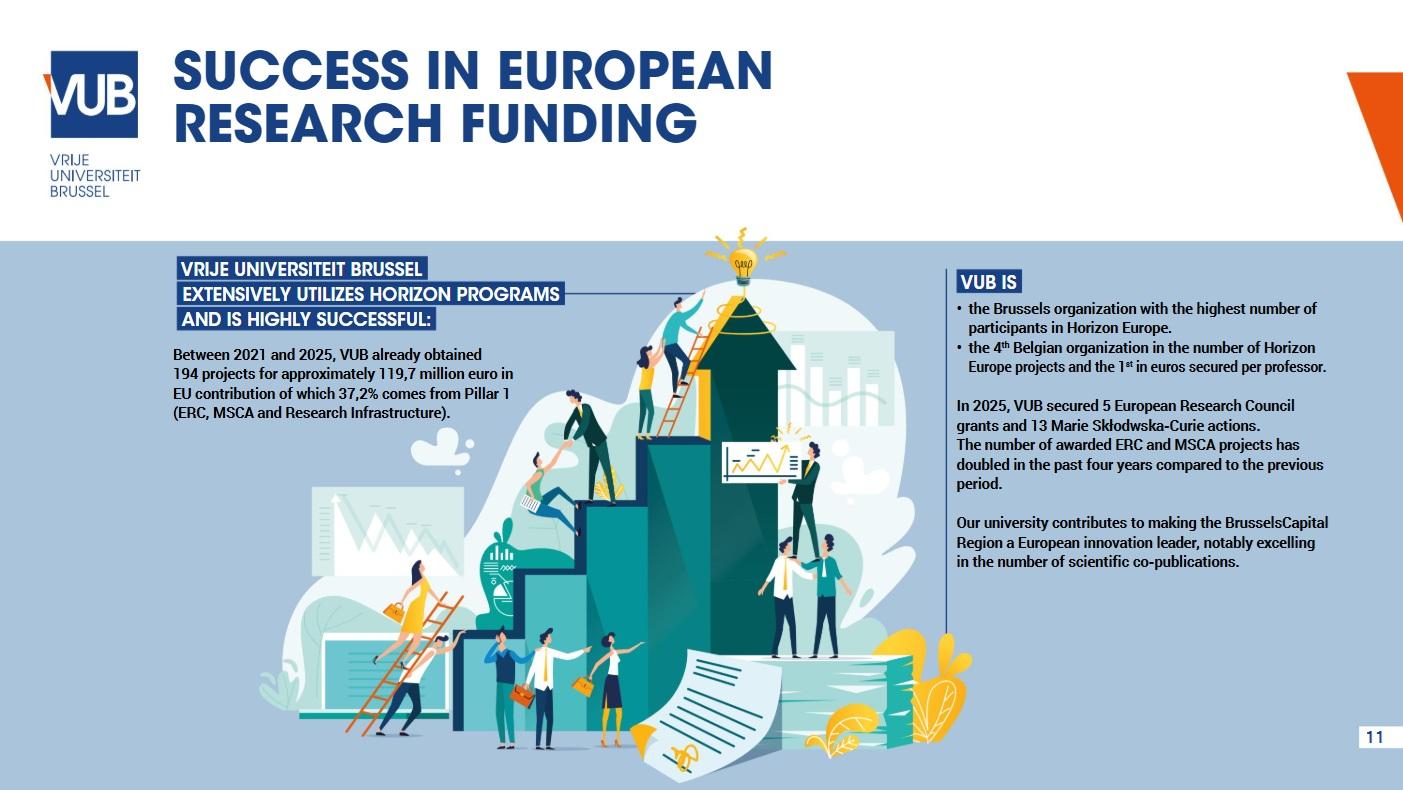
The university also performs strongly on the international stage. Between 2021 and 2025, the VUB secured 194 European research projects, representing nearly €120 million in funding. The university achieved particularly strong results in prestigious programmes such as the European Research Council and the Marie Skłodowska-Curie Actions, and ranks among Belgium’s leading universities in terms of European research funding per professor.
Education rooted in science
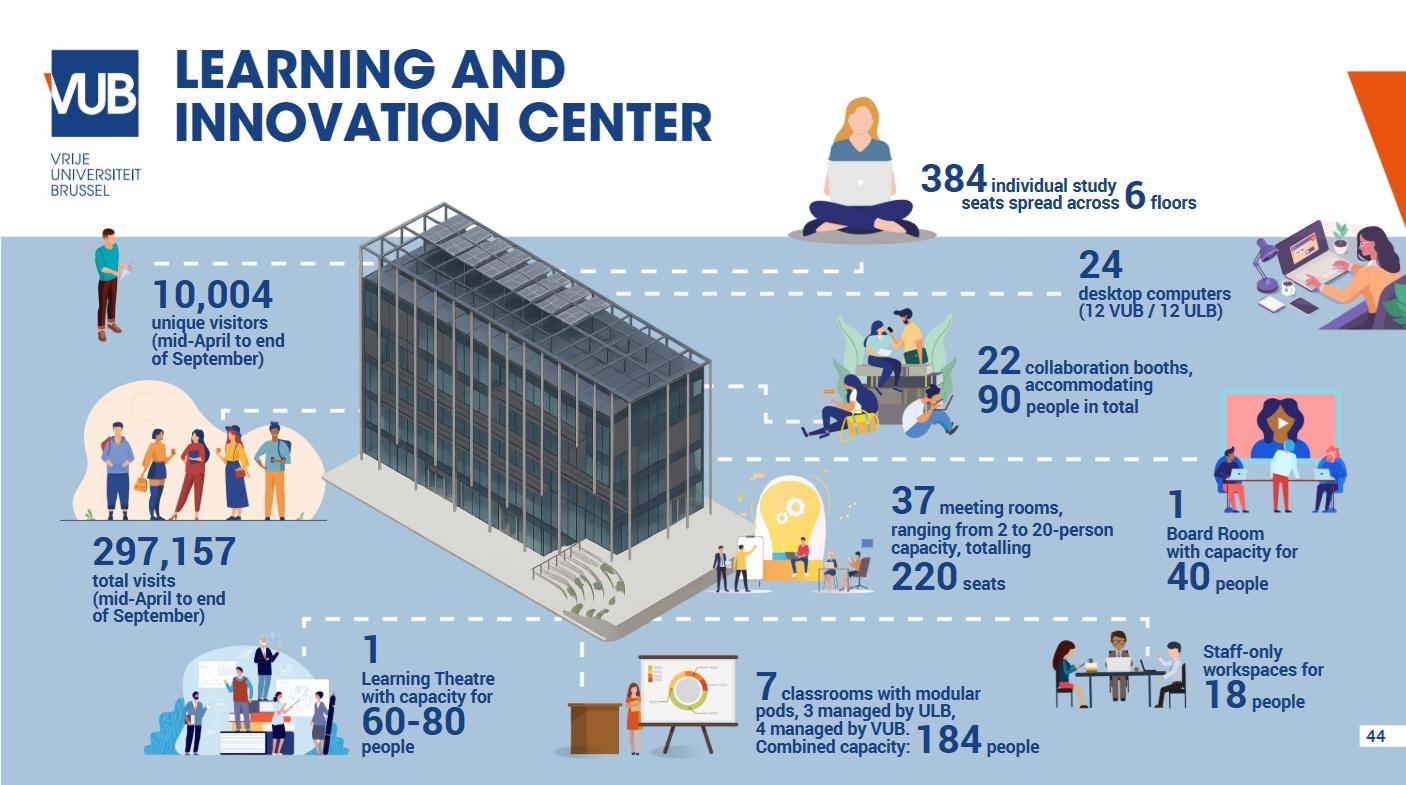
Research does not remain confined to publications and laboratories. The VUB positions itself clearly as a university where education is built on science. In the 2025–2026 academic year, the university has 24,695 students enrolled in programmes that are continuously enriched by the latest research insights. Students not only engage with existing knowledge, but also learn how that knowledge is created through experimentation, analysis and critical thinking. The international character of this education is particularly striking. More than 6,000 students come from abroad, representing 151 different nationalities. This diversity reflects the international research environment in which the VUB operates and strengthens the interaction between education and science. Its location in Brussels, the capital of Europe, undoubtedly plays a significant role in this. The close connection between research and education is also reflected in concrete initiatives. The university invests in innovative learning environments, such as the Learning and Innovation Center, where new approaches to education are developed. At the same time, it responds to current developments, for example by reviewing thousands of course components for the impact of artificial intelligence. In this way, education remains closely aligned with evolving scientific insights and societal needs.
The impact of science extends far beyond students and researchers. The VUB strongly emphasises societal engagement, among other things through interdisciplinary research networks that focus on major challenges such as climate change, mental health and urban development. Research is actively shared and translated into practical applications. “Relevance means recognition by international peers as well as making a meaningful contribution to society,” says Danckaert. In 2025, more than 7,500 people participated in the university’s outreach activities, and hundreds of researchers received support in communicating their scientific work.
This societal role is also reflected in the collaboration with the university hospital UZ Brussel, where research, education and care come together on a daily basis. Innovations in medical technology, such as new imaging techniques or treatments, are directly translated into patient care. In addition, the university ensures that research also generates economic impact. Through the Industrial Research Fund and various incubators, research ideas are transformed into applications and entrepreneurship. The Research Park in Zellik plays a central role as a growing innovation hub, where companies, researchers and start-ups collaborate. A concrete example of this investment strategy is the installation of a 7 Tesla MRI scanner, a unique research infrastructure that offers new possibilities in medical imaging and strengthens collaboration at both Flemish and international level.
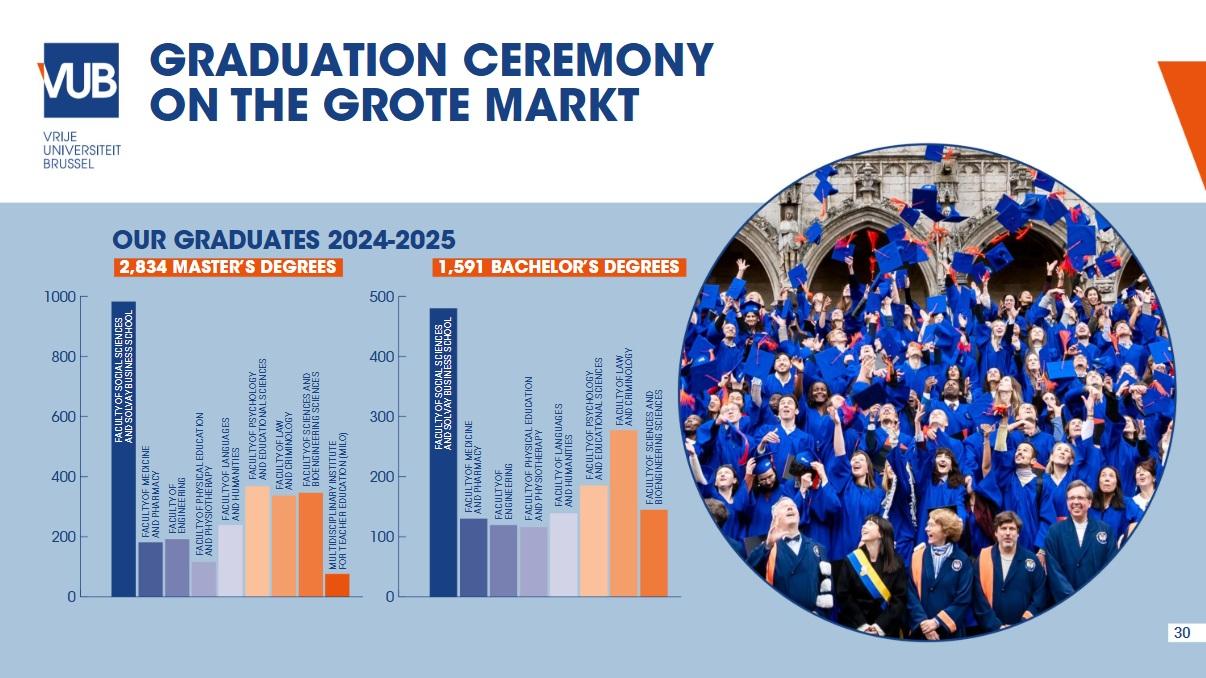
Perhaps the greatest societal impact lies in the scientifically trained graduates whom the university proudly produces. Each year, the VUB awards thousands of degrees. Students celebrate annually during the Graduation Ceremony on the Grand Place in Brussels, which has meanwhile become a defining tradition of the city. In addition, hundreds of doctorates are completed every year. Together, these graduates form an alumni network of more than 80,000 registered members. Jan Danckaert: “Science and education are at the core of our mission. We continue to pioneer in research and to valorise where it creates societal added value.”