

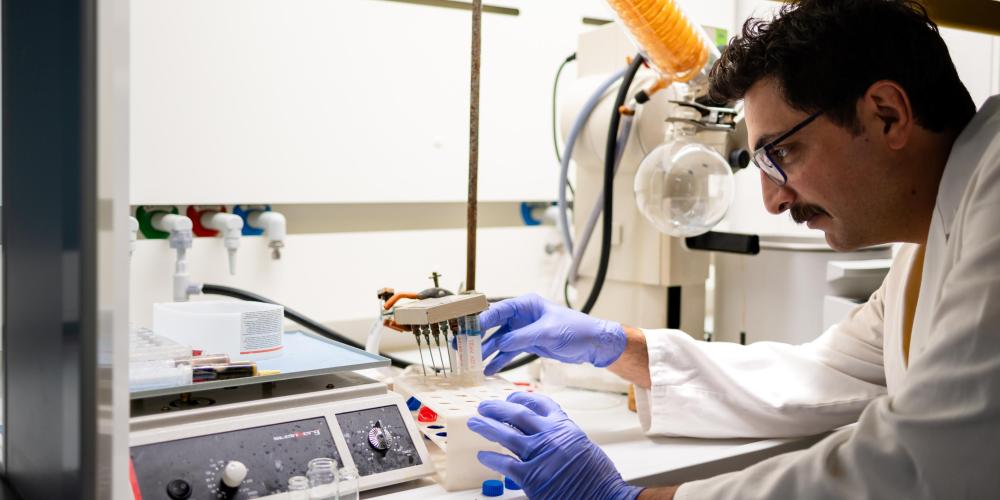


The prestigious Leonidas Zervas Award has been awarded this year to VUB Professor Steven Ballet. It is an international top prize for an individual researcher, but also a well-deserved recognition of four VUB research groups that have joined forces. Together, they combine their expertise to cut, stabilise and miniaturise peptides, thereby bridging the gap between fundamental chemistry in the laboratory and the medicines that could make a difference for patients tomorrow.
Steven Ballet
“A linear peptide has a head and a tail, just like a snake. We chemically attach the tail to the head”
Professor Steven Ballet (head of the Organic Chemistry research group)
The Leonidas Zervas Award is one of the highest distinctions in the field of peptide research. What does this award mean for Steven Ballet and his team? “It is an enormous honour and an international validation of the hard work that our entire research group has been carrying out here since 2010. This award underlines the typically translational mindset of the VUB: we build bridges between groundbreaking fundamental chemistry in the laboratory and innovative therapies for the clinic.”
Successful scientists stand on the shoulders of giants, as the saying goes.
“That is certainly true in our case. We are building on the legacy of my distinguished predecessors, Professors Georges Van Binst and Dirk Tourwé. It is gratifying that we can continue this tradition of excellence and translate it into modern medical applications.” This research sits at the intersection of pure chemistry – in the form of peptide research – and new medicines. How does that work?
“Peptides are short chains of amino acids. They play a crucial role in our bodies, but as conventional medicines they have one major drawback: they are unstable. In the body, they are broken down extremely quickly by enzymes. In our laboratory, we design tailor-made amino acids and apply innovative techniques to control these peptide structures with great precision and make them more stable.”
How do you achieve that?
“One of our specialities is the cyclisation of linear peptides. A linear peptide has a head and a tail, just like a snake. We chemically attach the tail to the head, creating a cyclic peptide. That sounds simple, but the result is that enzymes can no longer nibble away at it. Such molecules can therefore survive in the human body.”
Does that lead to new medicines?
“It certainly can. For example, we have developed hybrid painkillers. They are as powerful as conventional opioids, but without their dangerous side effects, such as addiction and the risk of respiratory failure.”
“Steven Ballet wants to create an extremely small nanobody that still remains functional. That would be an immense medical breakthrough”
Professor Nick Devoogdt (Molecular Imaging & Therapy – MITH)
For medical applications, there is intensive collaboration with the Molecular Imaging & Therapy (MITH) research group. Within the Faculty of Medicine, this group conducts clinical and translational research.
Nick Devoogdt
How did this collaboration come about?
“In the clinic, we need highly specific molecules. To forge those, you need true top scientists in fundamental chemistry. Steven Ballet is one of them.”
What exactly does he do for your team?
“Our group develops new diagnostic methods to detect diseases more quickly and accurately, particularly through PET scans. To make this imaging possible, we need to attach a radioactive label to a probe. A probe is a small molecule that binds very specifically to a particular disease process or tumour. Steven develops these peptides and designs the chemistry required to link radioactivity to them in a stable way.”
You are collaborating on a process you call ‘minimisation’. In other words: making things smaller. What is the objective?
“For years, we have been using nanobodies very successfully to diagnose diseases. These are very small, highly specific antibodies. But we discovered that it might work even better if we could make the nanobodies even smaller.”
How much smaller?
“As small as possible. A nanobody consists of around 125 amino acids. Together with Steven, we are trying to reduce this to the absolute essential core: a peptidomimetic – a more stable and effective version of a peptide – consisting of only 10 to 30 amino acids, while still binding perfectly to the disease target or tumour.”
What if you succeed?
“If Steven finally cracks that code, it would represent an enormous clinical and economic breakthrough. Today, nanobodies have to be produced biologically using bacteria or yeast. That is a complex, uncertain and extremely expensive process; optimising such a molecule for clinical use can easily cost millions and take years.”
And that would not be the case with a minimised peptide?
“Those could simply be synthesised chemically in the laboratory. Scaling up production would be far more cost-effective and much easier. It is the holy grail for the clinic.”
Sophie Hernot
“In cancer treatment, hydrogels release their therapeutic nanobodies in a controlled manner over a longer period of time”
Professor Sophie Hernot (Molecular Imaging & Therapy – MITH)
The diagnostic probes used in PET scans are not the only form of collaboration between fundamental chemistry and radiochemistry. Professor Sophie Hernot and Steven Ballet are also developing biomaterials together.
Professor Sophie Hernot and Steven Ballet are also developing biomaterials together. What exactly are they?
“Steven’s group develops hydrogels based on natural, biological and biodegradable peptides – absolutely no plastics. These biogels contain molecules for targeted drug delivery.”
What is your contribution?
“We investigate how these hydrogels behave in a living organism. To do so, we label them with radioactive or fluorescent substances. Using intravital imaging – imaging within a living organism – we can visualise exactly how the release process unfolds and where the drug travels within the body over time.”
So this research really works both ways?
“It is precisely this multidisciplinary collaboration that makes the research so special. By combining chemistry, biology and advanced imaging techniques, we can answer questions that no single discipline could solve on its own. That allows us to make much greater advances.”
Have you already achieved concrete results?
“Indeed, and they are quite spectacular. Recent preclinical tests have shown, for example, that these biogels dramatically improve the tumour-targeted uptake of therapeutic nanobodies against cancer.”
How does that work?
“The gel keeps the medicine localised and releases it gradually over a longer period. This results in much more effective immunotherapy with fewer systemic side effects. Here too, the integrated approach makes the difference: because Steven can modify the basic building blocks, we are able to evaluate very rapidly and repeatedly how these changes affect the intended application. This interaction accelerates the optimisation process and increases the likelihood of clinical breakthroughs. The societal relevance is enormous.”
How well known is this work in academic circles?“Increasingly so. That was evident recently at international symposia, where our PhD researchers received the highest awards for their presentations on these biomaterials.”
“If he feels like designing a completely new letter that does not exist in nature, he simply does it”
Professor Jan Steyaert (Director of the VIB-VUB Centre for Structural Biology)
Another crucial VUB pillar in this success story is structural biology.
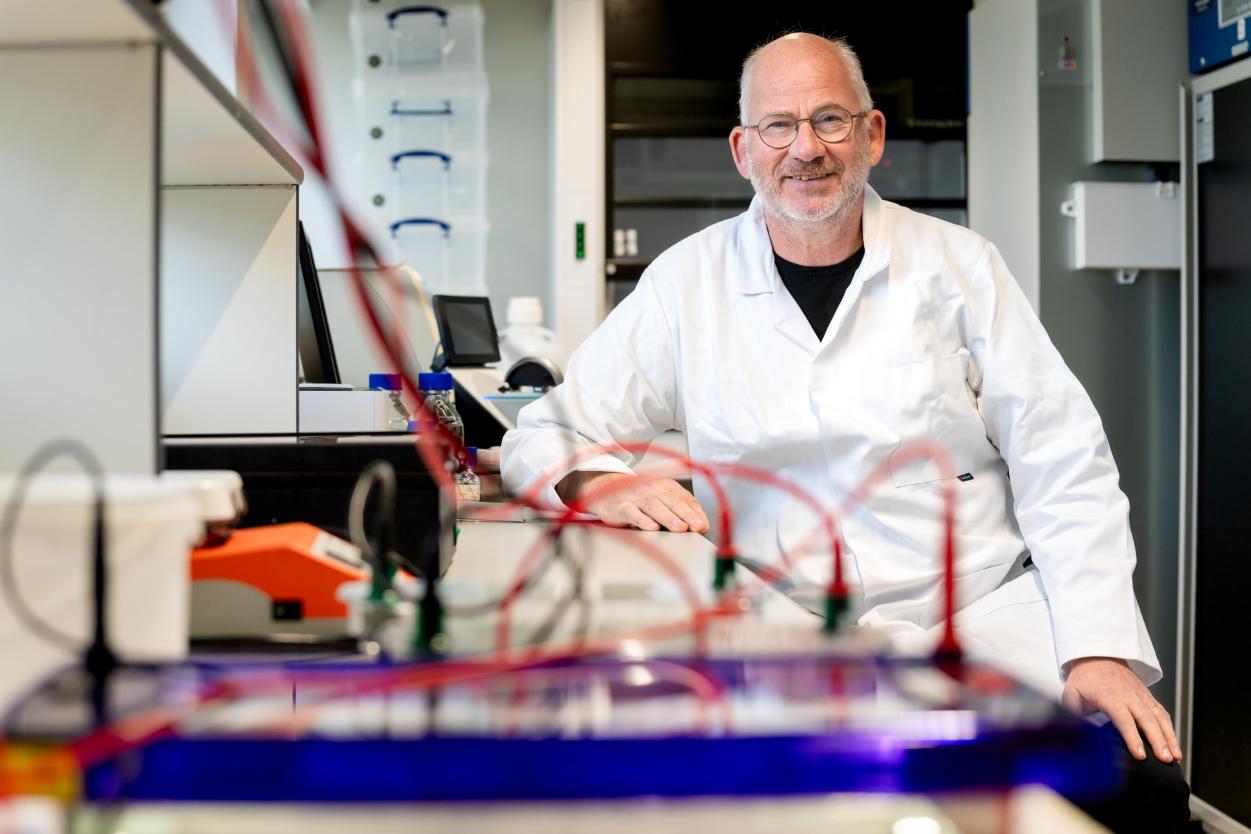
Jan Steyaert
How does the nanobody research of Professor Jan Steyaert, which previously contributed to Nobel Prize-winning research, connect to Steven Ballet’s work?
“We have worked on nanobodies for twenty years. They are fantastic biomolecules, but they remain complete proteins consisting of around 125 amino acids. What Steven essentially does is reduce these large proteins to something much smaller, while aiming for exactly the same therapeutic effects and applications.”
How does he achieve that?
“Biologically, we are limited to the twenty natural amino acids – the twenty natural building blocks, so to speak. But Steven can combine natural amino acids with synthetic building blocks through his synthesis technologies. I see it this way: biology has only twenty letters, whereas Steven has fifty or a hundred with which to write sentences. Where we need an entire book, he writes a short, powerful sentence. This is truly ‘next-generation biologics’.”
What are the concrete advantages of these shorter, synthetic sentences compared with larger proteins?
“The advantages are enormous and open up entirely new frontiers. Our natural proteins, for example, are so large that they cannot pass through cell membranes. They also cannot cross the blood-brain barrier and therefore never reach the brain. With his smaller peptides, Steven may be able to overcome those barriers in the future.”
Are there any other advantages?
“A large protein cannot be administered orally; it always has to be injected into the bloodstream. A small, stable peptide could potentially one day be delivered in pill form. That is far more comfortable for patients.”
Do your fields ever overlap?
“Never, and that is exactly what makes it so beautiful. Our technologies are entirely complementary. I first do the purely biological work with biomolecules. Once we identify interesting targets or mechanisms, Steven translates them into smaller, synthetic entities. He does this using an automatic, programmable synthesiser that literally allows him to determine which letter to attach to the next.”
That sounds as though he can recreate nature.
“If he feels like designing a completely new letter that does not exist in nature, he simply creates it himself. That is Steven’s playground. It leads to groundbreaking science that is also much more compact and therefore more amenable to modern tools such as artificial intelligence.”
“Our laboratory is a breeding ground for top talent that goes on to occupy key positions in leading pharmaceutical companies”
Professor Steven Ballet (head of the Organic Chemistry research group)
The scientific ‘north-south connection’ between Etterbeek (fundamental chemistry in the north of Brussels) and Jette (the medical faculty in the south of the city) is clearly bearing fruit. Nick Devoogdt describes this as the perfect example of the added value of the VUB’s Strategic Research Programme funding.
“Physically and institutionally, we operate in completely different worlds. But thanks to SRP funding, we have been able to strategically recruit researchers who can build bridges and learn each other’s language. Without that support, this cross-fertilisation would never have become so structurally embedded.”
The fact that the Leonidas Zervas Award was awarded to Steven Ballet is, of course, closely linked to the 172 publications and seven patents to his name. Yet his colleagues especially praise his role as a mentor. That may well be the recognition he values most. “Since 2010, we have had the privilege of training 22 PhD students, 60 Master’s students and 24 postdoctoral researchers. You never run a laboratory on your own; it is a breeding ground for top talent. When I see our VUB graduates moving on to key positions at leading companies such as Janssen Pharmaceutica, Pfizer and GSK, I know that we have successfully built that bridge. This Leonidas Zervas Award is a tribute to the entire team and an incentive to continue innovating for the healthcare of the future.”