



The turmoil in the Schengen area is regrettable, but it offers a revealing insight into the situation in which the EU and its Member States now find themselves, writes Merijn Chamon in De Standaard.
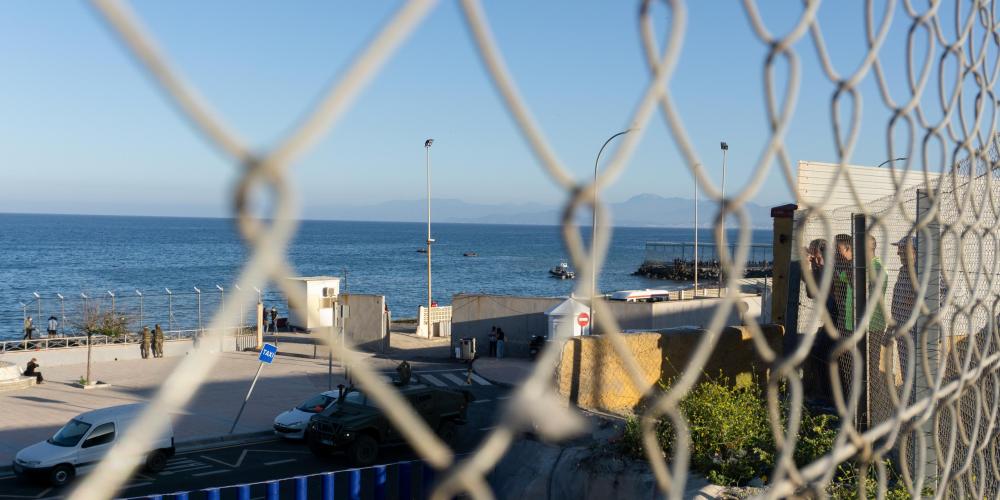
A brief recap. Morocco orchestrates a mass crossing into the Spanish enclave of Ceuta in retaliation for the Spanish Prime Minister’s visit to Algeria. Most of those involved – it is difficult to speak of migrants, as there was no intention to migrate – returned to Morocco shortly afterwards. Yet other EU Member States are up in arms. This is remarkable: although Ceuta is part of Spain, it is not part of the Schengen area. When Schengen was established, Spain stipulated that it would continue to carry out identity checks on people travelling between Ceuta and mainland Spain or other EU Member States. There is therefore little risk to the rest of the EU. The priority should be to send a clear message to Morocco on behalf of the EU as a whole.
Nevertheless, the Italian government loudly announced the introduction of border controls with Spain. It is a fine piece of political theatre, especially since Italy does not appear to be actually checking every flight arriving from Spain. Even so, Italy is violating the Schengen rules, as internal border controls may only be reintroduced where there is a genuine threat to public policy – which is not the case here.
This is nothing new. For more than a decade, several Member States have been reintroducing border controls on the basis of vaguely defined risks, including those supposedly arising from the Syrian civil war, the war in Ukraine and, more recently, the conflict in Iran. The claim that these conflicts pose a concrete threat to internal security and make border controls necessary is, to put it mildly, implausible. Moreover, such controls are supposed to be exceptional and temporary. The Court of Justice reminded Austria of this as recently as 2022. Although the Schengen Borders Code was relaxed in 2024, the fundamental principle that internal border controls must remain exceptional and temporary still stands.
Commission stands by
Spain subsequently responded by issuing Italy an ultimatum and, in turn, introducing border controls with Italy. In doing so, Spain is also violating EU law, in two respects: no concrete threat can be demonstrated and, unlike under international law, retaliatory measures between Member States are prohibited under EU law, as the Court of Justice has repeatedly confirmed.
EU Member States thus find themselves caught in a spiral of performative politics, sacrificing the rule of law in the hope of scoring easy political points.
There is, of course, nothing new about national politicians focusing on the short term and acting with their domestic constituencies in mind. Indeed, this is an important reason why the EU was given independent institutions tasked with safeguarding the general interest and taking a longer-term view. Yet this is where things are also going wrong. For a decade, the European Commission has stood by as Member States undermine the Schengen area, without taking meaningful action. Not a single Member State has been brought before the Court of Justice for breaching the conditions governing the reintroduction of internal border controls.
The reason is not hard to find: in the current political climate, populists would immediately accuse the Commission of undermining national sovereignty and imposing an ‘open-borders policy’. As a result, it limits itself to issuing critical opinions to Member States that introduce costly and ineffective border controls.
The crisis in Schengen is therefore symptomatic of our time. Politicians hope to gain popularity through blatant violations of the law and by pursuing – or merely announcing – ineffective and costly policies. Meanwhile, the institution that is supposed to rise above the political fray has itself been paralysed by the collective hysteria surrounding migration. And citizens readily accept it.
Bio
Merijn Chamon is Professor of European Law at VUB. His research focuses on the constitutional and institutional law of the European Union, as well as the EU’s external relations.