



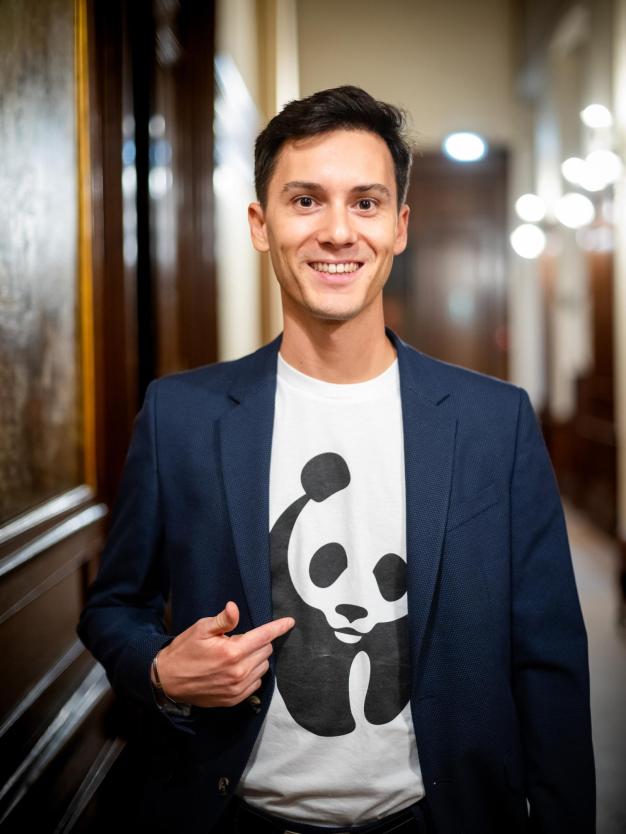
After completing his Master’s in Biology, Steven Van den Panhuyzen went on to pursue an Educational Master’s at VUB. Today, he heads WWF Belgium’s youth and education department. “I dream of a future where the importance of climate and environmental education is no longer called into question.”
What exactly does your current job involve, and what do you enjoy most about it?
Steven Van den Panhuyzen: “After a year of teaching, I got the opportunity to join WWF Belgium. I worked there as an Education Officer for four years, developing teaching materials for schools, creating workshops and training volunteers to deliver them in schools. Recently, I became manager of WWF’s youth department.
I find pretty much everything about my job fascinating. (laughs) What I particularly enjoy is the idea that we can plant a seed in young people and hopefully inspire them to take action on sustainability and climate change later in life. We try to do that in a playful way, without preaching. For example, we’ve developed escape games about plastic pollution.
Children don’t always have easy access to nature either. That’s why many of our workshops are free, and the Ranger Club’s extracurricular nature activities are open to all young nature lovers and their families. On top of that, I get to work with a highly motivated team of people who are passionate about nature. And then there’s our entire network of incredibly committed volunteers who get involved at events, camps and schools. It’s a real privilege.”
What do you remember most about your time at VUB?
“What I remember most about my Educational Master’s are the interesting school projects that went beyond simply teaching in the classroom. For example, we also surveyed parents to explore how we could involve them more closely in their children’s learning. I also had some great lecturers who taught their subjects with real passion.”
Are there any connections from your student days that have stayed with you?
“One person who comes to mind is Heidi Depraetere, who taught the course ‘Onderzoekende school’ [Inquiry-Based School]. She not only had an extensive knowledge of the academic literature, but also gave us practical tips and was closely involved in our projects. She was a truly inspiring lecturer. I also made some great friends during my time at VUB, and we’re still in touch today.”
Did you have a clear idea of what you wanted to do after graduating?
“As a child, I wanted to become a teacher, so choosing teacher training after my Master’s in Biology felt like an obvious next step. Later, that ambition became a little more specific: I wanted to work for an NGO, preferably in a role where I could make a difference in the world. When I saw the vacancy at WWF, all the pieces of the puzzle fell into place. I’ve been working here for almost five years now.”
Has VUB had a strong influence on the way you think?
“The V stands for freedom of expression, but also for having the courage to speak your mind, even when the circumstances aren’t ideal. That’s something I value and something I learnt during my time at VUB. As a teacher, you also have an important role to play in making young people aware that they have a voice – and that their voice matters.”
Do you think student life is different today?
“Definitely. The future has become more uncertain. Just think of the impact of the pandemic, which was caused by the way we interact with nature. Students missed out on Erasmus exchanges, couldn’t take part in student societies and saw their social lives put on hold for a long time. That leaves its mark, especially because your student years are precisely the time when you’re discovering who you are and what you stand for.”
“I believe in the multiplier effect: making a difference by inspiring others to take action too”
How are you trying to make a difference in society today?
“I believe in the multiplier effect. It’s not just about trying to make a difference as an individual, but about inspiring others to do the same. We train a lot of volunteers, for example, who then go into schools and inspire young people in turn. Just yesterday, I was training future teachers myself, and I think it’s important to keep doing that.
The impact of education is still too often underestimated. We can wait for politics, legislation or industry to change, but as teachers, we should never underestimate our own power to set things in motion. If we can bring people along with us, our message becomes all the stronger.
To be clear, we never tell people that they have to do this or that. It all starts with personal conviction. With making a conscious choice to fly less, sort your waste, eat more plant-based food or shop locally, for example.”
What do you still dream of achieving in your career?
“I dream of a future where climate and environmental education is no longer called into question. The government recently decided to end funding for MOS: duurzame scholen, straffe scholen [MOS: sustainable schools, strong schools] from September 2026. That’s particularly disappointing because its impact and relevance can clearly be demonstrated.”
What is the one piece of advice you would give to students graduating today as future teachers?
“Wherever possible, incorporate climate and nature education into your lessons and work together with other teachers. Try to pass on not only knowledge, but skills as well. And make room for the many initiatives by national and international environmental organisations working to tackle climate change, protect biodiversity and promote sustainable development. They offer an important counterbalance to the often bleak picture of our climate presented in the media.”