



In the early 1980s, Flanders Technology International set out to help Flanders shake off its industrial past and embrace technology and innovation. The Flemish Government revived that tradition in 2024, with VLAIO taking the helm in 2026. On 16 October, a new edition will launch under the slightly revised name Flanders Technology & Innovation (FTI), bringing a month of activities to eight cities. VUB Vice-Rector Innovation & Industry Relations Peter Schelkens welcomes the initiative. After all, it helps academic knowledge find its way into businesses and wider society – exactly where it belongs.
Scientific research is expensive. Where does a university find the money to fund it all?
Peter Schelkens: “A large share of research funding is secured by researchers themselves. We receive funding for both fundamental and applied research from government and industry. When it comes to securing European research funding, we rank among the leading universities in Europe. As a university, we also receive structural core funding from the government, which we can allocate to research teams. Teams can obtain this funding based on their track record in areas including fundamental research, applied research and knowledge valorisation.”
Can fundamental research also create economic value?
“Absolutely. Many results that are ultimately brought into practical use have their origins in fundamental research. That research regularly generates intellectual property and inventions that can be patented. It is a misconception that fundamental research only produces theoretical results whose practical value becomes apparent decades later.
“To be clear, we need both fundamental and applied research. Both are essential to keeping the innovation ecosystem alive. As a university, we also create structures that allow us to bring the right people and disciplines together relatively easily when a new field of application or technology emerges. That can, for example, lead to the creation of a spin-off. We mainly establish a new company when we have developed a technology that existing businesses are unable to take forward. Our first preference, however, is to transfer the technology and/or license the intellectual property to an existing company, at market-based conditions.”
Is there not a risk that universities will increasingly focus on research with economic potential?
“No, because without fundamental research there is no innovation – it really is that simple. It may not produce an immediate result, but the findings that emerge from it can prove extremely valuable in the long term. The key is to maintain the right balance between different levels of research and ensure that the entire pipeline continues to be fed. I also want to stress that we are a university that places great importance on academic freedom. We are what is known as a comprehensive university, meaning that all the main research disciplines are represented. As a university, you have to nurture and support that entire system. A great deal of progress happens precisely at the intersection of different disciplines.”
“Without fundamental research, there is no innovation – it really is that simple”
How often are spin-offs created from VUB research?
“We are currently establishing four to five spin-off companies a year. These are not straightforward processes. You need to find investors and reach agreements on how intellectual property will be managed and owned. That takes a great deal of time and can place a considerable burden on the founders and researchers involved. That is why we are now working on a faster and more transparent process, making it easier for everyone involved to create a spin-off. We aim to roll this out during the current academic year.”
In which areas does VUB have a particularly strong track record in spin-offs?
“They span a wide range of disciplines, but there are a few areas in which we are particularly strong. One is biotechnology and medical technology. Ablynx, which works with Nanobodies® and has since been acquired by Sanofi, is an important example. Another major player is Collibra, in ICT. Both are unicorns (editor’s note: start-ups that are not yet publicly listed and are valued at $1 billion or more).
We also have spin-offs in sustainable energy, mobility and energy production, including offshore wind energy. Electronics, photonics and robotics are other strong areas.”
Why is it important for a university to create companies like these?
“A spin-off can ensure that a technology that might otherwise remain unused actually reaches the outside world. At the same time, it creates economic impact locally. Jobs are created within the company itself, but also among suppliers. Over time, money may also flow back to the university. That can happen through intellectual-property licensing, agreements under which part of the profits are returned, or when the company is sold. But we are generally not talking about enormous sums of money. Especially when economic conditions are difficult, it can take a very long time for companies to grow. These are therefore very long-term efforts.
The university does not become rich from this, by the way. Knowledge valorisation is first and foremost a form of service to society. We receive funding for fundamental and applied research, and we then have a societal responsibility to ensure that the results of that research are ultimately put to use. Of course, that will not be possible for every research result.”
“A spin-off can ensure that a technology that might otherwise remain unused actually reaches the outside world”
There will undoubtedly be people who are uncomfortable with the idea of research being commercialised. How do you respond to that?
“That debate was fought out in the past, and I hope we have moved beyond it by now. Of course, some researchers simply want to focus on research, and that is perfectly fine. Nobody is forced to pursue valorisation. It also requires a specific set of skills and sufficient critical mass within the research team. One important driver is the fact that today you almost always have to work across disciplines to achieve your goals. That quickly leads to collaboration with non-academic partners such as industry, hospitals and government. It also teaches you how the world outside academia works: how products and services are developed, how companies are created and managed, how teams are led, and so on.”
One sector that is constantly looking for this kind of expertise – and has considerable budgets available – is defence. How do you deal with research requests and potential investment from that sector?
“That is obviously an area where you have to proceed with the necessary caution. We have several ethics committees at the university, including one dedicated entirely to the dual use, military use and misuse of research. Defence-related research projects are routinely assessed by that committee. We find that most of these projects involve dual-use technologies: technologies with substantial civilian applications that can also be used in a military context. Technologies intended solely for military purposes are not developed here. At the same time, we believe we have to take our responsibility towards society. We live in a world that demonstrates every day that defence matters.”
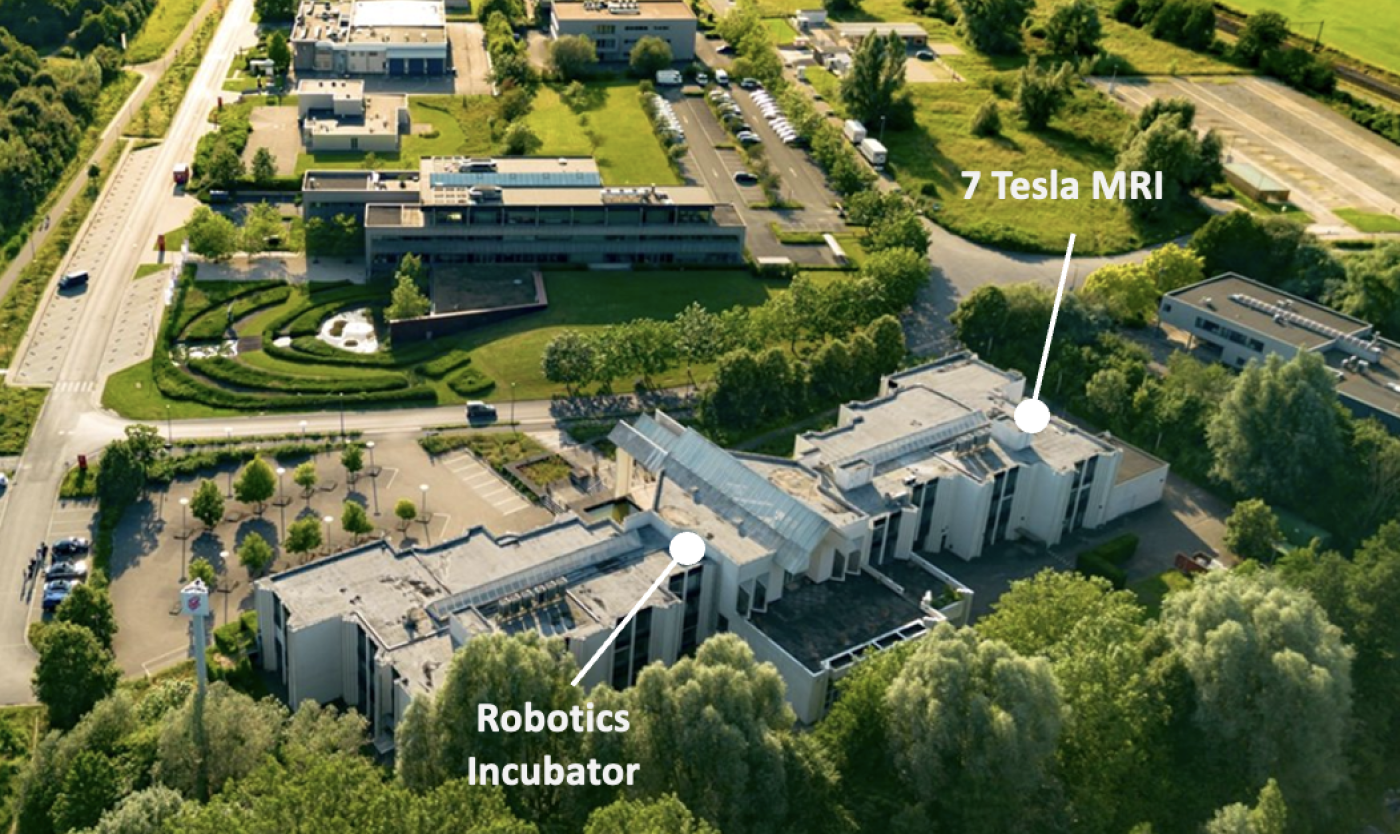
Researchpark Zellik
Can the university’s research infrastructure generate income as well?
“Yes. Our aim is to make our research infrastructure available to companies and other interested parties wherever possible. This is particularly useful when it comes to very expensive or unique infrastructure. If a piece of equipment costs €100,000, a company may decide to buy it itself if it expects to use it intensively. But if we are talking about a €5 million pilot line, a company is less likely to make that investment itself if it cannot be certain that it will pay off.
“One of our key sites in this respect is the research park in Zellik. Since this year, we have owned the site and are responsible for its entire operation. The ambition is to develop it into a sustainable, energy-neutral park over time, with research also focusing on these themes. The campus has a living lab for sustainable energy technologies, including battery research and the use of sustainable gases such as hydrogen and biogas. We also want to get a robotics incubator up and running during this academic year. That is one of our main objectives.”
Does collaboration with companies also benefit the research itself?
“Absolutely. Research infrastructure is used to carry out scientific research, but questions from companies can also generate new scientific questions. That creates cross-fertilisation and can help improve the infrastructure itself. It is a good illustration of the interaction between fundamental and applied research.
“One example is our Photonics Innovation Center, where specialised optical components are developed for companies. Having unique equipment also gives you an advantage when new research projects emerge. You may be invited to participate in projects precisely because you have that infrastructure available. And that, in turn, can generate new research funding.”
Bio
Professor Peter Schelkens is Vice-Rector Innovation & Industry Relations and a full professor at VUB. His research focuses on multidimensional signal processing and computational photonics. In 2013, he received an ERC Consolidator Grant. He has published more than 350 scientific papers and is involved in several spin-offs and patents.
Research in the spotlight at the FTI Festival
Just as in 2024, the FTI Festival returns this autumn, bringing together the Flemish Government, VLAIO and a range of partners to showcase Flanders’ strengths in innovation, research and technology development to the world. VUB is one of those partners and plays an important role in the FTI Brussels Festival, which offers activities for businesses and the wider public alike.
The programme includes Business Tracks featuring keynotes, pitches and open lab tours on the VUB campus, an Innovation Walk at Researchpark Zellik, demonstrations at the FTI Expo in Mechelen and much more.
“The FTI Festival is interesting because it allows you to reach both a professional audience and the wider public,” says Peter Schelkens. “It also supports our positioning towards government and strengthens our international profile.
“When Flanders Technology International was created in the 1980s to put Flanders on the map, it led to some major achievements, including imec and the Flemish Institute for Biotechnology (VIB). Hopefully, this edition of FTI will produce equally strong results.”
Would you like to find out more about VUB’s different contributions to the FTI Festival 2026? Or would you like to attend one of the events yourself?
More information and registration
Businesses, prospective partners and other interested visitors can get an exclusive behind-the-scenes look at our laboratories during the Fast Tracks on the VUB campus. More information and registration: