

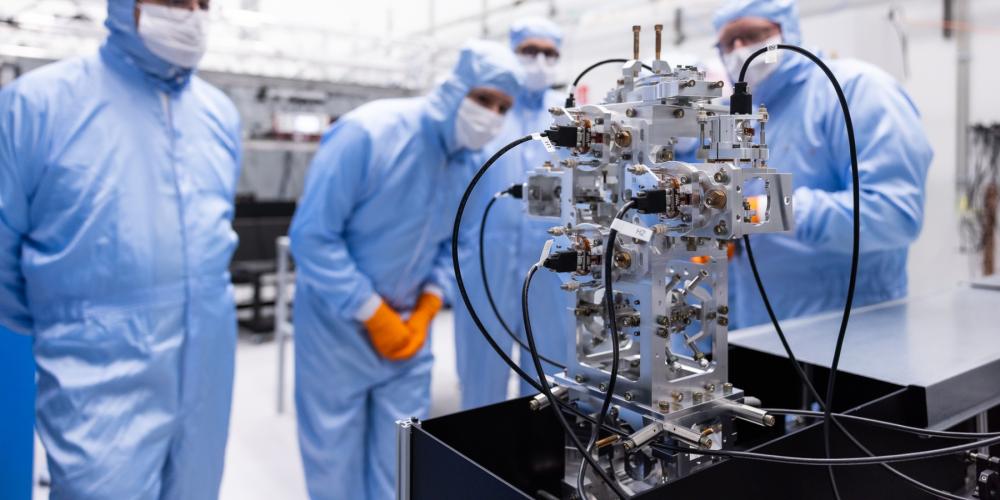


Observatories dedicated to the study of gravitational waves have already been established elsewhere, but they come with significant limitations the Einstein Telescope aims to overcome. Achieving this, however, requires so many entirely new technologies that scientists from Belgium, the Netherlands and Germany have set up ETpathfinder, a lab in Maastricht where all components for the Einstein Telescope are being developed one by one. Elise Van den Bossche, a doctoral researcher and member of the High Energy Physics team within the Physics Department at the VUB, already feels completely at home.
What is wrong with existing gravitational-wave observatories?
Elise Van den Bossche: “They suffer greatly from what we call ‘noise’, which interferes with the measurements. Because they are located at the Earth’s surface, they are, for instance, sensitive to seismic vibrations. We aim to mitigate this by building the Einstein Telescope several hundred metres underground, where such vibrations are more dampened. There is also ‘thermal noise’. It may sound strange, but even at room temperature the atoms in the mirrors of such a telescope vibrate too much. Since gravitational-wave measurements are extraordinarily precise, even the slightest vibrations affect our results. That is why it has been decided to carry out the measurements under cryogenic conditions, specifically at -200 degrees Celsius. However, this creates another problem: at that temperature, glass begins to vibrate even more. We therefore had to find a solution, which we did by making our mirrors from silicon instead of glass. Unfortunately, that led to yet another issue; the laser beam we used is absorbed by silicon mirrors rather than reflected. A solution was found in the form of a laser beam with a much lower frequency—in the infrared spectrum. The combination of these three new elements (cryogenic temperatures, a new mirror material and a new wavelength) has never been tested before. The aim of ETpathfinder is to design, test and prepare this technology for the Einstein Telescope. The detector will ultimately consist of two parts, combining both current technology (room temperature, glass mirrors and the ‘standard’ laser frequency) and these new innovations, thereby increasing its sensitivity.”
That sounds like quite a challenge…
“Indeed, every solution to one problem creates new challenges, like a row of dominoes that keeps on falling. Since all of this is new technology, there is no manual to follow. We also need to investigate and demonstrate that the combination of all these different solutions is compatible. Fortunately, we can carry out these experiments here at ETpathfinder—which is effectively a 10-metre-long prototype for the Einstein Telescope. Imagine having to overcome all those obstacles several metres underground… It will already be an immense task to replicate, on a much larger scale and below ground, the technology we are currently developing in our lab.”
What exactly is your role in this project?
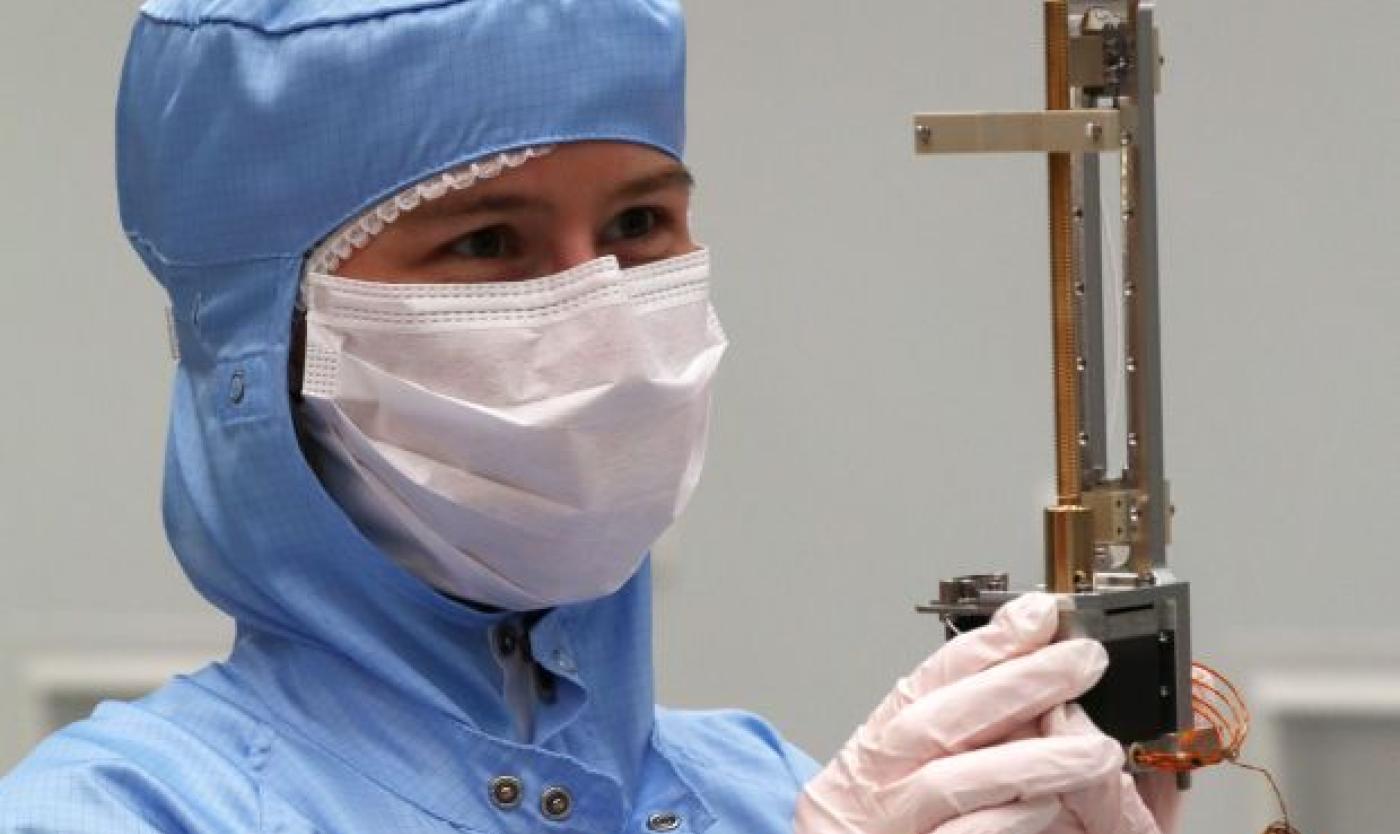
“So far, I have worked on two components of the ETpathfinder. The first is the so-called local control system, which we use to correct the oscillation of the mirrors. To minimise the impact of vibrations from the Earth’s surface—still measurable even deep underground—the mirrors that reflect the laser beams are suspended like pendulums. They may appear motionless, but tiny oscillations can occur, which naturally disrupt the measurements. With the local control system, we can measure these oscillations precisely and then correct them instantly using magnets.”
“Actually, it sounds a bit like how you cancel out background noise with active noise-cancelling headphones?”
“Indeed. You could compare it to that, in a way—a very expensive one, of course.” (laughs)
And what is your second project here at ETpathfinder?
“That’s the input mode cleaner, although we’re still working on it. Its purpose is to ensure that the laser beam we send out is as pure—as perfectly round—as possible. The better we achieve that, the more precise our measurements will be.”
So does that solve all the issues?
“Oh no, not at all. Current detectors, for instance, also suffer from quantum noise. This is a type of noise caused by the fact that the photons in a laser beam do not arrive neatly all at once at the mirrors, but rather in groups. We plan to address this using something called a quantum squeezer—essentially a kind of funnel that packs the photons more closely together, making them form a more uniform group. However, these quantum noise reduction techniques for the Einstein Telescope still need further development and investigation. And with a project like this, it is hardly surprising that unexpected problems keep arising—after all, it has never been done before, so there is no telling what else may come up. But we are confident we will find solutions to those as well.”
Bio
Elise Van den Bossche is a doctoral researcher and member of the High Energy Physics team within the Physics Department at the VUB, where she is actively involved in gravitational-wave research. She contributes to international experiments and data analysis to better understand the fundamental properties of matter and forces. Several days a week, she works at ETpathfinder in Maastricht on the development of the Einstein Telescope.