

AI is rapidly changing the work of translators and interpreters. But according to VUB senior lecturer Koen Kerremans, technology will not make human language expertise redundant. On the contrary: the more AI can do, the more important it becomes to assess whether its output is accurate and appropriate for a particular situation. Tomorrow’s language professional will combine strong linguistic and cultural skills with the ability to use technology critically and help steer multilingual communication.
Article series
AI is changing work. How is it changing education?
Artificial intelligence will fundamentally change the way we work. But what does that mean for students who are building their careers today? In this series, VUB professors explain how AI is affecting their field, which competencies will become important in the future, and how degree programmes are adapting to a labour market in full transition.
Is there still a place for translators in tomorrow’s labour market?
Koen Kerremans: “Absolutely. There will continue to be a need for translation. Thanks to technology, and more recently generative AI, the possibilities for translating are only increasing. For companies, for example, AI lowers the barrier to providing product information in other languages more quickly and cheaply, making it easier to reach customers abroad. Human translators will remain necessary to assess whether that information is accurate and appropriate for the language and culture of the target audience. “This changes their role. Translators have been working with translation memories, terminology databases and machine translation for some time. Today, translators are increasingly given a pre-translated text to post-edit: checking the output and correcting it where necessary. As a result, the work is shifting partly from translation itself towards checking, revising and verifying. But that still requires a very high level of language proficiency and subject knowledge.”
What makes a human translator better than AI?
“AI can process a great deal of what is visible in language: words, sentences and increasingly the broader context. But communication is about more than that. There are communicative intentions, registers, cultural differences and specific expectations on the part of a client. These are things that are not always visible to an AI. Cultural and situational knowledge helps a language professional recognise such implicit communication needs.
An AI translation can be linguistically correct and yet still be unsuitable for the context in which it is to be used. The human translator therefore assesses whether the translation is accurate and whether it is appropriate for the target audience.”
“An AI translation can be linguistically correct and yet still be unsuitable for the context in which it is to be used”
When does that happen?
“Sometimes you encounter what we call false fluency: a text that reads very smoothly but nevertheless contains substantive errors. This can happen, for example, with specialised terminology. A language model can translate a technical concept very convincingly without the result actually being correct. In such cases, a translator may have more work checking the output than if they had started with a reliable translation memory or a validated terminology database. Producing text more quickly therefore does not automatically mean translating more efficiently.”
What impact is AI having on the work of interpreters?
“Here too, it is not black and white. Interpreters can use AI to prepare for an assignment, for example by gathering information about the subject and relevant technical terms. There is also a great deal of experimentation with speech translation and automatic subtitling, for example in online meetings. In well-defined situations, this can be useful, but in real, complex or high-risk conversations, you cannot simply assume that these systems are reliable enough to replace a human interpreter. “Take, for example, a doctor talking to a patient who speaks another language. If a message is translated incorrectly, the consequences can be serious. Emotions and intentions also play an important role. A patient may not say that something is unclear, but hesitate or give an evasive answer. An interpreter can pick up on such signals and ask for clarification without interpreting for themselves what the patient means. Non-verbal communication also contributes to meaning.
AI systems have become increasingly good at taking context into account over the years, but not all the relevant information from a conversation and its surrounding situation reaches the system. A fluent automatic translation therefore does not guarantee a successful conversation.”
How reliable are current systems?
“That depends heavily on the language combination and the domain. You cannot say: this is the best AI translation system today. What works well for English–Dutch in a particular field does not necessarily work well for another language combination or another subject. Much depends on the data on which the model was trained. Garbage in, garbage out: if there is a lot of noise or insufficiently high-quality data in a model, you will see that reflected in the output. The same applies to languages. Some languages are much better represented in the training data of AI models than others. English occupies a dominant position in many models. So-called low-resource languages, such as Tigrinya and Pashto, have far less digital language data available. As a result, systems are often less reliable for these languages. Dutch has a relatively large amount of digital language data, but it is less strongly represented than English in many models. There are also differences within a single language. Think, for example, of Belgian Dutch and Dutch as spoken in the Netherlands. If one variety is much more strongly represented in the data, it can also dominate the output. Models can also reproduce cultural or social biases present in their training data.”
“You cannot say: this is the best AI translation system today. Much depends on the data on which the model was trained”
Does this give language professionals a new role?
“I think it does. I am sometimes asked by people in the profession: which is the best system? As a language professional, you need to be able to advise on which system is suitable for a particular assignment. Not every text, for example, needs to be processed by the same large language model. Sometimes a smaller or more specialised model is more appropriate. In some cases, it may even be worthwhile adapting a model using high-quality data from the organisation itself. When doing so, you also have to take confidentiality and data protection into account. That, in my view, is an important future role for language professionals: not simply producing output, but also helping to determine which technology is used, how it is deployed and how quality is monitored.”
Are there sectors in which AI struggles to take over?
“Highly specialised fields certainly remain challenging. But literary translation is also a striking example. Literary translation is an art in its own right. Literature contains an author’s way of thinking, a historical context, a particular genre, imagery and rhythm. These are all layers that are much harder to capture in an automatic translation. The translator seeks to recreate that complexity and evoke a comparable literary experience in new readers. This is an area where a human translator can genuinely make a difference.”
How is the degree programme adapting to this rapid technological change?
“Our core mission remains to train students to become highly skilled language users with a profound understanding of culture and communication. Technological skills build on strong language proficiency and cultural knowledge. They do not replace that foundation. Students must also understand how AI systems work, what their limitations are and how to assess their output critically. That is why, for example, our bachelor’s degree in Applied Linguistics includes a course on language and AI, in which students learn what happens under the bonnet of these systems. The master’s programme covers multilingual AI and language technologies. Students also apply this knowledge in translation and interpreting workshops. They learn to justify their choices: why are they using a particular application, and what checks are necessary?”
“Students must also understand how AI systems work, what their limitations are and how to assess their output critically”
Why should I choose to train as a translator or interpreter today?
“Our students are now being trained as multilingual language professionals who understand multilingual communication, technology and the social context in which language is used. They learn not only to translate and interpret, but also to consider when technology can be used responsibly and how to safeguard the quality of multilingual communication. It is not just ‘human in the loop’, but really ‘human in control’: the human remains in the driving seat. From the 2027–28 academic year, the current master’s programmes in Translation and Interpreting will also be merged into a single Master of Arts in Translation and Interpreting. This reflects professional practice, where translators and interpreters increasingly combine different roles. We are not only preparing students for existing tasks; we are also teaching them to engage critically with new developments.”
Bio
Koen Kerremans is a senior lecturer at Vrije Universiteit Brussel (VUB), where he is affiliated with the bachelor’s programme in Applied Linguistics and the master’s programme in Translation. He teaches, among other subjects, research methods, terminology and translation technology, including multilingual AI. His research brings together terminology and specialised knowledge transfer, language technology and generative AI, and multilingual communication in public services. Kerremans is a member of the Brussels Centre for Language Studies (BCLS) research group.
In brief
- AI is fundamentally changing the work of translators and interpreters, but strong linguistic and cultural skills remain the foundation for understanding, assessing and guiding multilingual communication.
- Specialised, sensitive and complex communication remains particularly difficult to automate fully.
- The quality of AI translation depends heavily on the available data, the language combination and the context. Languages for which little digital data is available remain a major challenge.
- The language professional of the future will be more than a translator or interpreter: they will also be an expert in selecting, assessing and responsibly deploying language technology.
- VUB is increasingly integrating AI and language technology into its programmes, and from 2027–28 it will move towards an integrated Master of Arts in Translation and Interpreting.
Academic Opening 2026-2027
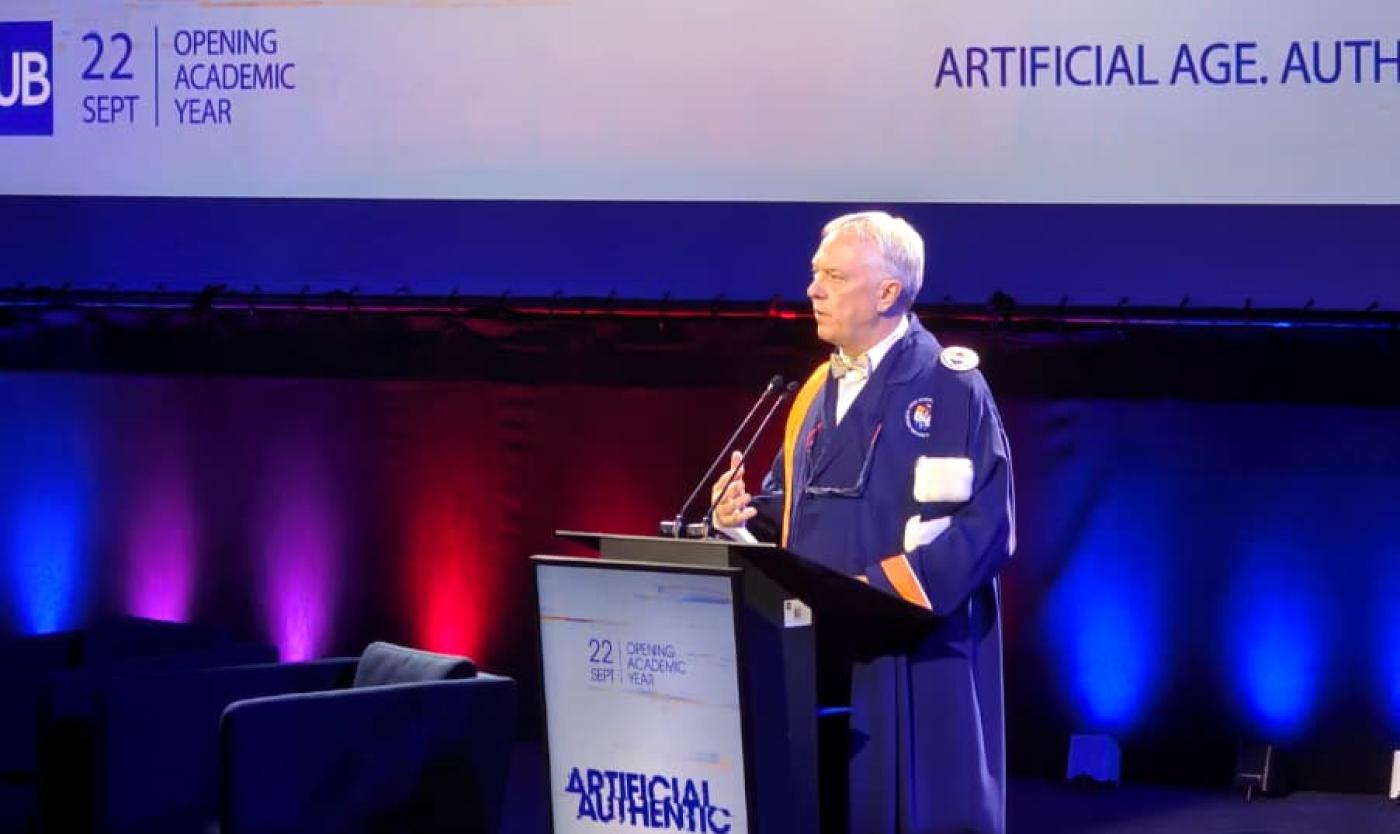
How do we prepare young people for a world in which artificial intelligence and technological change are having an ever greater impact? That question lies at the heart of the VUB's Academic Opening on Tuesday 22 September in Aula Q on the Etterbeek campus. Under the theme Artificial Age. Authentic Education?, the university will bring together students, researchers, lecturers, policymakers and societal partners for a debate on the future of education, knowledge and society.
For more information and to register, visit: Academic Opening 2026.
Also on 22 September: VUB Kick-Off
This year, the Academic Opening Ceremony and the VUB Kick-Off will take place on the same day at the Etterbeek campus. The Kick-Off is the annual welcome event that marks the start of the new academic year for students. Throughout the day, the campus will come alive with information stands hosted by VUB services, student associations and organisations from across Brussels. Students will have the opportunity to explore the wide range of services and activities available on and around campus, meet fellow students and take part in a variety of activities.