



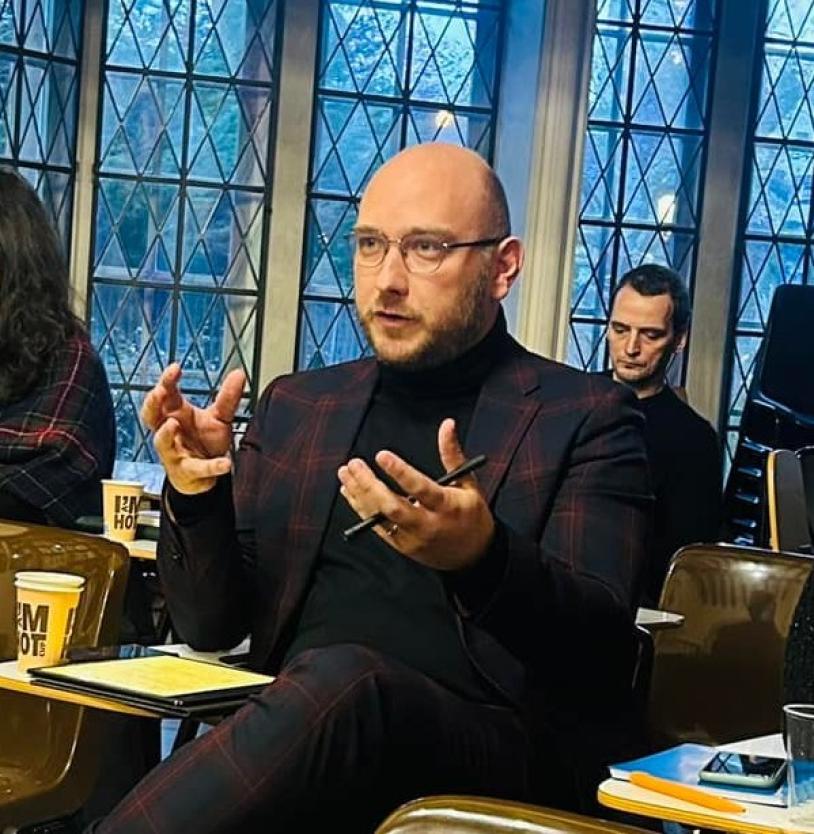
Niels De Nutte is a postdoctoral researcher at the Vrije Universiteit Brussel (VUB) and a staff member of the research service of deMens.nu. He questions the supposed revival of religious feeling in Flanders.
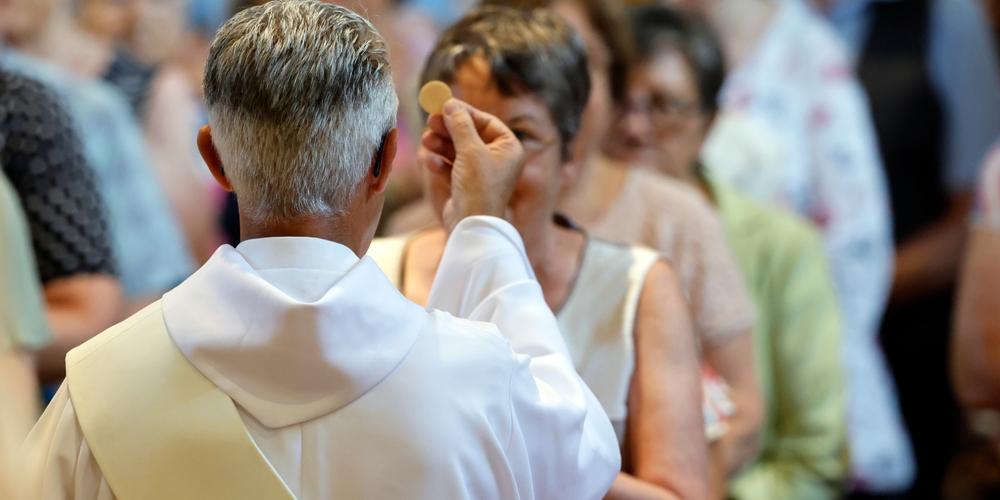
We can scarcely follow the media in Flanders for a week without being confronted with an article claiming a religious revival. New “God influencers” appear, adults are baptised, and young people testify—hand on the Bible or Qur’an—about rediscovering their faith.
The only critical voice in this may well have been the nuanced report by the Jeugdonderzoeksplatform. This academic research does not point to a revival of faith among young people, but rather to a different form.
That the search for meaning, in whatever form, is gaining importance—I will not dispute that. But this so-called religious revival, and the apparent constant urge of our media to reinforce that perception, deserves some nuance.
CULTURAL CHRISTIANS
How religious is Belgium today? In truth, we do not know that very well, due to a lack of solid data. What we do know is that only a small minority of our population actively practises religion. For Catholics—still the ‘largest’ group—that is less than 9 per cent of the population. In international sociological research on religion, this is referred to as a ‘nominal level’. In most Western countries, this is the lowest level at which a dominant religion still exists within a secular society.
Nothing unusual there. The Muslim community follows at 6 per cent, while figures for other religious groups decline further. Altogether, this amounts to 16 per cent of practising believers in Belgium.
For Catholics, one might also include the group of cultural Christians, but the question is to what extent these are truly Catholics, or rather people who identify with certain values and were raised within the tradition. The renowned Pew Research Center shows that one in five Belgians identifies as atheist, making it the largest philosophical grouping.
BAPTISMS AND FORMAL LEAVINGS
The figures often cited to support a return of religion are the rising numbers of adult baptisms. Over the past three years, these stood at 362, 534 and 689 respectively. Broken down by region, this amounts to 182 baptisms in Flanders, 152 in Brussels and 355 in Wallonia. Converted, this represents 0.003 per cent, 0.012 per cent and 0.01 per cent of the total population.
So the celebratory tone seems rather odd. It is also striking that no news outlet has taken the trouble to view the figures in this way. Headlines often refer to a ‘strong increase’ in recent years. With such low figures, an increase is easy to demonstrate—but in terms of the overall population, it is entirely irrelevant.
Moreover, articles fail to compare the number of baptisms with the number of formal departures—also by adults, of course. With the exception of 2023, when more than 14,000 people formally left the Catholic Church (the Godvergeten documentary played a role), these figures have for years been many times higher than adult baptisms. And even these formal departures are likely an underestimate of those who quietly walk away. Removal from the baptismal register—because that is all it amounts to—has only symbolic consequences. It changes nothing in the life of the individual concerned.
PUTTING THINGS IN CONTEXT
As a researcher of worldviews, it seems essential to me that figures are interpreted correctly and placed in context. It is true that the search for meaning is an important element in our society, and the polarised world of orthodox Catholics and anticlerical secularists is long behind us. But there is no sign of a revival in practising religion, and this group remains a small minority in our society. Let us not make it larger than it is.
Those who speak of a return of religion confuse movement with direction in people’s search for meaning. Meaning takes many forms: in relationships, in work and activities, or in beliefs. But that this search automatically leads to religion is far from certain.