
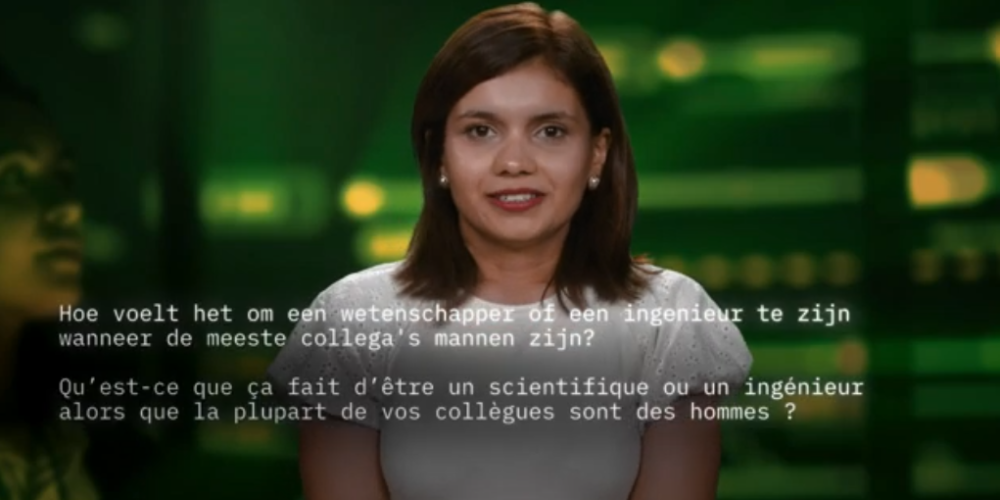


The Universitaire Associatie Brussel interviewed female role models working in higher education within STEM as students, PhD candidates, professors, staff members and/or researchers. From straightforward questions such as “What kind of work do you do?” to more in-depth ones like “What inspired you to choose your career?” — they answered them all. Below, you can read what the nine women affiliated with the VUB had to say. All the video interviews can be found here.
The work you can do within STEM is highly diverse. Among those interviewed are PhD candidates and doctoral researchers, professors, researchers, and even combinations of all three. The specific focus of their studies ranges from pharmacy to computer science, yet a common thread runs through their work: every field has both a theoretical and a practical dimension, and the challenge often lies in bringing the two together.
Anouk Verstuyft
What motivates you to pursue a career in science?
Vrije Universiteit Brussel researcher Anouk Verstuyft (bioengineer) works with mycelium — the root network of fungi — as a sustainable material, including for her furniture collection Fungal Functions. She feels her research area is on the verge of gaining real momentum and driving significant innovation. “The idea that I could contribute to that is incredibly motivating,” she says.
It is striking that many of the scientists are driven by a desire to help others by contributing their part to the world of research. That is certainly the case for bioengineer and PhD candidate Annah-Ololade Sangosanya.
Annah-Ololade Sangosanya
Elisa Gonzalez Boix
Vrije Universiteit Brussel professor of computer science Elisa Gonzalez Boix likewise draws her motivation primarily from the fact that she works on technology that other scientists can benefit from.
Is STEM too difficult for women?
“What I found difficult, men found difficult too,” says Sarah Bilal, educational staff member at the VUB and PhD candidate (medicine and pharmacy).
Sarah Bilal
Najat Aourz
Vrije Universiteit Brussel professor Najat Aourz (pharmaceutical and pharmacological sciences) emphasises that studying is challenging for everyone, and that no difference can be observed between men and women when it comes to acquiring knowledge.
Professor Damya Laoui (bioengineer) adds that during her studies she initially had to prove herself in order to be regarded as an equal by her male colleagues. According to her, that is far less the case today. At the time, women were also often encouraged to opt for ‘easier’ courses of study. She was, for instance, advised to become a teacher so that she could take holidays alongside her children — even though she did not yet know whether she wanted children at all.
Damya Laoui
Hatice Satilmis
Do you find it frustrating to often be in the minority as a woman in STEM?
Vrije Universiteit Brussel researcher Hatice Satilmis (medicine and pharmacy) says that in secondary school she was in a class with only two other girls. “Despite being in the minority at the time, we were able to build close friendships through our shared interests,” she says with a smile.
Several students and professors point out that men are not in the majority within their degree programmes. However, PhD candidate Jara Salueña Martin (bioengineer) notes that at the ‘top of the pyramid’ of academia this is often still the case — and that it is up to female students and researchers to help bring about change.
Jara Salueña Martin
Marthe Ballon
PhD candidate Marthe Ballon (financial and applied mathematics) puts it this way: “Don’t let yourself be put off by degree programmes or careers that are currently dominated by men. There’s no point in comparing yourself to your fellow students either. Every student starts out with a different level of prior knowledge or background. Ultimately, though, everyone has the opportunity to get the very best out of themselves at university.”
The Universitaire Associatie Brussel (UAB) brings together the strengths of the Erasmushogeschool Brussel (EhB) and the Vrije Universiteit Brussel (VUB). This collaboration in both education and research results in support, services and initiatives for more than 30,000 students and 5,000 staff. The VUB and EhB are characterised by their commitment to quality, social engagement, international outlook and future-focused approach — qualities that allow them to stand out in a cosmopolitan capital such as Brussels.