

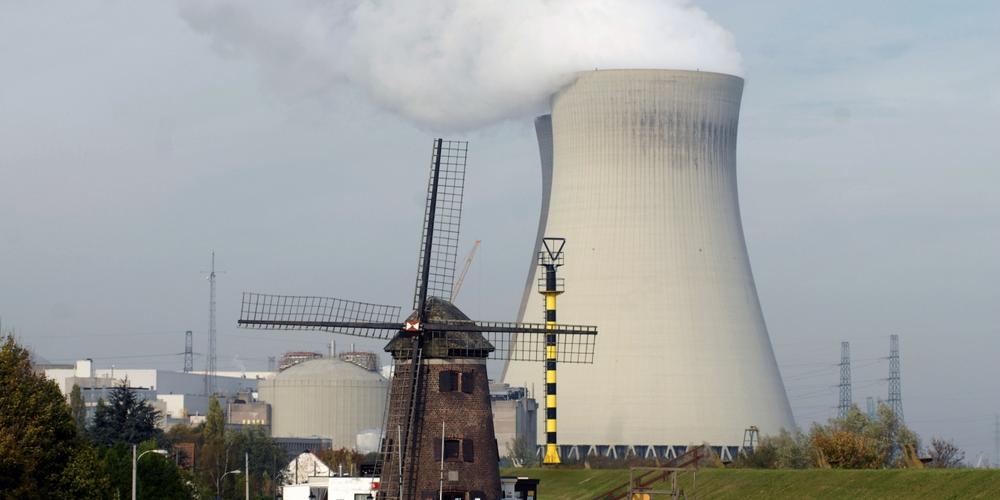


With the nuclear power stations, the Belgian state is not entering unfamiliar territory when it comes to nationalisation in the energy sector. Emeritus professor of history Guy Vanthemsche recalls the coal mines, which the government ultimately failed to save. Is the nationalisation of Belgium’s nuclear power stations a surprise? Not really. And the fact that the decision is being taken by a government with a strong liberal streak? That is hardly surprising either, at least not to historians. The past shows that the relationship between government and the private sector is far more complex than political slogans suggest. Nor is this the first time the Belgian state has taken over a troubled economic sector.
Although the decision appears to run counter to liberal principles, MR chairman Georges-Louis Bouchez justifies the intervention by arguing that (nuclear) energy is “a strategic sector”. Curiously enough, he is repeating an argument already put forward by the socialist parties at the beginning of the twentieth century. According to the Belgian Labour Party and later the BSP/PSB (the unitary predecessors of PS and Vooruit), the management and operation of key economic sectors belonged in the hands of the community. Alongside banks and transport, this meant that the coal mines and the gas and electricity sectors should also become public property.
Belgian coal first
That socialist dream never became reality in Belgium — at least not while private companies continued to make profits. Once that was no longer the case, however, the state could suddenly become the owner. That is precisely what happened in the coal sector. After pouring enormous subsidies into bottomless pits for decades, the government took a dominant stake in the loss-making Kempense Steenkoolmijnen company in 1980 — effectively a nationalisation. The so-called ‘national interest’ supposedly required the Belgian economy, and particularly the steel sector and electricity plants, to be supplied with expensive domestic coal — a position defended for decades. In the end, however, it proved a dead end. After the closure of Belgium’s last mines, the necessary and cheaper coal and coke were imported from abroad. At the same time, nuclear power stations were rapidly gaining ground and accounting for an increasing share of electricity production.
Those nuclear power stations were entirely in private hands, more specifically those of the electricity companies belonging to the group of the now-defunct holding company Société Générale de Belgique. After the Second World War, Belgian private capital clearly saw major opportunities in the development of civilian nuclear activities. Yet in the 1950s and 1960s the socialists wanted electricity generation through nuclear fission to be entrusted to the state — or at the very least to involve substantial public shareholding in future power stations. After all, this was considered a ‘strategic sector’, and the government had already invested considerable sums in nuclear research.
But, as with the other nationalisation plans, nothing came of it. Such drastic interventions were consistently blocked by the other major political force of the time: the Christian democrats of the CVP-PSC, predecessors of CD&V and Les Engagés. Ironically, the nationalisation of the energy sector in France in 1945 had led to the creation of two flourishing and efficient companies: EDF and GDF (Électricité and Gaz de France respectively).
As a result, the construction and operation of Belgian nuclear power stations remained in the hands of the private sector — more specifically, after mergers between Belgian electricity companies, in the hands of the monopoly player Electrabel. The company initially formed part of the Société Générale group, but later — despite all talk of national strategic interests — it was taken over by French big business (GDF-Suez, renamed Engie in 2015). Despite the major subsidies the Belgian government granted to the nuclear sector for many years, the enormous profits generated by the nuclear power stations therefore remained firmly in private hands.
The state playing catch-up
The dominant position of private big business in the ‘strategic sector’ that nuclear power has always been emerged largely behind closed doors, through discreet consultation within and between the boards of private companies, ministerial cabinets and the former Electricity and Gas Control Committee. Permission for the construction of the first power stations, Doel I and Tihange I, was granted in the second half of the 1960s without any prior parliamentary debate. Further plants were already in the pipeline by then. Public debate about the desirability of civilian nuclear energy — sparked by protests over the possible construction of a plant in Zeebrugge — only gathered pace in the mid-1970s. By that stage, however, Belgium had already fully committed itself to nuclear power: there was no turning back.
Whether, at what price, and under what conditions the current nationalisation plan will ultimately be realised remains entirely unclear. Minister of Energy Mathieu Bihet (MR) stated that “thorough research” into technical, legal and financial issues is still needed before the plan can move forward (De Standaard, 2 May). That statement points to a decades-old weakness in the government’s handling of energy policy: a lack of genuine expertise in the sector. Because the state has only ever been able to monitor the heart of the private energy sector from a distance — indirectly, through more or less effective regulatory bodies — it never developed real know-how of its own. Traditionally, the state has therefore been forced to play catch-up rather than lead the way.
That structural lack of knowledge, and the relative powerlessness that comes with it, stems from the ‘strategic’ choice Belgium upheld for decades: the state was consistently denied meaningful capital participation in the profitable energy sector. According to the traditional liberal narrative, private entrepreneurs know better than politicians and civil servants what is good for the economy, and the state is supposedly ‘by definition’ a poor industrial actor. But now that private capital no longer sees a future in nuclear energy, those arguments suddenly seem less convincing.
So what will the promised “thorough research” conclude? Who knows — perhaps by 2035 large wind turbine parks will stand on the sites of Doel and Tihange.