

The Einstein Telescope, an equilateral triangle of tubes measuring 80 centimetres in diameter and stretching 10 kilometres in length, is set to be buried underground somewhere in Europe in the foreseeable future. Its aim is to detect gravitational waves resulting from cosmic events that were beyond the reach of earlier generations of such observatories – LIGO in the United States and VIRGO in Italy. Several precision components for the Einstein Telescope are being manufactured at the VUB’s Photonics Campus in Pajottegem.
The telescope in fact consists of six so-called interferometers, capable of “sensing” the slightest fluctuations in the gravitational waves travelling through the universe. At each corner of the triangle, two interferometers will be built one above the other. One will be tuned to detect very low-frequency signals, and the other to high-frequency signals. They operate using light and only produce a signal when a minute difference in length arises within the tubes of the interferometer telescope.
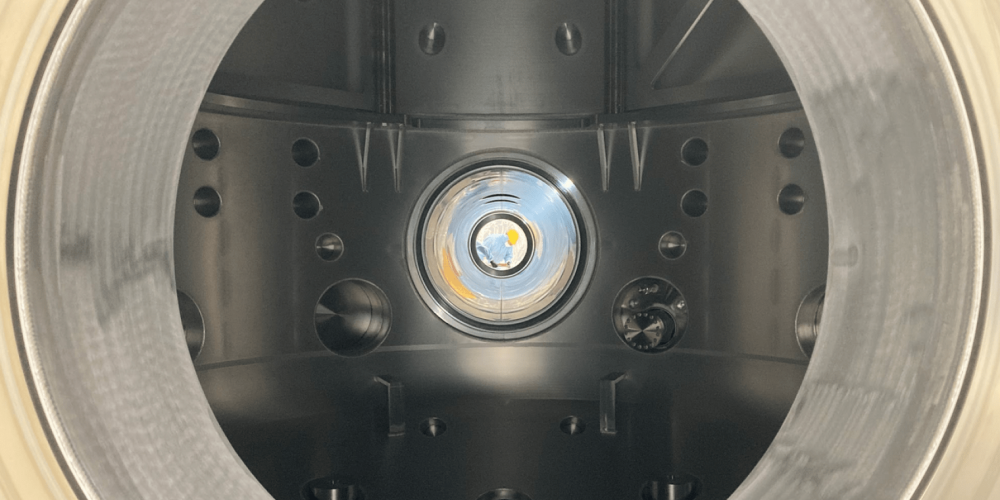
“Normally there is no signal and nothing appears on the measuring equipment,” says Professor Michaël Vervaeke of the VUB’s B-PHOT research group. “It is only at the corners, where the tubes meet and where the light in the different tubes can interfere with one another, that a signal emerges in the form of a ring of light at the very moment minuscule changes occur in the length of the tube system. The instruments will be able to measure differences of 10⁻¹⁸ metres or even smaller – dimensions on an atomic scale.”
Extremely pure monocrystalline silicon
These tiny differences in length are caused by gravitational waves, which we know produce such variations here on Earth. “They are the result of cosmic events taking place far out in space, such as colliding black holes or exploding stars,” Vervaeke explains. “It was not that long ago that the first gravitational wave was detected. Nowadays, we observe at least one every week. We suspect there are many more, potentially arising from much smaller and lighter events in space, but that we simply fail to register them. We hope the Einstein Telescope will make that possible.”
“The Einstein Telescope must be able to operate at a temperature of 15 kelvin”
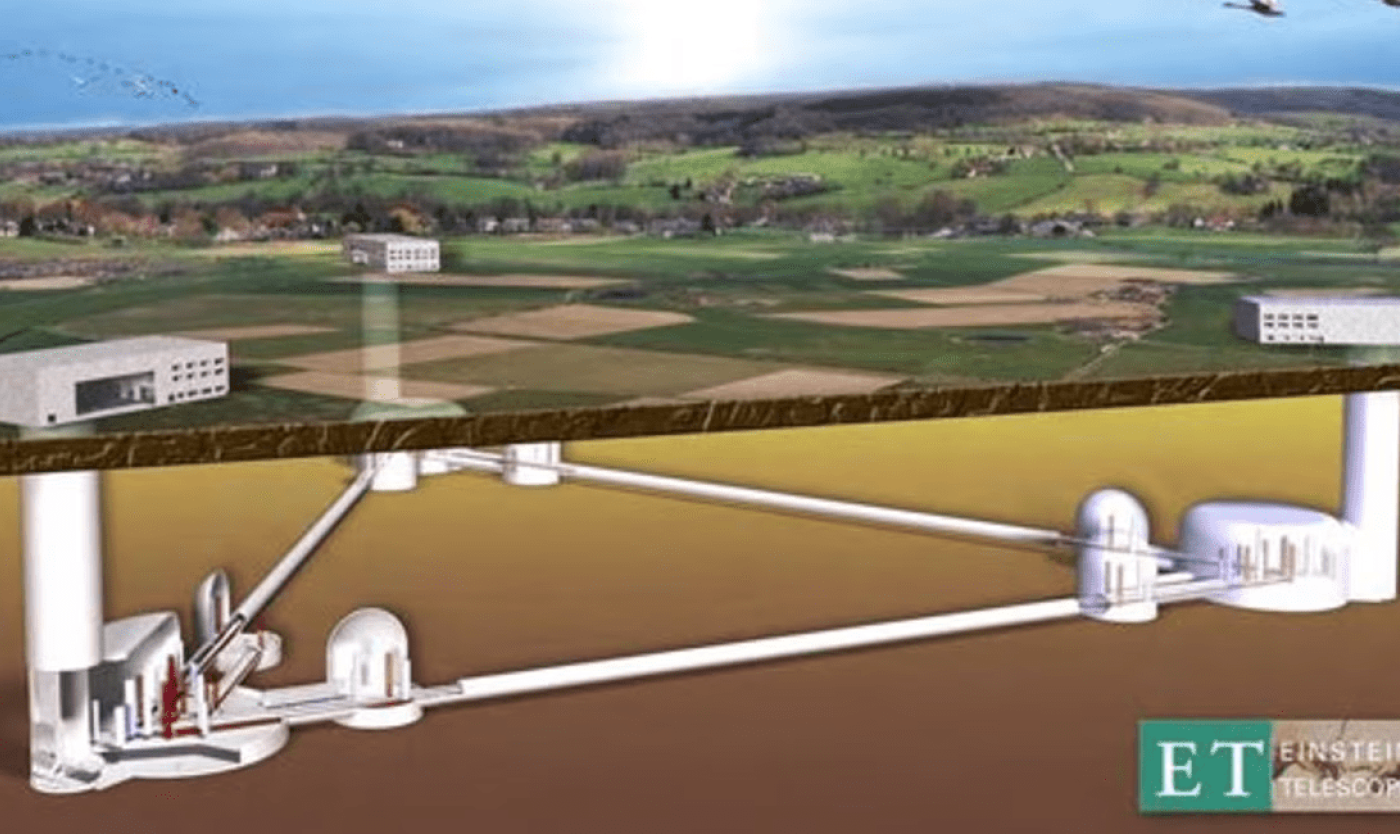
Structuur van Einsteintelescoop © Michael Vervaeke
To achieve this, it is crucial that the components of the Einstein Telescope are manufactured with extreme precision. They must meet almost unattainable standards. “In Maastricht, work is under way on producing a laser light source with a highly stable wavelength of 1550 nanometres,” says Vervaeke. “At the same time, in Aachen, Germany, a stable light source is being developed for light with a wavelength of 2090 nanometres. At the VUB’s B-PHOT research group, based at our campus in Gooik, we are working on the input and output mode cleaners – instruments designed to stabilise and filter these laser sources to an exceptional degree, ensuring that exactly one mode is transmitted and received at a very precisely defined frequency. “We are also working on the mirrors for the prototype and will contribute to those for the final telescope. The prototype mirrors will have a diameter of 15 centimetres and a thickness of 8 centimetres. They are made from extremely pure monocrystalline silicon. That purity must be preserved throughout every stage of processing, from raw silicon to the ultra-precise mirror, which will need to reflect very high light powers of several megawatts.”
The final version of these mirrors will have a diameter of 45 centimetres, a thickness of 57 centimetres and a weight of around 200 kilograms. They must be – and remain – exceptionally pure in order to absorb as little light as possible. After all, when light is absorbed it is converted into heat, and the Einstein Telescope must be able to operate at a temperature of 15 kelvin – just fifteen degrees above absolute zero. “Any disturbance, any slight warming, and even the movement of atoms within the silicon, can degrade the signal-to-noise ratio,” Vervaeke explains.
A triangular CERN
The exact location of the new telescope has yet to be determined. At present, three possible sites are under consideration: one near the tripoint of the Euregio Meuse–Rhine at the Belgian–Dutch–German border, one on the island of Sardinia, and potentially one in Saxony, Germany. “A stable subsoil with minimal seismic activity is essential,” says Vervaeke. “The vacuum tubes – forming what will effectively be a triangular version of CERN – must be buried deep underground to avoid seismic noise from ocean waves and interference from all manner of human activity. At the points where the tubes of this विशाल triangle meet, vast underground chambers – almost cathedral-like in scale – will be constructed to house the measuring equipment. These are therefore major subterranean engineering works.”
The scientists at the VUB have not waited for a final decision. At the end of 2025, the FWO-IRI project E-TECH was approved – a significant step in developing the technological infrastructure needed to support the Einstein Telescope. Within this project, several Flemish partners are working together to build research and testing capacity, positioning Belgium for a role in preparing the future detector. For the VUB, the main contribution lies in expertise in photonics and precision optics, particularly through the B-PHOT research group, which is developing optical components with extremely low surface roughness and high accuracy.
Cleanroom in Halle
In September, an Ion Beam Figuring machine was installed in Pajottegem for the final shaping of mirrors for the Einstein Telescope. This system makes it possible to fine-tune optical surfaces at the nanometre level after polishing – a crucial step in achieving the extreme precision required to detect gravitational waves. The technology represents the final stage in the production process of ultra-precision mirrors and enables surface deviations to be corrected down to the atomic level. The installation forms part of the VUB photonics infrastructure in the Pajottenland and complements ongoing work on optical components for the Einstein Telescope. It strengthens local capacity to develop and validate high-quality mirror optics, which will be essential for the future instrument.
“Completion of a cleanroom in Halle is also expected this summer, as part of the ETpathfinder Smart Skills Lab ecosystem,” Vervaeke adds. “This facility will be used for training, as well as for assembling and testing optical components under controlled conditions. It will enable training programmes for engineers, technicians and companies wishing to be involved in the development of the Einstein Telescope, while also supporting demonstration and development activities in precision optics and photonics.”
Bio
Professor Michael Vervaeke is a professor at the Faculty of Engineering at the Vrije Universiteit Brussel. He graduated in 2000 as an electrical engineer, specialising in photonics, and obtained his PhD in engineering science in 2007, both at the VUB.