



We understand more than 95 per cent of our own mass — and of the mass of the visible universe — only superficially. A new research project led by Charlotte Van Hulse aims to change that. She is returning to Flanders to establish her own research group at the Vrije Universiteit Brussel (VUB), thanks to an Odysseus grant worth €2,524,497 from the Research Foundation – Flanders (FWO).
“Visible matter is made up of atoms,” Van Hulse explains. “The atomic nucleus consists of nucleons — protons and neutrons — which in turn are composed of a high-energy ‘soup’ of extremely fast-moving and constantly interacting quarks and gluons. Gluons have no mass and quarks only a negligible one, yet through their interaction they generate the vast majority of visible mass. With my new research project, I want to understand how this process works.”
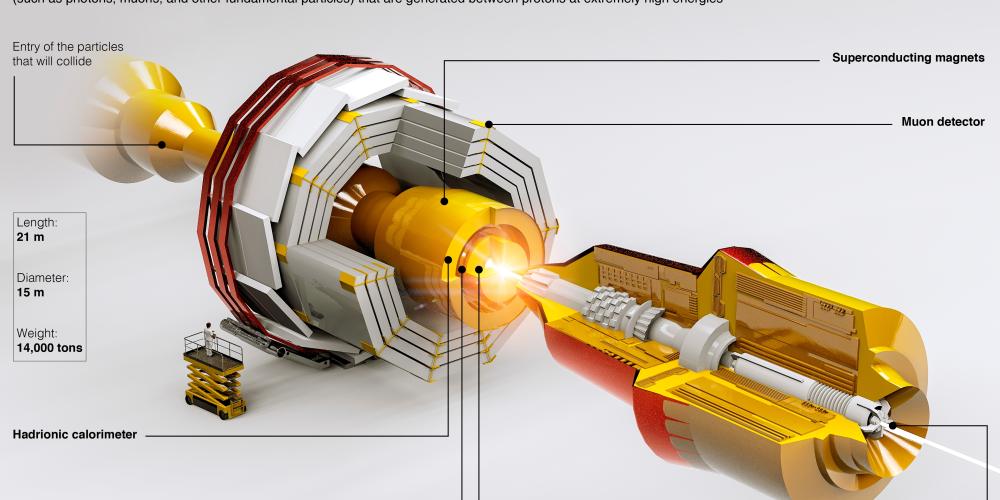
Van Hulse plans to analyse and combine data from the Compact Muon Solenoid (CMS) experiment at CERN’s Large Hadron Collider (France/Switzerland) and from the future Electron-Ion Collider (EIC) at Brookhaven National Laboratory (United States). In the CMS experiment, protons and heavier atomic nuclei are collided at extremely high speeds. At the EIC, protons and heavier nuclei will be collided with electrons. In many of these collisions, the protons and heavier nuclei break apart, creating a range of new particles. Collisions in which the beam particles remain intact will also be studied.
“These studies will allow us to gain a deeper understanding of the interaction between quarks and gluons,” says Van Hulse. “Where exactly are quarks and gluons located within the nucleon? How do they move? How do they generate pressure inside the nucleon and evolve into the subatomic particles we observe in our detectors? By exploiting the synergy between these two research facilities, we will be able to expand our knowledge of quark–gluon interactions — and therefore of how mass is generated.”