



Three years ago, Sebastiaan Vanseuningen began studying Political Science at VUB without too many expectations. Today, at 21, he is President of the Student Council. “I found a community here where I feel welcome and can be myself. Now I want to give something back.” As the new President, he wants to bring students closer to university decision-making.
If you are looking for Sebastiaan, chances are you will find him somewhere on campus. In class, at the Student Council or with KEPS, his faculty student association. When he wants to have a drink with friends, Pilar is a favourite spot. For studying, he heads to the LIC or STOA. And sometimes, simply walking around campus is enough to clear his head.
His involvement in student life did not begin at VUB. He was already a member of his school’s student council. “I like having a say in shaping the environment I’m part of. Over the past few years, I’ve found that the more you put into student life, the more you get out of it. For me, it’s mainly about that sense of community.”
‘The more you put into student life, the more you get out of it’
When Sebastiaan arrived at VUB three years ago, he mainly expected to come here to study. Things turned out differently. “I didn’t have particularly high expectations of student life. But I quickly realised that VUB is about more than attending classes. You grow as a person here too.”
For him, it is the people who make the difference. “Brussels is a fantastic city, and of course we have our campus and facilities. But ultimately, it’s the people who make VUB unique for me. I’ve always felt welcome here. You get the sense that everyone can be who they are.”
The campus itself plays a part in that. Students study, eat, exercise and go out in the same place, so they are constantly running into one another. “At other universities, everything can be spread across an entire city. Here, you develop a kind of VUB bubble much more quickly. For many students, it feels warm and safe.”
Straight into the presidency
Sebastiaan is not only starting his first year as President, but also his first full year as a member of the Student Council. Stepping into the role was therefore far from an obvious choice. “I was hesitant at first. But I thought back to my experiences on the student council at school and in student associations. I knew how rewarding it is for me to get involved. And the VUB community means a great deal to me. I wanted to help build on that.”
As President, he does not see himself as someone who sets the course single-handedly. Rather, his role is to make sure the council works well and its members have the support they need. He works closely with Vice-President Aube Bouwen. “I may be President, but the council is one team. We do this together.”
The Student Council represents students on bodies including the University Council and Education Council. Its members also work on specific issues and sit on various committees. For Sebastiaan, all those structures ultimately serve one purpose: making sure students have a voice at the table.
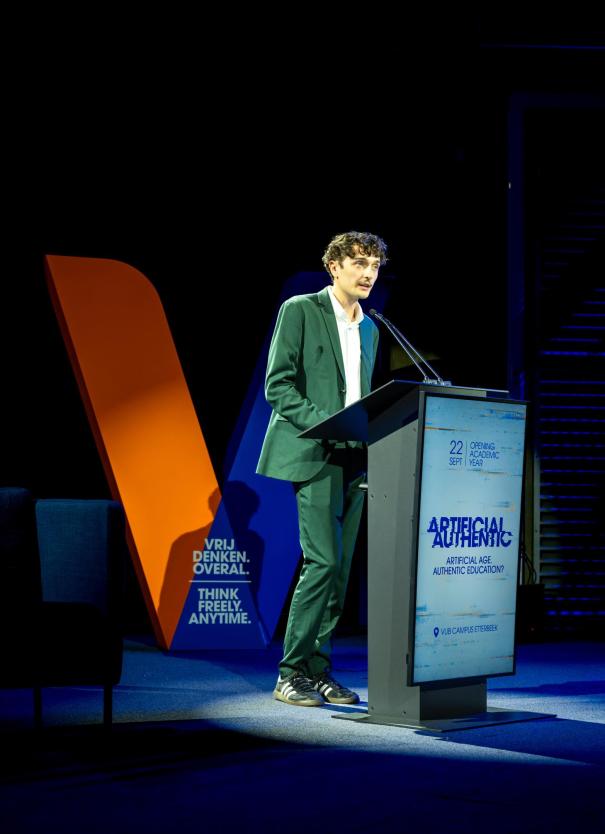
Sebastiaan at VUB’s Academic Opening Ceremony
Bridging the gap between students and decision-makers
According to Sebastiaan, that bridge between students and decision-makers will become even more important this academic year. Cuts to higher education will affect both the university and its students. He can already see the uncertainty they are creating, including among friends who rely on student grants. “Many students feel the impact of decisions in their everyday lives, while the decision-making itself can seem distant and invisible. The Student Council has an important role to play in bridging that gap.”
For him, that means more than responding once a decision has already been made. The council needs to gather concerns from across the faculties, scrutinise measures as they develop and build up enough expertise to be a credible voice in discussions. “We need to make sure that what matters to students reaches decision-makers too.”
But that bridge runs both ways. For many students, the Student Council itself can still feel removed from their everyday lives. Sebastiaan has noticed that getting involved in student organisations and campus life has become less of a given in recent years. “Some students think the Student Council is something outside their world. But we’re students too. You’re just as likely to run into us in a lecture hall.”
That is precisely why he wants to lower the threshold for getting involved. He wants to hear not only from students who are already active, but also from those who do not belong to an association, do not attend meetings or feel less connected to traditional student life.
At the same time, Sebastiaan still sees the campus as essential to creating that sense of connection. Even though much of studying, collaborating and meeting can now be done from home, some things are difficult to replicate online. “You can only really experience that sense of community by being here. You come to class, meet new people and make friends. That’s how connections form. And that’s exactly what makes your time as a student special.”
Critical thinking does not stop at AI
For Sebastiaan, students helping to shape their university is not only about representation. They should also be encouraged to think critically about education itself. AI has brought that debate into sharper focus. He regularly uses it as a study aid himself, for example to have course material explained in a different way. But for him, the question goes beyond when students should or should not be allowed to use AI. “We need to learn to judge when AI helps us move forward, when it is talking nonsense and when we are better off not using it at all.”
‘We need to know when AI helps, when it gets things wrong and when not to use it’
Knowledge remains essential. But simply being able to reproduce it should not, in his view, be the end goal of a university education. “As a student, I want to be able to do more than repeat in an exam what a professor has told me. I want to use that knowledge to tackle a problem that wasn’t in the course material.”
Sebastiaan believes this also means taking a critical look at assignments and assessment. Why not ask students to dissect an AI-generated answer, check its sources or uncover hidden assumptions? Testing basic knowledge remains important, but it should be followed by another question: what can students actually do with that knowledge? “Reproducing an answer is one thing. Showing why it stands up to scrutiny takes considerably more.”
For Sebastiaan, this touches on something deeply rooted in VUB’s DNA: Free Inquiry. If you teach students to question what is taken for granted, you also have to give them the space to scrutinise the university itself. “A university that asks students to question everything must accept that they will question its exams too.”
Ultimately, that brings him back to the same ambition. Students should not simply study at VUB; they should be able to feel that they are genuinely part of it. That comes from the people they meet and the sense of belonging they find here. But it also comes from having the space to make their voices heard, ask questions and help shape how things could be done better.
For Sebastiaan, that is what his presidency is all about: helping to build a university where students feel at home and have a critical role in shaping its future.
Find out more about the VUB Student Council and how you can make your voice heard.