



An international team has described Foskeia pelendonum, a tiny Early Cretaceous ornithopod from Vegagete (Burgos, Spain), measuring barely half a meter long. Led by Paul-Emile Dieudonné (National University of Río Negro, Argentina), the study reveals an unexpectedly derived skull and positions Foskeia near the origin of the European herbivorous lineage Rhabdodontidae. “From the very first moment anybody sees this animal one is staggered by its extreme smallness,” says Dieudonné. “And yet it preserves a highly derived cranium with unexpected anatomical innovations.”
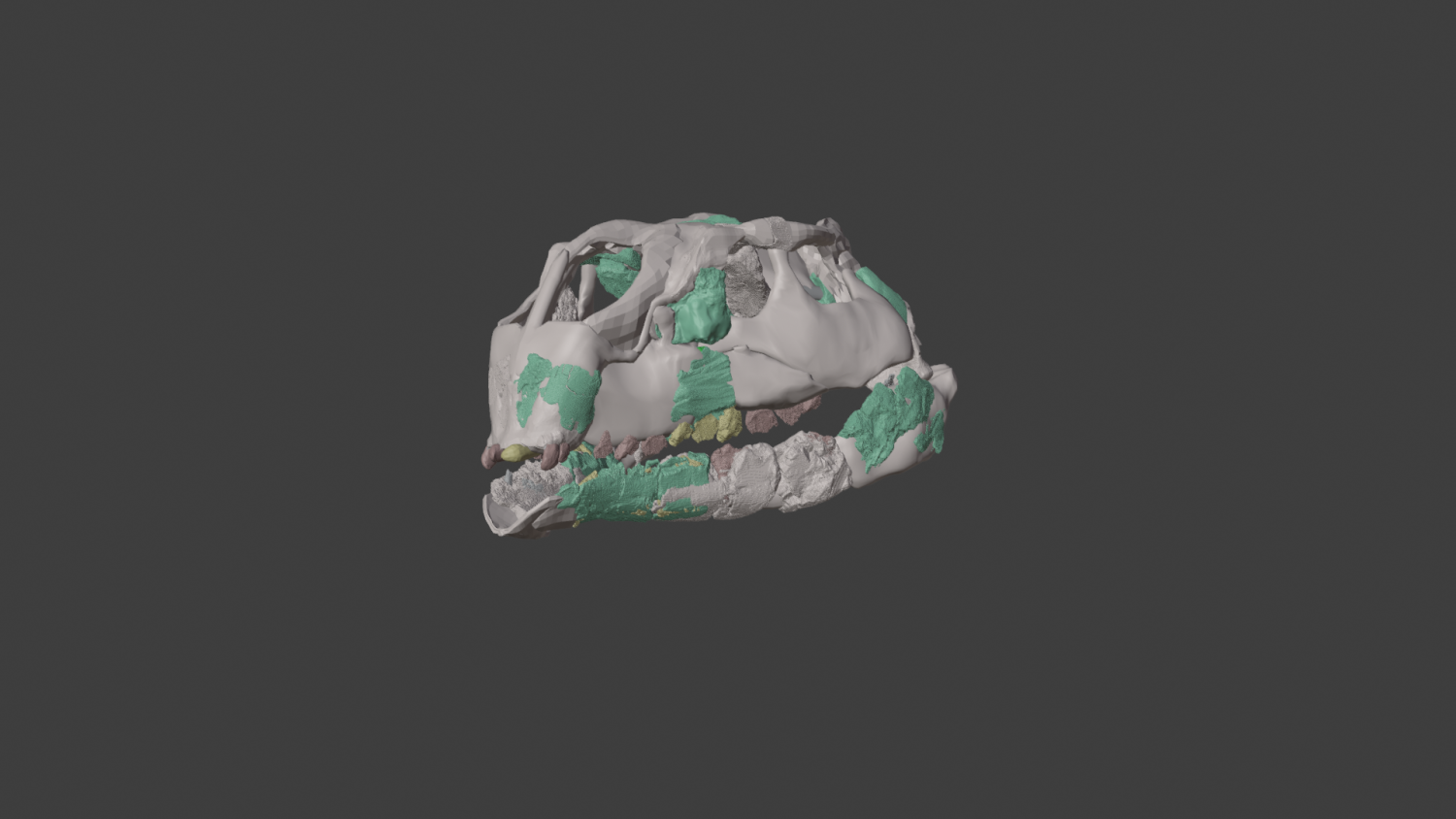
Reconstructie van de schedel van Foskeia pelendonum © Dieudonné et al. 2025
The fossils, representing at least five individuals, were first uncovered by Fidel Torcida Fernández-Baldor of the Dinosaur Museum of Salas de los Infantes. “From the beginning, we knew these bones were exceptional because of their minute size. It is equally impressive how the study of this animal overturns global ideas on ornithopod dinosaur evolution,” he notes.
The genus name Foskeia is derived from the ancient Greek. The prefix fos means ‘light’, given the very lightweight and small body size of grown individuals (Dieudonné et al. 2023). The combination of letters ‘skei’ derives from boskein, which means foraging. The species name pelendonum refers to the Pelendones, a Celtiberian tribe from the Fuentes del Duero (north of the province of Soria, southeast of Burgos and perhaps the southeast of La Rioja).
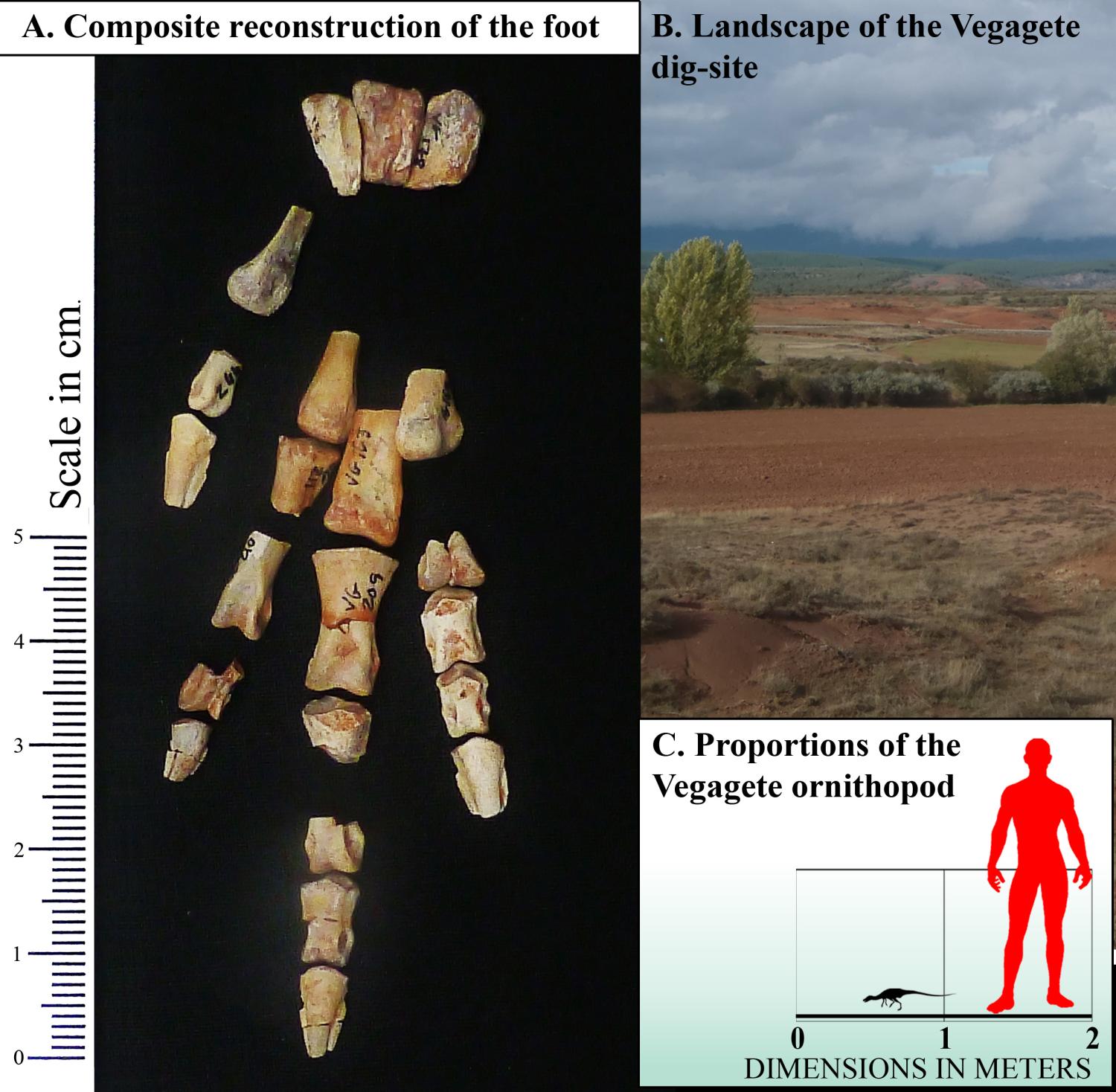
Composite image of the foot skeleton of Foskeia pelendonum, its finding locality, and size comparison with a human being. © Dieudonné et al. 2026
The researchers emphasize the evolutionary significance of Foskeia. Marcos Becerra (Universidad Nacional de Córdoba) remarks: “Miniaturization did not imply evolutionary simplicity — this skull is weird and hyper-derived.” Thierry Tortosa (Sainte Victoire Natural Reserve) adds: “Foskeia helps fill a 70-million-year gap, a small key that unlocks a vast missing chapter.” Tábata Zanesco Ferreira (Universidade Federal do Rio de Janeiro) notes: “This is not a ‘mini Iguanodon’, it is something fundamentally different.” Penélope Cruzado-Caballero (Universidad de La Laguna) concludes: “Its anatomy is weird in precisely the kind of way that rewrites evolutionary trees.”
Histological studies supervised by Dr. Koen Stein (Vrije Universiteit Brussel) confirm that the largest specimen was a sexually mature adult. “Bone microstructure tells us that at least one individual was an adult… with a metabolic regime approaching that of small mammals or birds. Knowledge of growth and development is essential if we want to compare the anatomy of Foskeia with other species. Young individuals are prone to changes in anatomical features as they grow.” Stein explains.
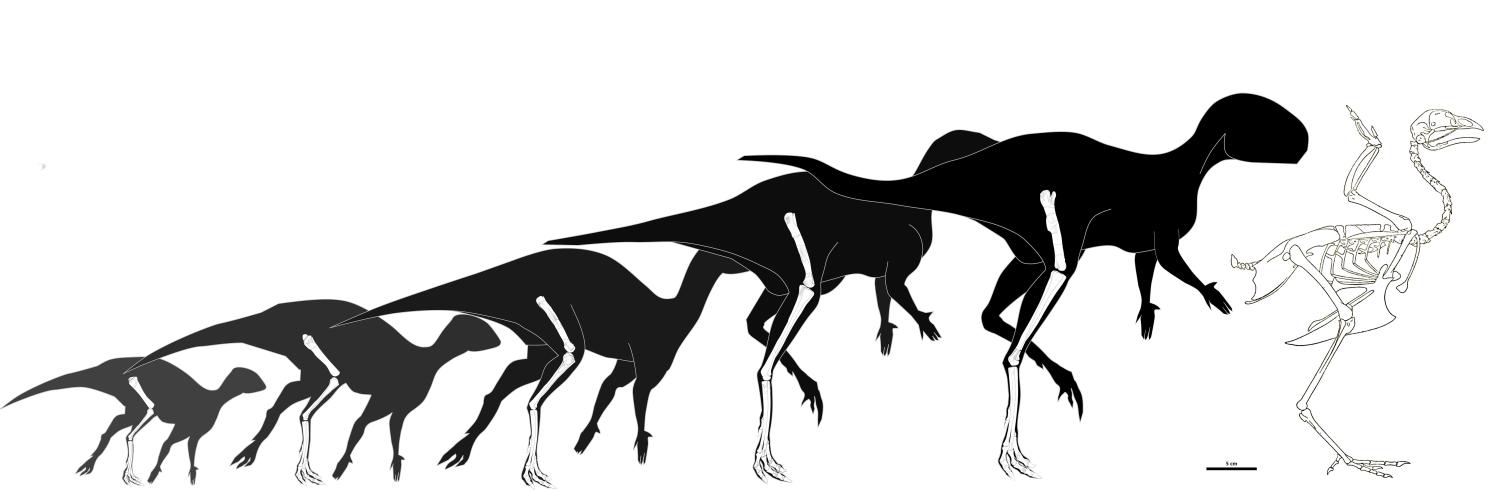
Growth trajectory of Foskeia pelendonum, compared to an adult chicken. This trajectory is based on differently sized bony elements and their histology. Note the proportionally smaller forelimbs in the more mature individuals.. © Dieudonné et al. 2026
A new phylogenetic analysis places Foskeia as sister to the Australian Muttaburrasaurus within Rhabdodontomorpha and expands the European clade Rhabdodontia. The dataset also recovers a topology reviving the long-debated Phytodinosauria. “In our results, the plant-eating dinosaurs… form a natural group called Phytodinosauria,” explains Dieudonné. “This hypothesis should be further tested with more data.”
Despite its small size, Foskeia shows specialized dentition and evidence of shifting posture during growth, relying on bursts of speed in dense forests. Dieudonné adds: “These fossils prove that evolution experimented just as radically at small body sizes as at large ones. The future of dinosaur research will depend on paying attention to the humble, the fragmentary, the small.”
Reference:
Dieudonné, P.E., Zanesco, T., Becerra, M.G., Tortosa, T., Cruzado-Caballero, P., Stein K., Torcida Fernandez-Baldor, F. (2026) The Vegagete rhabdodontomorph Foskeia pelendonum gen. et sp. nov. from the Upper-Barremian – Lower Aptian of Salas de los Infantes (Burgos Province, Spain) and a new phylogeny of ornithischian dinosaurs. Papers in Palaeontology. https://onlinelibrary.wiley.com/doi/10.1002/spp2.70057
Contact:
Dr. Koen Stein: koen.stein@vub.be 0471517909