

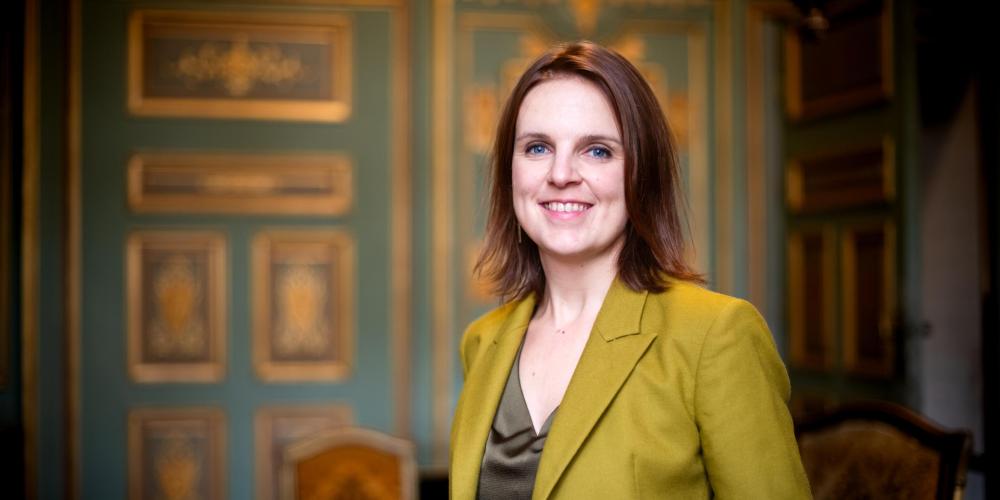


Gerontologist Lien Van Malderen works as a strategic policy advisor at Zorgnet-Icuro, contributing to the future of elderly care. “We must not let ourselves be paralysed by the challenges we face. Let’s see them as opportunities to do better.”
What exactly does your job at Zorgnet-Icuro involve?
“Zorgnet-Icuro is the umbrella organisation for all hospitals, mental health facilities and non-profit residential care centres in Flanders. As a strategic policy advisor for residential care, I focus on care homes. Our organisation supports around 330 care homes and represents their voice in consultations with the government. In this way, I contribute to shaping policy on the future of elderly care, which I find particularly fascinating.”
What initially attracted you to elderly care?
“Older people. (laughs) For many young people that may sound unusual, but for me it was clear from an early age. As a child, I spent a lot of time—through my grandparents—among people of their generation, and at school I chose activities related to elderly care. As a young adult, I first studied educational sciences—I wanted to support vulnerable adults—but even during those studies I quickly knew I wanted to focus on older people. A quarter of our population belongs to this group, and ultimately we will all become part of it ourselves. Yet it is often overlooked.”
How did you end up at the VUB?
“The VUB is the only place in Belgium where you can study a Master’s in Management, Policy and Care in Gerontology. Beyond that, I already had a warm feeling about the university. My partner studied there first, so I had already experienced the atmosphere. After my Master’s, I stayed on at the VUB for another seven years as a researcher. I studied how to strengthen quality of life and resident engagement in care homes. What I really appreciated during that time was the close contact between students and lecturers. The atmosphere is very accessible.”
Are there lecturers who left a particular impression on you?
“Absolutely. The very first gerontology lecture I attended was taught by Professor Tony Mets. He spoke with such passion and dedication about elderly care that from that very first session I knew: this is where I belong. This is what I want to commit to.”
Do you feel student life today is different from your time?
“This Master’s programme is designed for working students. Students who combine work and study do so with strong commitment, which created a very strong bond between us. Since COVID, there is more distance and hybrid learning. That offers students a lot of flexibility. Practically, it certainly adds value, but I do hope that physical distance does not lead to emotional distance. We used to travel to Brussels from all over Flanders every evening and on Saturdays, and that made us truly experience the programme together.”
“We will need to rethink care to meet growing demand”
What do you still carry with you from your studies in your current role?
“The importance of a critical voice. At any university—and especially at the VUB—you are encouraged to question things and to actually set change in motion. I have always valued that and I bring it into my current role. I try not to be guided by impulse, but to look at situations independently and from multiple perspectives.”
What challenges does elderly care face today?
“The challenges—or opportunities—are immense. The demand for care will grow exponentially in the coming years. The number of people aged over 80 will triple, and the number of people with dementia will double, while the labour market will remain stable or even shrink. So we will need to rethink how we approach care to meet that demand. At the same time, ageism is still everywhere: discrimination or disadvantage based on age. We must actively counter that. A ‘us versus them’ narrative will not get us anywhere. The rights of an ageing population must take centre stage. Finally, I notice that elderly care is often portrayed negatively in the media. Extreme but unrepresentative cases make headlines, while the sector is incredibly rich in expertise, commitment, professionalism and warmth. The image needs to be more balanced, so that those working in care every day remain motivated.”
Which professional achievement are you most proud of?
“Contributing to policy development allows you to help shift things. Recently, for example, we were involved in an awareness campaign around mental health in older people. What I value most is that through collaboration, you can really feel things starting to move. At the same time, I also find a lot of satisfaction in smaller, everyday achievements. Through training, we support care homes and think together about the practical challenges they face—often staff shortages. Within existing regulations, we explore how to deliver the highest possible quality of care. I feel a great deal of appreciation there.”
How do you see the future of your own career?
“I want to remain actively involved in strengthening the rights of older people and people in vulnerable situations, and in contributing to a future-oriented care system. There is a lot set to change, and I want to think strategically about that, both nationally and internationally. I also want to remain activist in my approach. I am not someone who stands on the sidelines—I try to help make change happen.”
What advice would you give to students graduating today?
“I would urge them not to be demotivated by the challenges in healthcare, but to see those challenges as an opportunity to take action. I hope graduates keep the drive to make a positive impact themselves.”
“What you do in healthcare is of immeasurable value”
How do you stay resilient in such a high-pressure sector?
“I try to acknowledge setbacks and give them a place, but afterwards I take a step back and look at what I can still do. In healthcare, becoming paralysed is not an option—the impact is too great. Unfortunately, 40% of people leave the sector within two years. That is dramatic. One of the main reasons is that they lose sight of their ‘why’. That is why we aim, through policy proposals, to bring care professionals closer again to that ‘why’, for example by reducing administrative burdens. We must ensure that people in healthcare feel that what they do is of immeasurable value and meaning. And older people must feel that they will always matter.”