
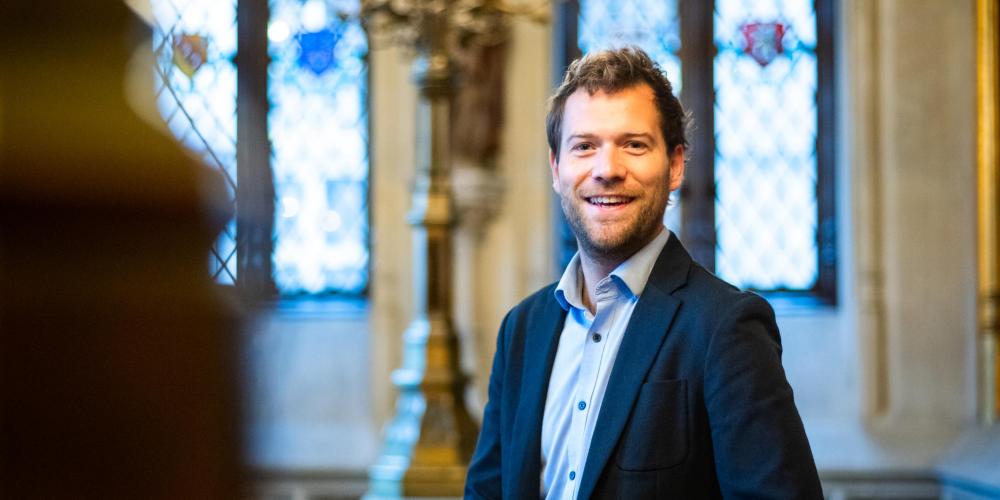


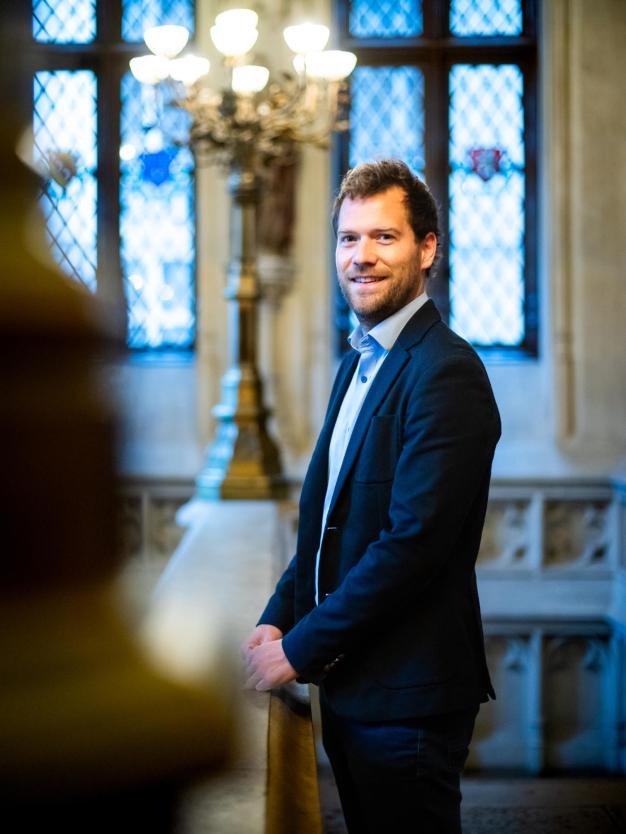
Bruce Stevens (31) studied Law at VUB and now works as a Protection Officer at the Office of the Commissioner General for Refugees and Stateless Persons (CGRS). In his role, he listens every day to the stories of people applying for international protection in Belgium. “To me, freedom also means responsibility. And that is something I try to bring to my work every day.”
What exactly does your current role involve, and what interests you most about it?
Bruce Stevens: “I work for the Office of the Commissioner General for Refugees and Stateless Persons, a federal institution that processes asylum applications. More specifically, as a Protection Officer, I conduct asylum interviews. People applying for international protection in Belgium come to me to tell their story. They explain where they come from, why they left their country and what they fear would happen if they returned. It is my job to ask the right questions and gain a clear understanding of their situation. After the interview, I make an administrative decision: either refugee status is granted or the application is refused.”
“What interests me most is the diversity. No two cases are the same, and neither are any two people sitting across from me. Many people are extremely nervous during an interview like this. If I can help put them at ease, allowing the tension to subside so that they can speak more freely, it can make a real difference to how the interview unfolds. After all, a great deal depends on that conversation.”
“In principle, I make the decision individually, but there is always a form of peer review. A colleague looks over the case as a second pair of eyes, ensuring that everything is assessed carefully and correctly.”
What memories do you have of studying at VUB?
“I studied at VUB from 2012 to 2017, completing both my Bachelor’s and Master’s degrees in Law. I have very fond memories of that period. What stays with me most is the atmosphere on campus: the sense of community, the diversity among students and the open, welcoming environment. To me, that is what characterises VUB.
One professor who made a lasting impression on me was Filiep Deruyck, Professor of Criminal Law. He taught with tremendous passion and enthusiasm. Whenever he explained a legal rule that he either agreed or disagreed with, you could really sense his engagement with the subject. It was infectious.”
“Human rights, democracy, equality and free thinking strongly appealed to me at VUB”
Did you have a clear idea of what you wanted to do after graduating?
“Immediately after graduating, I still did not have a clear idea of the professional direction I wanted to take. That is why I decided to pursue an additional degree: an advanced Master’s in Law and Economics. The programme took me to Italy for four months, Germany for three months and Israel for three months. That additional degree gave me time to explore further what I wanted to do. Even today, I do not have a rigid career plan mapped out. I actually find it valuable to learn along the way and adjust my path whenever necessary.”
Did VUB have a strong influence on the way you think?
“I deliberately chose VUB because, even at the age of 18, I identified with the university’s values. Human rights, democracy, equality and free thinking strongly appealed to me. VUB certainly reinforced those values, not only through the courses and professors, but also through conversations with fellow students and the debates taking place on campus.”
How do you interpret the V in VUB, and how do you apply it in your work?
“To me, the V stands for freedom: the freedom to think, to choose and to form your own opinions. But freedom also comes with responsibility. You have to do something with that freedom.
In my work, I try to put that mindset into practice by treating every conversation with respect, remaining open to different perspectives and being careful in the decisions I make.”
Do you think students today face different times?
“I think the world that students are entering today has become more complex. Geopolitical tensions, societal change and rapid digitalisation mean that young people have to actively defend their values more than they did in the past. For me, that means fundamental values such as human rights, democracy and equality. These are principles that cannot be taken for granted and require continued commitment.”
“Life isn’t handed to you on a plate. You’ll have to adjust course, and that’s perfectly normal”
How do you try to make a difference in society today?
“First and foremost, by doing my job with integrity and care. Whenever I can, I also try to help people who are facing difficulties outside of my work. It is not something I do systematically, but rather on an ad hoc basis. Small contributions can be meaningful too.”
What advice would you give to students graduating today?
“Don’t put too much pressure on yourself to have everything completely mapped out already. Life isn’t handed to you on a plate. You’ll have to adjust course, and that’s perfectly normal. It is precisely by being flexible that you eventually find your own path.”
And what advice would you give specifically to students in your degree programme?
“To Law students, I would say: look beyond the traditional career paths. The legal profession, the judiciary and working as in-house counsel are well-known options, but a Law degree can take you in far more directions than you might initially think. Explore your options, ask questions and stay curious. Think outside the box.”
Curious about the forces shaping world politics?
Discover VUB's study programmes:
Microcredentials and postgraduates: Democracy: challenges and futures EU Policy Making
Bachelors: Politieke wetenschappen Social Sciences
Masters: European Integration European and International Governance
ALL PROGRAMMES IN ENGLISH ALL PROGRAMMES IN DUCTH