

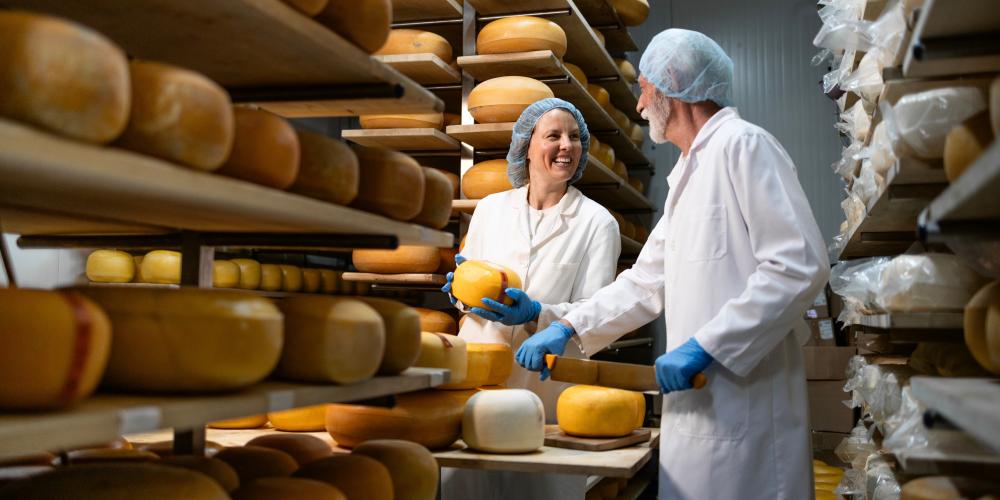


Recent doctoral research at the Vrije Universiteit Brussel (VUB) by Hannes Decadt (IMDO, Research Group Industrial Microbiology and Food Biotechnology) sheds new light on the ripening of Gouda cheese and demonstrates that bacteria originating from the brining bath have a surprising and valuable potential in the cheese ripening process. Decadt describes how a salt-tolerant bacterium from the brine, Tetragenococcus halophilus, was deliberately used for the first time in Gouda cheese production, with striking results.
Decadt’s doctoral research originated from a question that is also highly relevant within the cheese industry: why does cheese that is produced in an apparently identical way nevertheless taste different each time? “Imagine baking the same apple pie every week, yet ending up with a different result each time,” says Decadt. “If you always do everything in exactly the same way, that should not really be possible.” In collaboration with a European cheese producer, he mapped in detail the microbial and biochemical composition of both the cheese and the production environment.
An important, yet often underestimated, element in the cheesemaking process is the brining bath, in which cheeses are immersed for several days to absorb salt. These brining baths are rarely completely replaced and therefore develop into complex microbial environments. Decadt analysed the bacteria present in the brine and distinguished between undesirable and potentially beneficial bacteria. Earlier research by Decadt, published in 2024, showed that one bacterium, Loigolactobacillus rennini, was responsible for undesirable cracks and unpleasant odours in cheese due to cadaverine production and gas formation.
At the same time, Decadt identified another bacterium in the same brining bath: Tetragenococcus halophilus. In contrast to the ‘undesirable’ bacterium, this salt-tolerant lactic acid bacterium displayed interesting properties. “The beneficial bacteria from the brine had never been studied before, and we were the first to use them intentionally in cheesemaking,” says Decadt. This resulted in a unique and innovative step: the deliberate addition of a bacterium that had previously been regarded as a wild, uncontrolled microorganism.
In the newly published study, Tetragenococcus halophilus was used together with Lacticaseibacillus paracasei as an adjunct starter culture in Gouda cheese production. The results are promising. Cheeses to which Tetragenococcus halophilus was added proved to be at least as palatable as the control cheeses, but ripened more rapidly. “The cheese containing the salt-tolerant bacterium Tetragenococcus halophilus is unique and ripened faster than the same cheese without the additional bacterium,” says Decadt. “Faster ripening represents a significant economic advantage for cheese producers, without compromising flavour or quality.”
Decadt’s research demonstrates that variation in cheese is not only related to milk, seasons or processing conditions, but also to microbial dynamics within the factory and the bacterial cultures used. By gaining a better understanding of which bacteria are present and what role they play, cheesemakers can steer flavour, texture and ripening more precisely. According to Decadt, his research opens the door to a new way of thinking within the cheese industry. “My research may inspire other cheesemakers: perhaps the secret of a truly exceptional cheese lies hidden deep within the brining bath.”
Decadt’s research was recently published in the international scientific journal Frontiers in Microbiology under the title Application of Lacticaseibacillus paracasei and Tetragenococcus halophilus as adjunct starter cultures in Gouda cheese production.