

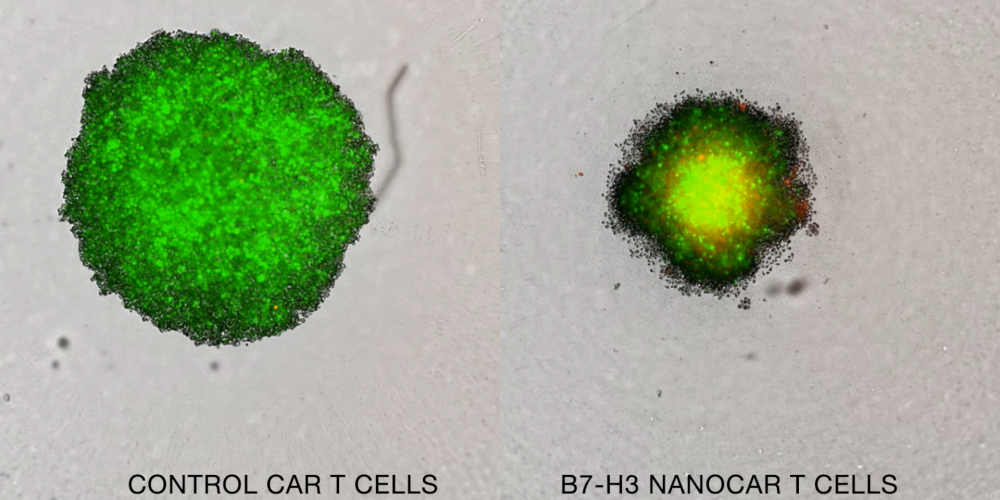


An international research team led by Arne Van der Vreken, Prof. Dr. Eline Menu, and Prof. Dr. Karine Breckpot (Translational Oncology Research Center, VUB) has made an important discovery that may advance the fight against multiple myeloma, also known as Kahler’s disease.
Multiple myeloma is a form of blood cancer that mainly affects older individuals and is characterized by the buildup of malignant cells in the bone marrow. As a result, patients may suffer from bone fractures, anemia, infections, and kidney problems. While advanced immunotherapies such as CAR-T therapy already exist—where a patient’s own immune cells are engineered into cancer killers—relapse still frequently occurs with current BCMA-targeting CAR-T treatments. One reason is that tumor cells can lose the BCMA protein and thus escape the therapy.
The team has now discovered that another protein, B7-H3, is present on cancer cells in approximately 60% of myeloma patients. This had never been described before for this type of blood cancer. As such, B7-H3 represents a new and important target for attacking the disease.
This discovery was made possible through an intensive collaboration with the University Hospital of Parma and UZ Brussel, which provided access to an exceptionally rich biobank of patient samples. This allowed the team to thoroughly analyze B7-H3 expression in **actual patient cells—not just cell lines—**and to map the extensive heterogeneity of myeloma tumors.
The researchers then engineered three types of modified immune cells:
-
CAR-T cells that recognize BCMA (the classical target)
-
CAR-T cells that recognize B7-H3 (the newly identified target)
-
CAR-T cells that recognize both targets simultaneously
“You can think of the ‘dual’ CAR-T cell as a therapy that attacks the cancer from two fronts at the same time,” says Arne Van der Vreken.
When dual CAR-T cells were administered to mice with myeloma, something remarkable happened.
“In our mouse models, we observed a complete and lasting cure after just a single injection,” says Eline Menu. “This is an extremely promising result that shows how difficult it becomes for the tumor to hide when two different targets are attacked simultaneously.”
Because not all myeloma patients are BCMA-positive—and myeloma cells can lose surface proteins under therapy pressure—a dual approach could drastically reduce the risk of relapse. Although the results currently come only from human tissue samples and mouse experiments, they represent an important step toward future clinical studies in patients.
“With this dual CAR-T strategy, you increase both the accuracy and the completeness of tumor recognition,” says Arne Van der Vreken. “It has the potential to pave the way for a new generation of CAR-T therapies with more durable responses.”
Reference
Van der Vreken A., Meeus F., Tu C., van den Broecke L., et al. B7-H3 nanobody-based CAR T cells control multiple myeloma growth, while dual BCMA/B7-H3 CAR T cells overcome antigen escape. Journal of Hematology & Oncology, 2025. B7-H3 nanobody-based CAR T cells control multiple myeloma growth, while dual BCMA/B7-H3 CAR T cells overcome antigen escape | Journal of Hematology & Oncology
Contact:
Arne Van der Vreken: Arne.Van.Der.Vreken@vub.be
Eline Menu: Eline.Menu@vub.be