

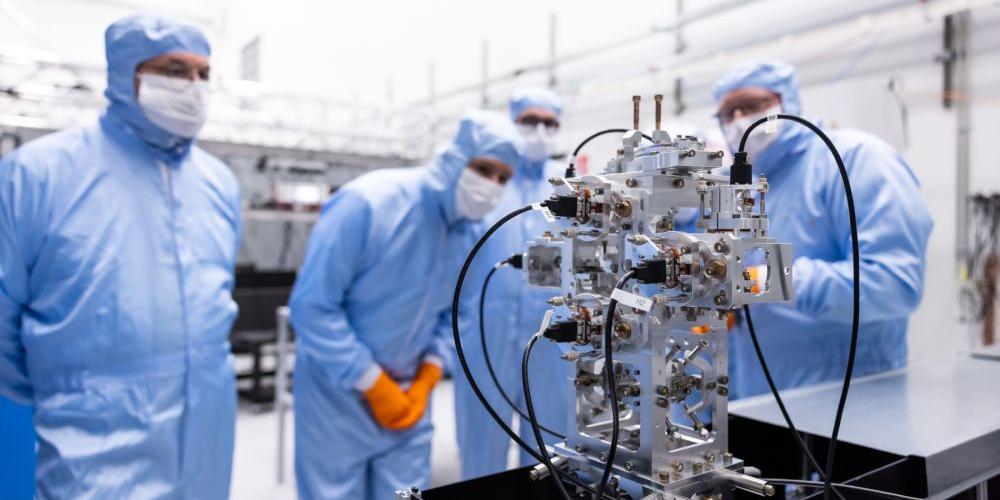


Deep underground, researchers are working on an instrument that could reshape how we see the universe. The Einstein Telescope is designed to measure gravitational waves with a level of precision that remains out of reach today. In doing so, it opens a new window onto phenomena that have so far stayed invisible—from colliding neutron stars to the earliest phases of the universe. The Vrije Universiteit Brussel (VUB) is involved on several fronts. From fundamental physics and precision optics to test infrastructure and subsurface research, VUB scientists are helping to build the technology—and thinking critically about its wider impact.
The dossier brings together different perspectives on the Einstein Telescope. Below, we highlight a selection of articles that show how this project pushes scientific boundaries, demands technological innovation and raises questions about societal responsibility.
Searching for the fundamental building blocks of the universe with an underground telescope
The Einstein Telescope aims to make visible phenomena that do not emit light and therefore remain beyond the reach of conventional telescopes. Gravitational waves offer an alternative. Professor Alexander Sevrin explains how these measurements can generate new insights into black holes, neutron stars and the so-called “dark ages” of the universe.
“We retn the pumped water to nature”
A project of this scale underground also has consequences above ground. VUB researchers are developing groundwater models to map the impact of the Einstein Telescope on the region. Their work focuses on reducing risks and identifying solutions that protect water systems and local ecosystems.
Mirror, mirror beneath the ground
The sensitivity of the Einstein Telescope depends on extreme precision. Researchers at B-PHOT are developing mirrors and optical systems capable of detecting the tiniest deviations. This demands technology at atomic scale, with tight control over light and temperature down to the smallest detail.
Reinventing the gravitational-wave observatory at ETpathfinder
At ETpathfinder in Maastricht, researchers are testing the technologies that will later be used in the Einstein Telescope. New materials, different laser frequencies and systems to reduce noise must work together to create a more sensitive instrument. It is a process of trial, adjustment and starting again—until everything aligns.
