



Astronomer Katrien Kolenberg (VUB, KU Leuven and the University of Antwerp) has been awarded the Willem de Graaff Prize, a triennial distinction presented by the Dutch Astronomical Society for excellence in science communication in astronomy. She receives the award for her original approach to making complex cosmic phenomena accessible to a broad audience, through activities ranging from public lectures and citizen science to art projects and music. “To me, it means that I no longer have to hide the different parts of myself—science, art and communication.”
What exactly did you receive the Willem de Graaff Prize for?
Katrien Kolenberg: “It is a prize for science communication in astronomy, awarded every three years. It recognises someone who has made a significant contribution to public engagement in astronomy and space research. For me, it is truly an acknowledgement of a path I chose myself, and one that was not always straightforward. I have always tried to communicate science not only through traditional lectures or articles, but also in more immersive ways, for example through art or sound. So yes, it feels like a validation: that it is perfectly acceptable to look beyond the traditional forms of communication.”
“Science speaks to the mind, but art touches the heart; together they become truly powerful”
You are both a researcher and a communicator. Are those not contradictory roles?
“Some people see them that way, but for me they actually reinforce one another. As a scientist, you often spend years working on a single, highly specific topic. That is incredibly valuable, because it allows you to go very deep. But you may only reach a relatively small audience. I realised quite early on that the papers I write might only be read thoroughly by a hundred people or so. And that is perfectly fine; that is how science works. But alongside that, I also wanted to do something that would have an impact in a different way and reach more people. Moreover, communication forces you to step outside your niche. When you have to explain something to a broad audience, you also start looking differently at your own work. Sometimes that even leads to new insights.”
You combine science with art. What does that add?
“Science primarily appeals to the mind, whereas art tends to speak to the heart or the gut instinct. And that combination is incredibly powerful. Through art, you can touch people in a way that purely rational explanations often cannot. That can be very subtle, but it can also be confronting. Art does not necessarily have to be ‘beautiful’, but it can provoke something that makes people start thinking differently.”
One of your best-known projects allows people to ‘listen’ to stars?
“That may sound strange, because there is no sound in space — there is no medium through which sound waves can travel. But stars do oscillate. And we can measure those oscillations through the light they emit. What we do in the ‘AstroSounds’ project is convert those data into sound. So, what you are actually hearing is a translation of what is physically happening inside the star. Pulsating stars are gigantic spheres of gas that expand and contract, rather like breathing. This causes variations in brightness, and we can measure and translate those variations into sound. The result is surprising: some stars sound rough or ‘grainy’, while others sound almost harmonious, as though you were listening to a musical instrument. Every star has its own unique ‘timbre’.”
Why is that more than just a clever gimmick?
“It is absolutely not a gimmick. Sound provides an additional channel for analysis. For example, we collaborate with blind astronomers, for whom listening is essential when interpreting data. But it can also be valuable for sighted researchers. Sometimes you can hear patterns or subtle differences that are not immediately apparent visually. By using multiple senses, you can enrich your analysis. At the same time, it is a wonderful way of engaging people. As soon as people hear that you can ‘listen’ to stars, you immediately have their attention. It opens a door.” You also communicate about the Einstein Telescope. What can we expect from that?
“The Einstein Telescope will detect gravitational waves: ripples in space-time itself. That opens an entirely new window onto the universe. For centuries, we have studied the cosmos through light — visible light, but also radio waves, infrared radiation and X-rays. With gravitational waves, we gain an additional sense. We will no longer only observe the universe; with our new instruments, we will also be able to ‘feel’ it in a different way. What we are seeing with current detectors is only the tip of the iceberg: colliding black holes, merging neutron stars. With more sensitive instruments, we will be able to observe far more. I expect that this will lead to new physics, and that we will have to revisit our current models. New data often force you to rethink what you thought you understood.”
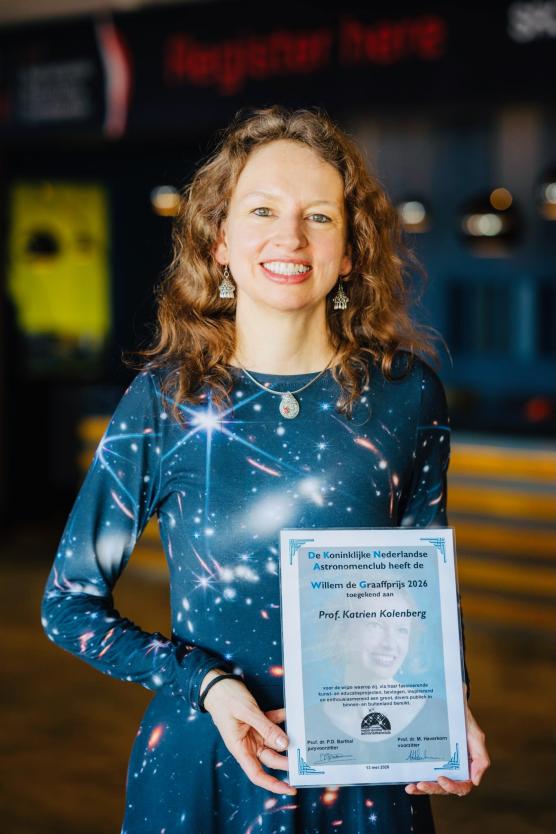
Katrien Kolenberg
“It is both absurd and beautiful: we are incredibly small, yet we are capable of thinking about the cosmos”
And can we also ‘hear’ those gravitational waves?
“Yes, and that is what makes them so fascinating: those signals already fall within the audible frequency range. Unlike with stars, you do not even have to speed them up. But what you hear is often… surprisingly mundane (laughs). It sounds rather like a kind of ‘chirp’. Yet what is actually happening is that two black holes are merging — one of the most violent events in the universe. I find that contrast wonderful: something cosmically immense that sounds like something very small.”
What personally drives you in this work?
“Wonder. That feeling of awe. When I think about the universe and our place within it, I forget my everyday concerns. It gives you perspective. It is both absurd and beautiful: we are incredibly small, yet we are capable of thinking about the cosmos. We are the cosmos thinking about itself.”
Doesn't that make human beings seem very insignificant?
“Yes, but that is precisely where the beauty lies. That tension between the small and the vast evokes a sense of wonder. We are tiny compared with the universe, yet we are part of it. The elements that make us who we are were forged in stars. Our bodies are literally made of material that was created in stars billions of years ago. So yes, you could say: we are stardust trying to understand itself.”
What does this prize mean to you personally?
“For me, it means that I no longer have to hide those different parts of myself — science, art and communication. They belong together, and I need all three of them to function. For a long time, I was advised to keep those worlds separate. But this prize shows precisely that their combination has value. That it is not a weakness, but a strength. It feels like a validation of the path I have chosen. And if I see that it also encourages young researchers to follow their own path more confidently, then that may be the most rewarding outcome of all.”
Bio
Katrien Kolenberg is a Belgian professor of astronomy at the Vrije Universiteit Brussel (VUB). She specialises in pulsating variable stars, stars that rhythmically expand and contract, causing changes in their brightness. She is also affiliated with KU Leuven and the University of Antwerp. She has worked at international research institutions such as University of Vienna and the Harvard University. Alongside her research, she is known for her strong commitment to science communication and public outreach, making complex astronomical concepts accessible to a broad audience. She is also active as an artist and amateur musician — she plays the cello, among other instruments, and creates visual artwork — and explores the interaction between art and science.